
Architecting Robust .NET Apps: Clean & Hexagonal Patterns Explained
Quick Summary:This blog is your introduction to .NET architecture patterns that focuses on clean and hexagonal architecture designs. It explains how these patterns differentiates business logic from external dependencies, enhances its testability and makes applications scalable. Let’s learn their key principles, benefits, implementations, and why combination of them can ensure robust and maintainable .NET apps.
Introduction
Plenty of .NET projects start strong but end up being a huge failure and collapse. It is due to under growing features, tight deadlines and tangled dependencies. Hence here the real culprit isn’t the code but a lack of solid foundation in terms of architecture. That’s why modern .NET development services use architecture patterns such as clean and hexagonal. These have eventually become an essential part of development.
Modern .NET architecture patterns can make your application have clear boundaries, flexible structure and long term stability. Now you can easily add features, switch among technologies and scale without breaking your core logic into a terrible disaster. Through this guide we will try to simplify both clean and hexagonal patterns and show how they might help .NET teams to build a system that is robust even when everything keeps changing.
Need for structured architecture
A normal project for development starts with a set goal to be met. Later when the world starts evolving and you have to add new features to your existing application, the code base becomes a great hassle. Small updates can create chaos when you have to worry about everything from logic, business rules to database operations. It can lead to an unknown and unexpected issue. This stage where disturbance occurs due to update is sometimes known as Spaghetti code.
Common Indicators of this situation are:
- Facing problems while separating and testing business logic.
- Heavy dependency on frameworks or databases.
- Inflation in maintenance cost when introducing new features.
- Lesser clarity and slower onboarding process for new developers.
Instead of a normal approach when you use clean and hexagonal architecture patterns they divide code in clear and independent layers. Hence making it possible to communicate via well defined interfaces.
Getting to know clean architecture
Clean architecture is a concept that was put forward by Robert C Martin. The main ideology behind this concept was that business logic must be independent of other factors like framework, user logic, database and more. This architecture mainly forms concentric circles where dependencies always lie inwards, that is to the center or core. Main principles of clean architecture are:
The main concept of clean architecture is dependency rule. It states:
- Independence on frameworks: The business logic must not rely on a specific technology.
- UI dependence: The system must function exponentially even when there are any changes made to the UI interface.
- Database independence: There must be no need to rewrite business logic while switching to a new database.
- Testability: The main logic of an application must be open for testing without the need to run the entire application.
“Source code dependencies will only point in one direction that is inward. Nothing in an inner circle can know anything about something in an outer circle.”
It indicates that higher level policies that include core business logic should always be unaffected by any changes made to lower level circles.
Parts of clean architecture
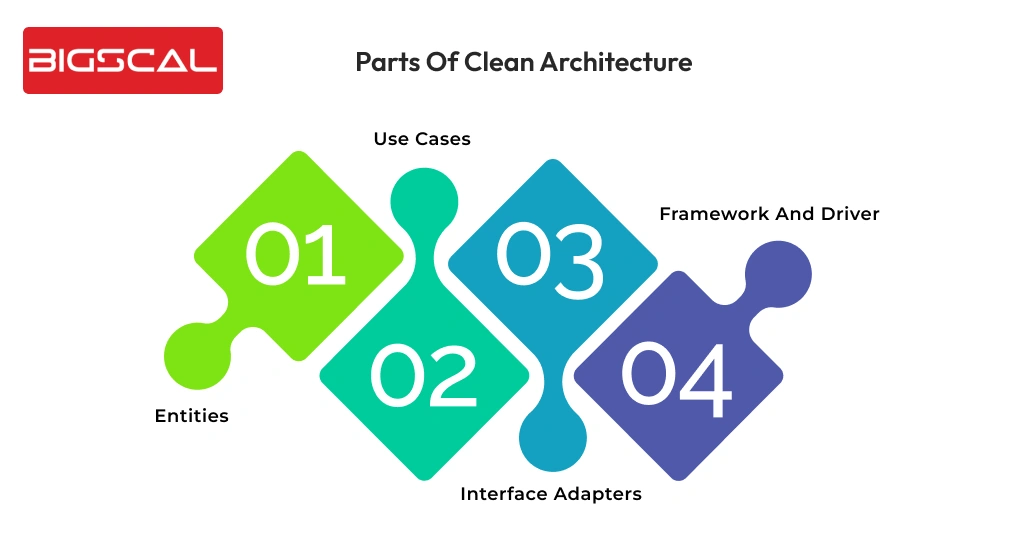
The clean architecture is divided into four crucial layers:
Entities
It represents the main epicenter of the application. This portion consists of business logic and objects. It is not dependent on framework and external factors such as invoice, order, student and more.
Use cases
It defines the manner in which entities interact in order to fulfill application specific aims. You can state the workflow as “enroll a student” or “create a grade report.”
Interface adapters
This component is responsible for translation of data among circles that inner to the external layers. It encompasses controllers, presenters or repositories that helps internal logic to adapt with framework or database.
Framework and driver
It is the outermost layer that includes all frameworks and drivers. Database and messaging systems are also present in this circle. You can easily make changes to them without affecting the inner circle that consists of business logic.
The flow always moves inward:
Frameworks → Adapters → Use Cases → Entities
Benefits of clean architectural pattern
There are plenty of benefits of clean architecture. Let’s learn few of them:
- It separates concerns clearly without impacting the other crucial portion.
- It becomes easy to maintain and flexible to use.
- Simplifies the process of testing each unit and automation.
- Easy to migrate technology or upgrade systems.
- Better understanding of system structure.
When you develop a practical and clean code architecture it helps you develop a software with a long life. Furthermore, in this instance, modifications to external components have no effect on business logic.
Getting to know hexagonal architecture
Hexagonal architecture was a concept given by Alistair Cockburn. It is also known as Ports and Adapters. This approach employs decoupling of the core logic of application from external inputs and outputs with the help of abstract interfaces also called as ports and concrete implementations that are adapters. The core ideology behind this is:
- The core encompasses business logic which is crucial and must not be dependent on any external system.
- Communication to the external world like APIs, databases and more is carried out through ports.
- These ports are implemented by adapters for connecting the core to particular technology.
This model is called a hexagonal model due to its visualization in that shape. A variety of interfaces, including databases and user interfaces, are represented on either side. Its main components are:
- Domain logic: It’s the main center that specifies business rules.
- Ports: It’s an abstract that states operations for both input and output.
- Adapters: Implementation that carries out conversation between the core and external systems.
Relationship between clean and hexagonal architecture
Although both clean and hexagonal architecture are different terms, their main aim is shared. Both of them separate business logic and lay emphasis on dependency inversion. Here’s a table to depict relationship among them:
| Aspect | Clean Architecture | Hexagonal Architecture | Common Ground |
|---|---|---|---|
| Core Idea | Layered circles protecting the domain. | Ports & adapters isolating the domain. | Both shield business logic from external systems. |
| Structure | Entities → Use Cases → Interfaces → Frameworks. | Domain → Ports → Adapters. | Inside–outside separation. |
| Dependency Rule | All dependencies point inward. | Adapters depend on the domain via ports. | Domain remains independent. |
| Communication | Through interface adapters. | Through ports & adapters. | Both use adapters to interact with the outside world. |
| Benefits | High testability, maintainability. | High flexibility, easy to swap tech. | Both improve long-term scalability and robustness. |
When applying practically, developers can combine both of these ideas practically. A clean architecture design employs hexagonal principles and can state how external systems interact with its central business logic.
Applying clean and hexagonal pattern in .NET
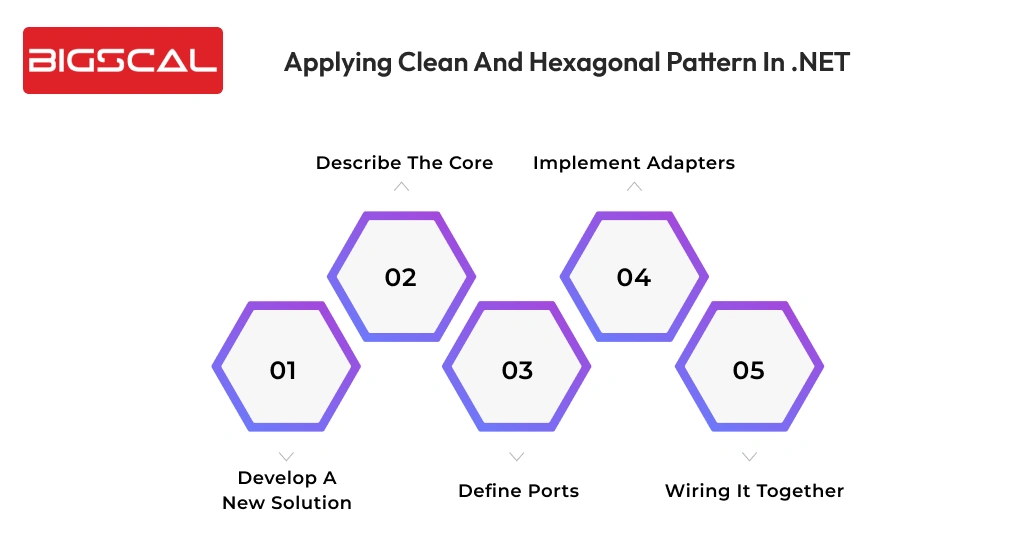
Let’s get into practical implementation of .NET application development through hexagonal architecture principles.
Step: 1 Develop a new solution
As part of the first step you will have to open Visual Studio or your choice of IDE to develop a solution for your project.
Step: 2 Describe the core
Now create a new project for the core layer inside the solution you have created. This project must consist of business logic, domain entities and use cases.
Step: 3 Define ports
As a part of the next step you will have to define interfaces or ports that indicate interactions necessary for your application. It consists of repositories, services and external dependencies.
Step: 4 Implement adapters
As the fourth step you will have to develop a separate project for the adapter layer. In these projects implement the interfaces that you mentioned in the core. In this section you can use different adapters for different external systems such as database adapter, Web API adapter and more.
Step: 5 Wiring it together
At last in your API project you will have to bring everything together. Finally use appropriate controllers or entry points that use core use cases and inject necessary adapters. Make sure your API has reference to both core and adapter projects.
Key practices for .NET developers
By now we are aware of what clean and hexagonal structure means and how to use them. Let’s know what are its key practices for developers:
- Ensure domain models are free from annotations and frameworks.
- Mention the interfaces in the core layer if need of any external dependencies.
- Implement adapters in outer layers.
- Employ dependency injections to ensure that core has concrete adapter during runtime.
For example a .NET application can define a student repository in its core layer and implement a database in an adaptive layer. Hence core never has to know which database it’s asking for.
Best practices for implementation of clean and hexagonal pattern
To make sure you use them in the correct way here are some best practices gathered for you:
- You must start simple and lay your eyes on core boundaries before you think to expand.
- Employ interfaces wisely to ensure that each external dependency has it.
- Make sure dependencies are unidirectional and avoid making them circular.
- Use mock adapters when testing each dependency solely.
- Name each package based on its role and not technology.
- Make a document on how data flows for future developers to understand better.
- Ensure to refactor regularly as iteration can enhance architecture.
Common mistakes to avoid while implementation of clean and hexagonal pattern
Here are some common pitfalls you must avoid:
- Avoid mixing domain logic with annotations.
- Coding external system dependencies in a tough manner inside the core.
- Using extensive engineering on developing small applications by adding unnecessary layers.
- Not sticking to architectural boundaries during development.
- Relying too much on framework conventions rather than abstraction.
Testing and Maintainability
The main reason behind using clean and hexagonal structure is its ease of testing and maintenance. As the core logic is independent of frameworks, you can test a unit without initialisation of web servers or databases. You can verify adapters solely through integration tests. Here are its benefits:
- Lesser complex for test setup.
- Execution of test suites is faster.
- Let’s identify the failure spots clearly.
- Stability for the long term when changing the environment.
Evolution and Relevance
Clean and hexagonal structure both are in terms with the modern solutions such as:
- Microservices architecture where each service is present in an encapsulated form with its logic and interfaces.
- Domain driven design that focuses on modeling business logic in a clear manner.
- Cloud native applications that need modular and deployable services.
- Test driven development by isolating problems.
As frameworks keep on evolving and demand for architecture with higher stability and .NET maintenance services is always increasing.
Transform your .NET architecture today
- Faster builds, scalable results
- Expert support at each stage
Comparison with Other Architectures
| Architecture | Pattern Focus | Key Limitations |
|---|---|---|
| Clean Architecture | Strong domain-centric design with strict dependency rules. | Can feel over-engineered for small projects; more boilerplate. |
| Hexagonal Architecture | Ports-and-adapters pattern for easy swapping of external systems. | Requires careful interface design; initial learning curve. |
| MVC | Separation of concerns between Model, View, and Controller. | Controller bloat, tight framework coupling, harder scaling. |
| Layered Architecture | Organizes code into logical layers (UI → Business → Data). | Rigid dependency direction; layers become tightly coupled over time. |
Conclusion
Clean and hexagonal architecture both are known to bring long term stability for your .NET software development. They make business logic independent, testable and ready to change anytime you want. No matter if your system grows, integrates with new tools or shifts to some modern platform, this architecture ensures that your foundation is still solid.
As a part of suggestion you must begin with clear boundaries and small abstractions. Know that implementing even a bit of change today can avoid chances of refactoring code tomorrow.
The landscape of software architecture is growing complex hence investing in a systematic and structured approach is crucial. For .NET teams that want to scale confidently with minimum risks, applying clean and hexagonal approach is a smartest decisions to make.
FAQ
What are the best architecture patterns in .NET development?
Clean and hexagonal architecture are considered the best and most robust patterns for building long-term, scalable .NET applications.
Why do .NET developers use clean architecture?
Developers prefer clean architecture because it separates business logic from frameworks, UI, and databases—making applications easier to maintain and test.
What makes hexagonal architecture useful in .NET projects?
Hexagonal architecture uses a Ports and Adapters design that allows external systems to be swapped or updated without affecting the core logic.
How do clean and hexagonal architecture differ from each other?
Clean architecture focuses on concentric layers with inward dependencies, while hexagonal architecture centers around ports and adapters. Both protect the domain but organize boundaries differently.
Can clean and hexagonal architecture be combined in a .NET project?
Yes. Modern .NET development often blends both—clean architecture defines boundaries while hexagonal defines how the system connects externally.
Are these patterns suitable for small .NET apps?
These architectures work best for medium to large applications. For very small projects, they may introduce unnecessary engineering overhead.
Do these architecture patterns enhance the testing process?
Absolutely. They make business logic testable independently of UI, APIs, or databases, resulting in faster and cleaner testing.
How do clean and hexagonal architecture lessen technical debt?
By separating domain logic from infrastructure, they make updates easier and safer—reducing long-term technical debt.
Do these patterns support microservices?
Yes. Their separation principles align perfectly with microservice boundaries and independent deployments.
Are clean and hexagonal architecture compatible with modern .NET tools?
Yes, they work seamlessly with dependency injection, EF Core, DDD, cloud-native practices, and other modern .NET tooling.