
Building Cloud-Native .NET Applications with Azure
Quick Summary:The future of software development is surely cloud native and we all know that. .NET on Azure is leading the way of application development. Through this blog we will break down what cloud native really means, why it’s necessary for modern applications and how Azure’s powerful tools help you create, deploy and scale applications effortlessly. You will also discover key benefits, best practices and strategies to ensure application is faster, resilient and future ready.
Introduction
We all know the planning stage is crucial to figure out how well your application will perform. Therefore, careful consideration must be given to the technology on which it will be built as well as the number of iterations required. You also have to assess what development process you must adopt for it.
No organization is rigid enough to use old methodology like waterfall unless you are not willing to experience exponential growth. The majority of organizations now look forward to migrating to the latest technologies for development. Azure based cloud native is one such popular approach among tech people.
It has been seen that companies are increasingly shifting towards services and infrastructure on cloud. But is it enough that you categorize your application as cloud native? Is cloud native just an attribute for an application or is it a method for development?
If you are in a dilemma where your services are and what is deployment methodology for your .NET development services then you are at the best place. Here we will briefly discuss what cloud native is and why adopt it along with .NET technology. Let’s get going.
What is cloud native?
Previously the cloud was thought to be a place to rent your infrastructure or platform. It has been decades into the increased adoption of cloud services. The market of cloud based applications has expanded to a remarkable extent. Now you also have a guide on how to use cloud platforms not just for hosting but for also combining all services necessary for development, deployment, maintenance and scalability.
If you currently have a cloud ready application and you are already deploying services on cloud there are high chances that you are already using certain services that belong to cloud native.
To help you understand, Cloud Native is more than just the cloud or a cloud-hosted application. Instead, cloud native is a way to create, construct, and launch your application in the best possible way by utilizing all of the cloud computing’s features.
The entire idea behind.NET on Azure is to provide clients with timely, accurate, and speedier services. Microsoft has presented multiple utilities to ensure that this is possible. Azure DevOps and Container driven in .NET core is the best blend for cloud native applications. It also advances the implementation of containerized deployment and microservices. On the other hand Azure DevOps ensures a combination of all utilities on the cloud to streamline delivery.
Understanding need for cloud native applications
Modern businesses are always in need of applications that scale exceptionally without disturbing user experience and operations. Cloud applications meet all of these demands by employing cloud infrastructure efficiently from the beginning. As per a survey from 2024 almost 89% of organizations have shifted towards cloud native technologies. Hence this shows how widely cloud native applications have reshaped strategies for software development and deployment.
These applications let’s team deploy any updates with faster speed and have no impact over operations and reduce downtime. Applications using cloud services tend to scale automatically in high traffic scenarios as per usage patterns. Cloud native .NET application development distributed workflow across different services. Hence as a whole it prevents a failure in a single service from impacting the entire system.
As an organization you can also gain benefits by paying up only for resources you actually use. Cloud based applications also support faster innovation with the help of automation and DevOps practices. Hence now your business can stay always competitive in the evolving landscape.
Go cloud native with .NET
- Scale and deploy easily
- Experience performance and resilience
Why choose cloud native .NET applications?
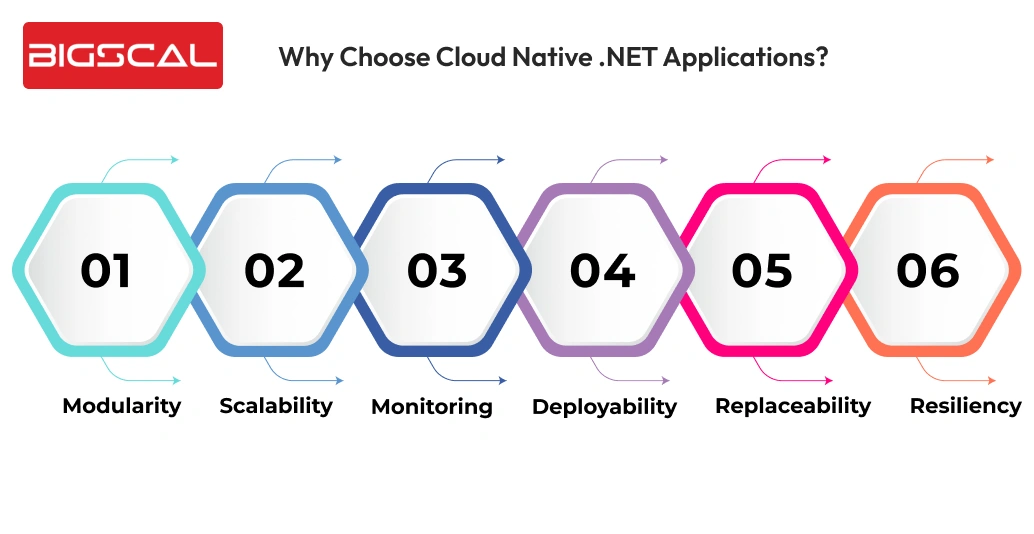
The main aim behind moving towards cloud native in .NET software development services is to ensure faster and best results to the client. Therefore cloud native can be considered as a combination of approaches like Agile, CI/CD pipelines, microservices, automation and more. It ensures that applications keep scaling as your business grows. Here are some positives that cloud based applications can provide:
Modularity
Cloud native .NET applications are crafted with the help of Microservices based architecture. Hence each module has its own business capability. This separation is responsible to eliminate high dependencies among systems to ensure the system becomes easier to maintain and scale whenever needed. It also ensures that developers can work on each service individually and test them in isolation and deploy any update necessary without impacting the entire workflow. This modular structure also enhances the development cycle, contributes to the code quality and improves team collaboration.
Scalability
Cloud native applications tend to scale automatically as per real time needs and workloads. Moreover containers and orchestration tools allocate resources in optimal manner during traffic spikes. Each service also scales independently without causing trouble to application readiness. Hence it ensures to avoid over provisioning and leads to lower operational costs. Through this approach businesses can maintain consistent performance even during peak hours and low usage periods.
Monitoring
All cloud-native.NET services have detailed health and performance data. Hence rather than focusing on the entire, teams monitor certain services. With the help of centralized logging, teams are able to quickly identify failures. Moreover real-time alerts are possible, and this will result in faster problem solving and reduced downtime. Monitoring enhances active optimization and boosts the system reliability.
Deployability
The cloud-native.NET applications support deployability with Automated CI/CD deployment pipelines. Teams usually update and do not have any interruptions in service. Additionally releasing in small batches can eliminate risk of rollback complexity and deployment risks. Continuous improvement cycle is used by developers to deliver new features much faster. The approach will save on time to market.
Replaceability
When you use a cloud native .NET application it is easy to replace any outdated services you want. The entire system is present as modules. As a result, you don’t have to completely redo the system in order to change a single service. This flexibility supports businesses to stay ahead in the evolving world and meet technology needs. Additionally, having the ability to replace services ensures lesser technical debt. Applications are always future ready with just a minimal refactoring effect.
Resiliency
Cloud native .NET maintenance services distribute workload on multiple services. Hence having a failure in single service will not lead to the crashing down of the entire system. Additionally they have an automatic restore system that recovers service quickly from failure. Load balancing also ensures best and uninterrupted user experience during times of service failure. Hence this design ensures higher availability and fault tolerance.
You must design your cloud native .NET application stateless. It is because storing session data can silently break auto scaling and lead to unanticipated failures during high traffic.
Conclusion
In conclusion, using.NET on Azure companies enables you to create scalable, resilient, and future-ready cloud native applications. Cloud native applications means more than just hosting on the cloud. Microservices, containers, CI/CD pipelines, and automation are all used in this comprehensive development methodology. Hence it ensures faster, more reliable and cost effective applications.
With the help of Azure’s robust ecosystem that encompasses DevOps, Kubernetes and monitoring tools, development teams can easily deploy updates. Hence it also lets you monitor performance in real time and recover from failure quickly. Modular architecture ensures independent development and scaling services with less downtime and technical debt.
It ensures applications can handle higher traffic, scale automatically and ensure consistent performance. Whether you’re developing new cloud-native apps or updating legacy systems,.NET on Azure enables you to stay competitive, innovate more quickly, and cut expenses. By embracing these principles, organizations can have a strong foundation for future growth, resilience and success for the long term.
FAQ
What are the benefits of running .NET on Azure?
Running .NET on Azure offers seamless scalability, enhanced security, high availability, and deep integration with Microsoft services, enabling faster development and reliable deployments.
What does cloud-native mean in .NET?
Cloud-native .NET development focuses on building applications using microservices, containers, CI/CD pipelines, and cloud services that can easily scale and adapt to changing demands.
Why should businesses choose cloud-native .NET applications?
Cloud-native .NET applications deliver improved performance, faster releases, cost efficiency, and enhanced resilience, making them ideal for growing business needs.
How does Azure support cloud-native .NET applications?
Azure provides powerful services such as Azure App Services, Azure Kubernetes Service (AKS), Azure DevOps, and Azure Monitor to build, deploy, and manage cloud-native .NET applications.
Are cloud-native .NET applications scalable by default?
Yes, cloud-native applications are designed to scale automatically based on real-time demand using containers and orchestration tools available on Azure.
How does microservices architecture help in .NET applications?
Microservices allow each .NET service to be developed, deployed, and scaled independently, reducing downtime and improving overall maintainability.
Is monitoring easier in cloud-native .NET applications on Azure?
Yes, Azure offers centralized logging, real-time alerts, and detailed performance insights, making monitoring and troubleshooting faster and more efficient.
How does CI/CD enhance cloud-native .NET deployment?
CI/CD pipelines automate testing and deployment, enabling frequent releases with lower risk and a faster time to market.
What makes cloud-native applications resilient?
Cloud-native applications use load balancing, auto-recovery, and service isolation to ensure failures do not impact the entire system.
Can existing applications be migrated to Azure?
Yes, legacy .NET applications can be migrated to Azure and modernized using containers, microservices, and Azure-native services.