
Building Microservices in .NET: Patterns & Best Practices
Quick Summary:The blog discusses the way .NET microservices change application development today and eradicates the idea of a one-size-fits-all design. You will find out why.NET is so successful in building scalable and cloud-built systems, patterns that work in real projects, and best practices that are used by professionals. At the end, you will have a clear strategy on how to make high-performing robust microservices.
Introduction
Nowadays applications are not designed to be small, fixed and predictable. They should also be capable of scaling easily, bending and being reliable, as the customer needs keep on increasing. This is whereby microservices radically change the design and maintenance of apps. By dividing these large systems into targeted and separate services, you can develop, implement, and scale features without adversely affecting other processes.
This blog goes further to discuss the concept of .NET microservices and why it has become a trendy choice in modern day application development. Through this text you will explore how .NET development services and its benefits of cloud-native deployment, powerful service communication, and scalable architectures. During the process, we will talk about the most significant trends, best practices, and useful information. It will allow you to build systems that are flexible today and ready to face tomorrow.
Developing Microservices with .NET
Microservices is one of the well known architectures used by almost each developer to ensure performance of applications. Additionally it also looks after other aspects of successful development such as flexibility, scalability and availability. Moreover it also lets firms create, manage and update their applications. Rather than monolithic architecture where it works as one big chunk, microservices architecture divides services into smaller pieces called microservices.
Each of these pieces has its particular task or business logic. Hence there are no problems of mixing between two microservices during work. The fact that microservices are isolated from one another is one of their primary benefits. Hence they employ APIs when there is a need to communicate.
Why microservices with .NET development is a great choice?

Are you trying to figure out why you should use microservices with.NET? Let’s learn them:
Cross platform compatibility
Microservices can run well on Windows, Linux and macOS since frameworks such as ASP.NET Core and.NET core support true cross platform development. This flexibility enables companies to choose infrastructure based on the cost and performance or compliance needs and do away with a single operating system. Cross platform development can enhance portability, faster release and enhance .NET maintenance services. It does so by creating a single codebase and deploying it anywhere. This functionality will be of great use to businesses that operate hybrid or multi-cloud arrangements.
Containerization ability
Containerized settings based on Docker and Kubernetes are compatible with .NET microservices. Containers enhance having consistent behaviour across development, testing and production as they package apps along with their dependencies. Kubernetes orchestration provides.NET applications with self-healer, load balancing and automatic scaling. The approach assists ASP.NET Core development teams to create effective and cost-effective solutions through maximizing resources, reducing downtimes, and facilitating faster deployments.
Cloud compatibility
.NET is built with an approach that prioritizes cloud deployment and supports seamless scalability in this environment. Applications with .NET microservices can be easily deployed, managed and scaled on important cloud platforms such as Microsoft Azure or AWS. .NET can be scaled on demand with built-in support of serverless computing, containers, and managed services, such as AWS Lambda, Azure App Services, and Azure Functions. This allows enterprises to improve on the current systems and move to cloud-native applications with the certainty of high availability, cost optimization, and uniform performances.
Ensure that .NET services are stateless. It is because storing data locally can break scaling.
.NET Microservices best practices advice from experts
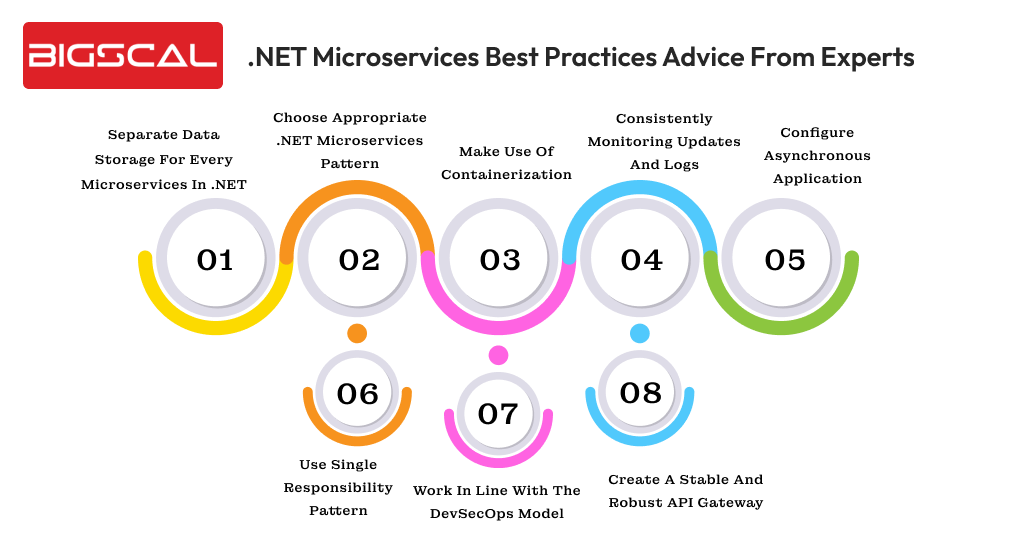
We have gathered a list of .NET microservices best practices that every developer must follow for smooth .NET software development. Let’s begin with one at a time.
Separate data storage for every microservices in .NET
If you wish to manage .NET microservices in the most effortless manner possible then you have to configure a separate database for each of these services. Or else the main aim of developing Microservices will not be achieved. Additionally you have to ensure that these databases are separated and the only way for them to communicate is with the help of APIs.
However in case when two services have to share the same database you can keep them separated by using a subset configured for that stuff. Through this best practice you can achieve better flexibility, lesser complexity, minimal dependency and lesser costs.
Choose appropriate .NET microservices pattern
When you decide to go for microservices you have four primary patterns to choose from. These are decomposition, integration, database and observability. You have to select one of these as per your requirement. Hence consult .NET development companies like Bigscal Technologies to have a clear understanding. Additionally you must also have knowledge of these patterns.
Decomposition pattern will let you break down the app and divide it into sub domains for easier deployment and maintenance. On the other hand integration pattern will help you in orchestration of operations and ingress the system. Moreover database patterns lays focus on communication between two or more databases. And at the end observability helps in finding and addressing issues timely and in a budget friendly manner.
Make use of containerization
When you opt for Microservices Architecture know that plenty of services will run in a simultaneous fashion. It does so to offer each one defined functionality. On the other hand when it comes to managing all of them together it can become a problematic scenario for the administrators. However, you may use containers to make this easy.
Using containers will ensure that each component is stored and executed in an isolated environment. Additionally each container has its own runtime and operating system. Hence due to all of this availability is maintained and .NET application runs smoother.
Consistently monitoring updates and logs
The best microservices and.NET industry specialists recommend that one should keep a check on the system on a regular basis. It allows you to visualize the entire functionality better and implement the needed changes. Also, Health Checks which is an inbuilt middleware is offered by.NET. It simplifies your task of assessing the fitness of the application. The logs are also to be stored in a centralized server. It will help you to establish the root cause of every incident. To observe the changes done to the.NET microservices application, one can have a look at the logs at any time. To prevent unauthorized activity, you can also upgrade the microservices and.NET version ensuring that all the patches are in place.
Build Smarter .NET Microservices
- Expert-led architecture and best practices
- Scalable, secure, cloud-ready solutions
Configure Asynchronous Application
You are advised to configure asynchronous communication among services to prevent service conflict and unavailability. All data processing should be adequately coordinated to get all the required services updated at the same time. Moreover, your model can also contain the following implementations in case you intend to fully utilize asynchronous communication in microservices with .NET.
- Any request is to be answered.
- Notifications should be sent to both the recipient and the sender.
- The service should be turned on to promote a message.
- The services should be able to receive many recipients and send them requests and responses.
Use single responsibility pattern
According to the specialists in the field, it is recommended to start with one responsibility pattern. It assists you in focusing on each of the critical services along with the vital components including classes, functions, and methods. It also reduces the learning curve such that every team member is able to complete his/her assignments on time. SRP also promotes enhancing flexibility, testability and reusability. These factors combine to cut down costs, manpower, and time. You also can increase observability and enjoy the advantage of integrating discrete .NET microservices.
Work in Line with the DevSecOps Model
The.NET microservices application of data and user security is recommended to be deployed using the DevSecOps approach by experts in the field. Besides facilitating the upholding of data integrity and confidentiality, it also helps to preclude the possible risks and illegal access. It also assists in counteracting any significant security concerns that might occur in the process of development, implementation or maintenance. Also, it provides the safety of each microservice environment. This leads to better quality of the .NET application development, higher productivity, reduced errors and minimal maintenance work.
Create a stable and robust API Gateway
The use of microservices in .NET applications requires a reliable API design that will be backward-compatible. You can use Microsoft’s .Net to rapidly and simply develop RESTful APIs to your microservices architecture. Also, you will ensure that there is no downtime and backward compatibility.
Also, preservations in application performance will be facilitated by the microservices design since it will only be running on the server side. It is also recommended that API versioning should be used to achieve this in order to enable the clients to work within the required API version.
Conclusion
Microservices architecture has become essential towards the creation of flexible, scalable and resilient applications, and .NET has a good framework to do it successfully. The cross-platform compatibility, cloud compatibility, container compatibility and high performance of .NET microservices allow teams to develop autonomous services that grow and evolve without influencing the entire system. Hire ASP.NET core developers for efficient development.
To attain long-term value, businesses ought to avoid common pitfalls and maximize business value by applying best practices such as service isolation, asynchronous communications, and containerization, suitable monitoring, and DevSecOps alignment. Well-designed use of microservices built with or using the .NET micro frontends is more likely to boost scalability and reliability and initiate innovation and simplify the growth of enterprise apps.
FAQ
How does microservices architecture improve .NET scalability?
Microservices architecture allows each service to scale independently based on demand, without affecting the entire system.
Why is .NET an ideal choice for microservices architecture?
.NET offers cross-platform support, high performance, cloud readiness, and strong container and API support, making it ideal for microservices development.
Can .NET microservices run on different operating systems?
Yes, .NET microservices can run seamlessly on Linux, Windows, and macOS environments.
How do .NET microservices communicate with each other?
They communicate using APIs, messaging queues, or event-driven architectures to ensure loose coupling and reliability.
Why should each .NET microservice have its own database?
Having separate databases reduces dependencies, improves fault isolation, and enables more efficient scaling.
How does containerization help .NET microservices?
Containerization ensures consistency across environments and simplifies development, deployment, scaling, and management.
Are .NET microservices suitable for cloud environments?
Yes, .NET microservices integrate easily with cloud platforms like Azure and AWS, supporting containers, serverless architectures, and auto-scaling.
What role does asynchronous communication play in .NET microservices?
Asynchronous communication prevents service blocking and improves system reliability and performance, even under heavy workloads.
How can monitoring improve .NET microservices performance?
Monitoring enables early issue detection, centralized logging, health checks, and reduced downtime.
Is DevSecOps important for .NET microservices?
Yes, DevSecOps ensures stronger security, faster deployments, and continuous compliance across all microservices.