
Building Multilingual .NET Applications the Right Way
Quick Summary:This blog aims to walk you through building multilingual .NET applications that can truly connect with the global users. It covers the role of .NET globalization, why these apps matter and how to implement localization in the right way. You will also get to explore practical steps, best practices and common pitfalls to avoid while scaling your apps across languages and regions.
Introduction
Innovation in technology has made it possible for anyone to provide services across the globe without actually moving to that place. Convenience has ensured that businesses can maximize their outreach and get in touch with their targeted users. Although there is one factor that can hamper this growth that is language. It is problematic when your target audience speaks and understands a completely different language.
When mobile apps consider only English as their main communication medium, its accessibility becomes limited. It could eventually hurt the revenue and you might miss out on lots of potential users. Hence this comes to a conclusion that considering multilingual .NET development services is crucial. It saves businesses from losing customers and surviving competition.
Through this we will discuss what is a multilingual application, reasons to build it and how .NET globalization can help you capture more audience without language barrier. Let’s get started.
What is multilingual app development?
Multilingual app development as the name suggests is the process of creating mobile applications that people from different cultural backgrounds that speak different languages can use. Hence in a .NET multilingual app, user interface, content and interactions are created and used to serve users from different linguistic backgrounds. Regardless of the language they employ, the ultimate objective is to provide a smooth and enjoyable user experience. As per a survey from Shopify the conversion rate was higher by 13% when buyers were shown stores in the translated language of their choice.
Multilingual application ensures that the content, user interface, format of text and language changes is available in localized form. It’s crucial if you want to reach a worldwide clientele. It expands engagement and caters to diverse user needs. You will have to collaborate with software development companies like Bigscal Technologies to create an application that is easy to use for people from different linguistic backgrounds.
Why are multilingual apps a necessity in this modern world?
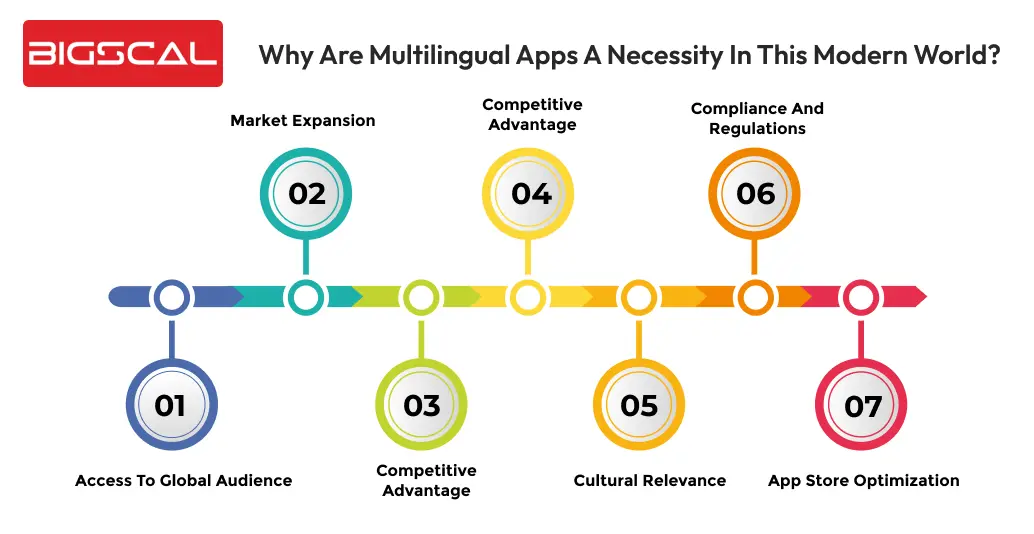
Multilingual application is a necessary factor in today’s digital landscape. It is due to plenty of reasons and we will discuss them here in detail:
Access to global audience
When you have a multilingual app it lets you communicate easily with people across different countries and regions. Hence by offering them content in plenty of different languages, you eliminate language barriers. Additionally it ensures that they can understand, navigate and engage with your No matter where they are, a.NET globalization app works well.
Market expansion
If your application is able to support multiple languages it can open wide doors for new markets and user segments. Hence boasting a multilingual application can let businesses reach a region where users might not be comfortable with default language. It can help your brand to grow internationally and get great adoption in diverse demographics.
Competitive advantage
Having a multilingual ability can help your app stand out in the huge competitive market. Users generally tend to favour apps that speak their native language and give a local feel. Hence it can enhance trust, increase downloads and give your application a clear win over competitors with limited language accessibility.
User experience
Multilingual apps are always a top notch choice that can add to a positive user experience. It enables users to communicate with apps in their mother tongue. Hence it avoids confusion, shortens learning curve and makes navigation smoother. So it ultimately leads to higher user satisfaction scores, better engagement and long term retention.
Cultural relevance
When you adapt content that is relevant to local culture you show respect to their values and preferences. Hence this cultural customization along with .NET globalization goes beyond just translation. It ensures that tone, visuals, and messaging with locals is all in alignment with their expectations. Hence it makes the app feel more relevant and relatable across the world.
Compliance and regulations
Different regions need applications to provide content in a particular language because of legal and regulatory standards. Therefore when you support regional language requirements it helps you remain compliant, skip penalties and enhance credibility with both the users and authorities.
App store optimization
Having a multilingual application can increase visibility on the app store with the help of language specific keywords and search behaviours. You can optimize titles, and meta data for different languages to enhance discoverability. It drives organic downloads and enhances overall app performance in the global marketplace.
Teams generally translate .NET app content but they skip error messages and legal text. It can confuse users and cause compliance issues.
Why is .NET an ideal choice for development of multilingual applications?
.NET tends to be an ideal choice for developing multilingual applications due to its comprehensive, built-in support for globalization and localization. It also boasts a powerful set of tools and robust ecosystem. As a result, it facilitates the development of programs that can easily adjust to various languages and cultural preferences. Here are some reasons to opt for .NET application development for multilingual apps:
- Has support for globalization and localization
- Resource files availability to simplify translation process
- For large applications it can compile resource files into satellite assemblies
- Framework is able to automatically detect and set user preferred languages and cultures
- Offers cross platform compatibility
- Has powerful tooling support
- Supports multiple languages for ease of programming
- Active community support and documentation
How to create a flawless multilingual .NET application?
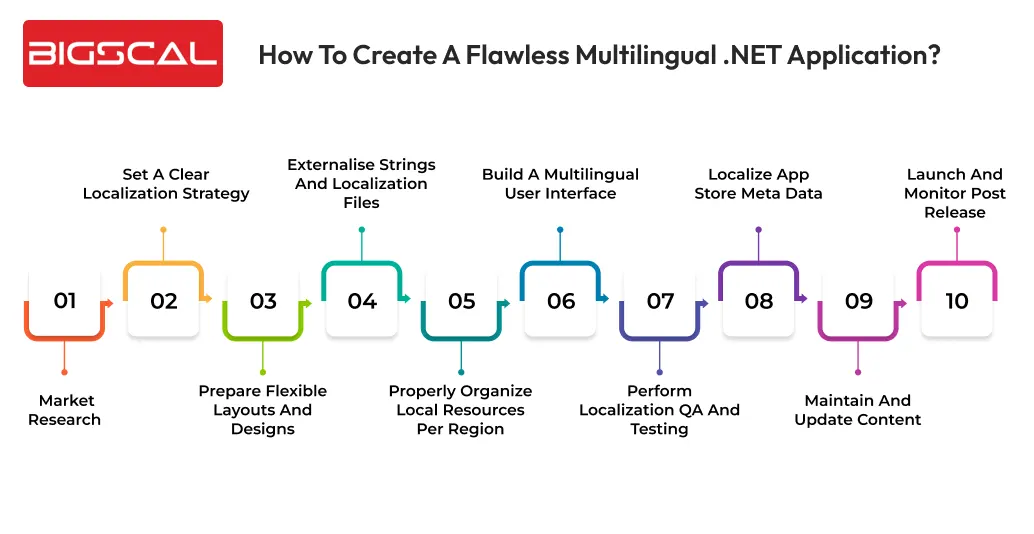
When you want to create a .NET multilingual application it comes with a several step procedure. It includes ensuring interface content and interactions are created and developed in a localised manner as per language and culture. Here’s a step by step process for multilingual .NET application development:
Step:1 Market Research
As the first part of the development you must conduct an analysis on your target audience and select the region you want to serve. Further study user demographics, choice of language, usage behaviour and potential for revenue. Hence it helps you choose the priority languages and ensure that your .NET application delivers value where it’s necessary.
Step: 2 Set a clear localization strategy
Now you have to begin creating a localization strategy that will show what you will translate and localize in your .NET application. Choose whether you want to localize the UI content, system messages or user facing elements. Setting priorities straight for language rollout will ensure consistency and save you from rush implementation.
Step: 3 Prepare flexible layouts and designs
Make sure your .NET application is designed in a manner that supports expansion of text, contraction and varied character sets. Create layouts that support both the ways left to right and vice versa without breaking alignments or readability. This can help you avoid UI issues that might happen after translation.
Step: 4 Externalise strings and localization files
Take all visible to the users text using the localization tools of.NET and place this text under resource files. The coding should not be mixed with labels, buttons, error messages and alarms. With this approach, each language is able to maintain its own resource set without disrupting application logic and is also easier to translate.
Step: 5 Properly Organize Local Resources per Region
You must assign language-specific materials such as pictures, videos and audio per region served. It ensures media and images are culturally acceptable and fit in every market. Effective resource management ensures consistency and prevents inadvertent cultural errors.
Step: 6 Build a Multilingual user interface
All over the .NET UI, replace hard coded text with localized string references. You must include a language choice on the settings of the app or when it is being onboarded. Additionally ensure ease in switching languages to make sure the consumers are able to do it so that the experience can be customized.
Step: 7 Perform localization QA and testing
It is essential to test every language version thoroughly to ensure that translations are accurate and have proper formatting. Additionally it also helps detect stability of functions. Validate text spacing, maintain a consistency along with high quality user experience across different languages.
Step: 8 Localize app store meta data
Along with the application you must also translate and optimize the app store listing. It includes name, description, screenshot and keywords. Having localized meta data can enhance visibility, improve search rankings and help users understand the app before downloading it.
Step: 9 Maintain and update content
You must always keep on getting user feedback on translation and cultural relevance. It assists you in identifying areas for development. You must monitor analytics to detect the gaps and performance problems. Ensure all language versions are aligned with the updates for better consistency as your .NET application evolves.
Step: 10 Launch and monitor post release
Now you are all set to release your multilingual .NET application. Later you can closely keep an eye on user engagement, reviews and localization related problems. Post launch monitoring will help you ensure better .NET maintenance services. You can detect and refine language support, resolve problems promptly and continuously enhance global user experience.
Build Global Ready .NET applications with Bigscal.
- Scalable multilingual apps
- Deliver seamless results globally
Conclusion
In conclusion, developing multilingual .NET applications in the right way is no longer an option but a necessity. It’s a global first digital world that prioritizes user convenience. With the help of .NET globalization businesses can help break barriers of languages, enhance accessibility and provide culturally relevant experiences to users across the globe.
A well planned localization strategy, flexible UI design and proper resource management can ensure consistency and scalability across different regions. When you combine .NET software development with continuous testing, updates and user feedback, multilingual apps can drive higher engagement, trust and market reach. Investing in globalization today can help businesses remain competitive, compliant and prepared for long term growth.
FAQ
How do you add multilingual support in .NET?
You can add multilingual support in a .NET application using resource files, culture settings, and built-in localization APIs to deliver language-specific content.
What is .NET globalization?
.NET globalization allows applications to adapt to different languages, regions, cultures, and formatting standards such as dates, numbers, and currencies.
What is the difference between localization and globalization in .NET?
Globalization prepares the application for multiple cultures, while localization customizes the content and UI for a specific language or region.
Can multilingual applications enhance user engagement?
Yes, users engage more with applications that communicate in their native language, leading to higher retention and improved user satisfaction.
What content should be localized in .NET apps?
UI text, error messages, notifications, metadata, and region-specific features should all be localized for the best user experience.
How does .NET globalization help in market expansion?
It enables businesses to reach global audiences by removing language barriers and delivering region-friendly user experiences.
Does multilingual support help with app store visibility?
Yes, localized metadata and keywords improve discoverability and increase organic downloads across different regions.
How do you maintain multilingual content in .NET apps?
Multilingual content can be maintained by regularly updating resource files, monitoring user feedback, and keeping translations aligned with application updates.
Does .NET support right-to-left languages?
Yes, .NET supports right-to-left languages such as Arabic and Hebrew through culture settings and adaptive UI layouts.
Is machine translation enough for .NET localization?
No, human review is essential to ensure translation accuracy, proper tone, and cultural relevance.