
How to Scale .NET Applications for Enterprise Load?
Quick Summary: Scaling .NET applications for enterprise loads needs more than just handling a higher amount of traffic. In fact it demands for smarter architecture, cloud readiness, and design that focuses on performance. Hence this blog will explore how .NET scalability is necessary for modern enterprises and use proven strategies to achieve it. From Azure powered scaling to optimizing database and async programming, discover how to create applications that grow without causing issues.
Introduction
In today’s digital landscape where technology advances with each passing day, enterprise applications are no longer simple tools. They are an approach to expand the reach of your business and grow the customer base. Moreover, enterprise applications are the backbone of digital transformation, as they not only manage operations but also support innovation simultaneously. Eventually these apps handle higher load along with features like better scalability.
Additionally with expansion in user base, complexity of business processes and need for real time data, the challenge is not just building applications but actively maintaining scalability. Ultimately it will determine if your .NET development services will remain scalable or not. It will help in determining that if an application can handle workload, traffic of functionality expansion without degrading performance.
At Bigscal technologies we specialize in developing enterprise grade applications that scale whenever necessary. With .NET scalability becoming a critical requirement; let’s explore how to ensure your application can grow effectively and reliably.
Why is scalability a huge need for enterprise applications?
A non-scalable enterprise application might work seamlessly for the first few users but end up causing disturbance later. Hence enterprises need apps that can:
- Adapt to the growth in the market and changing user demands.
- Enhance functionalities without needing to rewrite the core system.
- Integrate with third party APIs, CRMs and Azure for cloud services.
- Deliver best and consistent performance every time even after millions of data transactions.
To state simply, scalability is equal to survival in this competitive digital ecosystem. Moreover as per a research scalability is not an option for modern enterprise applications it is a must have. It is the measuring attribute to decide if the application can sustain heavy loads and real world usage of not. It has been seen that almost 90% of real world enterprise applications need performance evaluations across different load levels for measuring scalability capacity and resource limits.
Strategies to ensure .NET scalability for enterprise loads
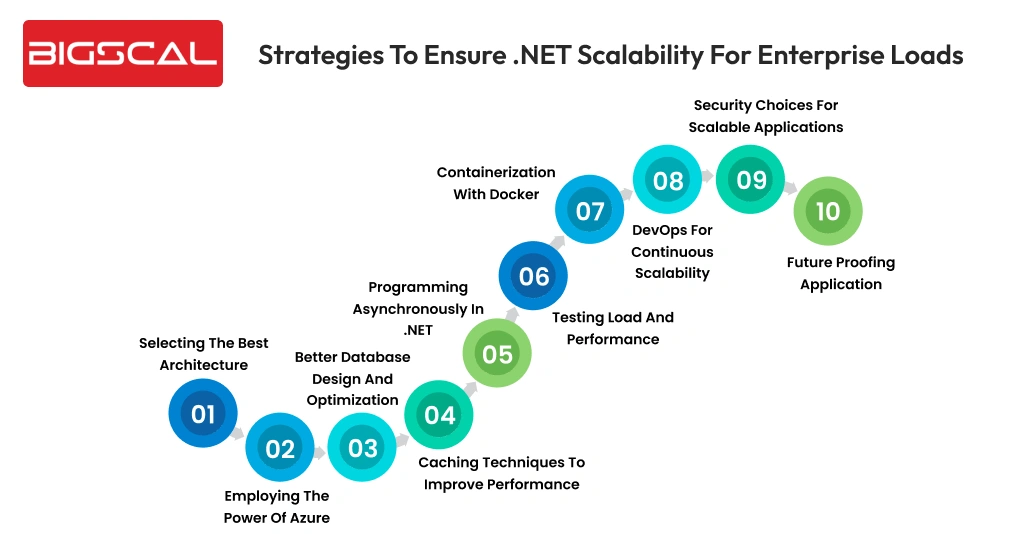
Let’s talk out on some greater strategies that can help ensure scalability of your application to handle enterprise loads:
Selecting the best architecture
The most primary step to ensure that the application is scalable is selecting the best architecture possible. It doesn’t matter whether you want to go for microservices, monolith or a hybrid approach, your architecture decision will lay a heavy impact on the scalability in future. Study the pros and cons of each architecture that will help you make the best decision as per your needs.
In addition to this you must also look after evaluation of how each architect takes care of deployment, isolation of faults and scaling independently. Each microservices ensures that each component can scale individually. On the other hand monolithic architecture will make testing simpler in earlier phases. Hence if you use a hybrid approach it can help you reap benefits of both architectures. Ultimately by combining architectural choices with business goals and traffic expectations you can ensure scalability and maintainability.
Ensure to version your data early for preventing hidden data dependencies and avoid breaking changes as your application scales.
Employing the power of Azure
Microsoft Azure is one of the most invaluable companions when you think about scalability in .NET applications. Azure has a suite of services from balancing the load to outscaling. Furthermore it can also easily integrate with .NET software development services. It also ensures optimal resource allocation along with exceptional scalability. Further explore how you can use these tools to have scalable and performant applications.
Furthermore, rather than just basic scaling Azure can let developers implement auto scaling rules, watch performance in real time and optimize costing with the help of best resource management. It can support both horizontal and vertical scaling through services such as Azure Kubernetes, Azure App Services and more. Through these analytics tools you can easily identify bottlenecks and enhance its reliability and scalability.
Better database design and optimization
A proper database is required to cope with increasing loads. Hence you must discuss the advantages of Azure SQL Database, indexing methods to enhance the speed of the database, and the best practices to be used in Database architecture. By implementing these concepts, you may ensure that the data layer of your application is ready to meet the requirements of scalability.
Another area to focus on is the simplification of queries, reduction of unnecessary joins and ensuring efficient database level caching. Additionally the use of techniques such as partitioning, replication, and sharding can be used to distribute data between computers more effectively. Hence when you design the database with the consideration of scalability, you are able to actively reduce latency. It will also improve throughput, and ensure consistency even as the data volume and user traffic climb.
Caching Techniques to Improve Performance
Caching is needed to reduce the load on the server and to increase the response time. Be aware of the importance of caching and take you through how you can build distributed and in-memory caching using redid and other technologies. The strategies will enhance the performance and responsiveness of your application.
However, caching enables a quicker way of providing some of the most requested information. Additionally without necessarily involving a continuous querying of the database. Moreover having In-memory caching may result faster in the single-instances situation. On the other hand when the situation is distributed defined as multiple servers, distributed caching enables scalability. Additionally it is because the data in the cache is distributed across multiple servers.
To actively maintain the accuracy of data and improve the performance of your application in a high traffic environment, you can ensure you install the right policies on caches to ensure a proper expiration policy and a proper cache invalidation policy.
Programming Asynchronously in .NET
Asynchronous programming is one of the tools that can be used to deal with multiple concurrent requests without affecting the performance. The benefits of message queues and async/await patterns usage are immense. These techniques are extremely useful in building scalable and responsive web applications.
Your application can execute non-blocking actions and make better use of system resources by utilizing asynchronous methods. Moreover message queues manage background processing and aid in service decoupling without compromising user experience. Additionally you may actively increase performance, lower latency, and create apps that scale well under heavy user demand. Hence for this regularly apply asynchronous programming patterns.
Testing load and performance
It is necessary that you simulate real world scenarios with the help of load testing. This approach can help you identify bottlenecks that might hamper performance. You must ensure to learn about the process of load testing and performance monitoring tools that can provide best insights on application behaviour. Additionally, understand that proactive scalability begins with having a great understanding of the application performance.
Containerization with Docker
Containerization with Docker has become one of the most popular and proactive practices for having best consistency across different environments. Keep on exploring how Docker can make deployment, scalability and .NET maintenance services simpler. Hence it can help your application run smoothly in every environment. Learn about advantages of containerization to build scalable applications.
DevOps for continuous scalability
Using DevOps culture for your application is necessary for better continuous integration, deployment and scalability. Know about automation tools and practices that ensure agility and scalability for .NET applications. By using DevOps you can streamline the development process and ensure scalability of applications.
Security choices for scalable applications
When you think about .NET scalability, you must never compromise on the security of the application. Check for best practices to ensure scalability of applications. Hence choose one that strikes a perfect balance between performance and best security measures. To ensure long term success you must check if your application has protection from potential threats.
Future proofing application
Thinking of future scalability challenges is a must for development of a resilient application. You should be informed about emerging technologies in the .NET ecosystem that help your application stay future ready. By sticking to the evolving user demands and technological evolution, you will ensure that application is scalable for the long term.
Develop a scalable application with Bigscal
- Enterprise grade scalability
- Azure powered performance
Conclusion
Enterprise success now heavily depends on how well applications will respond to the growth and not how it performs today. Moreover as user traffic increases, data multiplies and workflows become more complex, .NET application development must lay importance on developing a system that scales with confidence rather than just reacting to pressure. Ultimately scalability also ensures if an application can support long term business aims while delivering speed, stability and reliability.
By ensuring thoughtful architecture choices, making most of Azure scalable infrastructure, optimizing databases and adopting caching along with asynchronous programming, organizations can lay a strong foundation. Hence supporting these efforts with load testing, containerization, DevOps and security first design, .NET applications are future ready and scalable. Scalability can ensure enterprise systems can evolve seamlessly, handle increasing demands and drive sustained growth.
FAQ
How can I make my .NET apps scalable for high traffic?
You can enhance .NET scalability by choosing the best architecture with the help of Azure services, optimizing databases, implementation of cache and using asynchronous programming.
What is .NET scalability?
.NET scalability is the ability of an application to handle increasing user, data and workload without degrading performance.
Why is scalability important for .NET applications?
Scalability can ensure better performance, support, business growth and even avoid system failure under heavy loads.
Which architecture is best for scalable.NET applications?
Microservices can function best for large, complex systems. Additionally on the other hand monolithic and hybrid architecture can provide for simpler and evolving needs.
How does Azure help with .NET scalability?
Azure helps with auto scaling, balancing loads, monitoring and cloud native services that can help .NET application scale in the best way.
Does database design impact .NET scalability?
Yes it can optimize queries, indexing and partitioning. Hence, using scalable databases such as Azure SQL can enhance application scalability.
What role does caching play in scalability?
Caching can lessen database loads, enhance response time and eventually provide better performance during high traffic spikes.
How does load testing help scalability?
Load testing can help identify performance issues early and ensure applications are able to handle real world traffic.
Can DevOps enhance .NET scalability?
Yes DevOps can ensure continuous integration, automated deployment and faster scalability adjustments.
Is security affected when scaling a .NET application?
No when you implement it correctly, scalable architecture can maintain a strong security without affecting performance.