
Implementing Continuous Integration & Delivery in .NET
Quick Summary:You will be able to comprehend how.NET CI/CD helps you overcome laborious and manual processes to confidently provide software development after reading this article. It also aims to explain to you how continuous integration and continuous delivery can work together for testing and deployment. You will also get to know about the primary stages of CI/CD pipelines and best practices to follow. In conclusion, you will know how to release dependable, high-quality.NET apps more quickly and with fewer problems.
Introduction
Quality assurance of software products is important in the .NET software development landscape that is currently dynamic. To achieve this objective Quality Assurance (QA) procedure is necessary. Manual testing alone cannot meet the demands of contemporary software development. Continuous Integration and Continuous Delivery (CI/CD) is a concept that has emerged to be a radical answer to this issue.
CI/CD pipelines for the .NET development services are also necessary to automate the testing and deployment process and make faster and more reliable software releases. In this article, we will explore the creation of CI/CD pipelines to automate QA and ensure application is bug free and released timely.
Introducing CI/CD pipelines
Constant debate between Continuous Integration and Continuous Deployment is always ongoing and is a crucial part of DevOps process and is now in the limelight. People generally have mixed opinions that confuse which one is the best. Continuous Integration and Continuous Delivery encompasses a huge amount of operating principles and a gathering of practices that lets application development teams deliver changes in a reliable and regular manner. Let’s learn what individual terminology means?
What is Continuous Integration?
Continuous Integration is an approach where developers keep on combining alterations with the changes to the original branch. It is performed continuously, meaning multiple integrations occur each day. After completion, automated tests and builds run. Hence, it helps identify errors as early as possible.
CI is present as .NET software development practice where developers frequently include code into a shared answer throughout the day. After that automatic build and tests verify it many times per day. Additionally, it provides quick results, ensuring that any errors are detected and resolved promptly. If a bug is spotted, a unit test fails. In such conditions the developer has to revert changes to codebases for bug free state without debugging. Frequent integration ensures that very few changes are lost.
What is Continuous Delivery?
Continuous Delivery is a strategic approach where development teams look to ensure that the software is ready for launch at any time. After each milestone, software undergoes an automated testing process. It can be put into production if it passes the test.
It automatically releases or deploys software into the production line. At this point no one manually checks code and pushes into the app. Continuous Delivery doesn’t indicate that you have to deploy to the production of a client rather to the QA. The code you pass to Implementation must not have bugs and errors before you provide it to the customers. Code is tested automatically for issues and if there are none of them then the code is deployed. The main aim of this process is to create a code and send it to the user as soon as possible.
Most of the CI failures arise from test order and shared state issues due to random test execution in your .NET. CI pipelines will help you discover dependencies before their delivery.
Comparison between benefits of Continuous Integration and Continuous Deployment
There is always debate going on about .NET CI/CD pipelines. People are confused about whether strategy is best for both the business and the clients. Let’s examine their advantages in more detail.
Benefits of CI
- Better software delivery with continuous feedback: When you include continuous integration it lets you create repeatable processes that enhance efficiency of delivering software. Additionally it helps developers with automatic feedback so that they can resolve issues as soon as they arise. It ensures the development process is smoother.
- Lesser risks of deploying broken code: When you use continuous integration there are lesser chances of sending broken code to the production line. Frequent integration makes sure that code is error free due to continuous identification of errors and resolving them.
- Automated deployment flexibility: CI provides automatic deployment of code to the production line if it passes all tests successfully within the specific branch. This automation ensures flexibility and reduces the need for humans to interact.
- Better confidence on quality of code: When code makes its way through robust tests you will have high confidence on the code being shipped that it is bug free. Hence it leads to a software that is reliable and has lesser issues.
- Faster Software Delivery: By eliminating integration problems, CI lets you provide software promptly. Hence the integration process becomes streamlined, pushing out updates easier and releasing features without any issues.
- Elimination of drawn-out integration procedures: Regular integration eliminates the requirement for drawn-out and troublesome integration stages. As a result, there are no integration delays, allowing engineers to concentrate on innovation and testing out new methods for system improvements.
- Better productivity and quality assurance: CI makes productivity, visibility and quality assurance better in the midst of the development process. When continuous integration of code takes place teams can have an eye on progress, track issues early and enhance efficiency.
- Early detection of bugs and fixing: CI helps in identification of bugs early in the development cycle. Early problem detection allows engineers to address issues before they become serious ones, improving quality.
Benefits of CD
- Frequent updates and new features: When you use continuous deployment users get continuous updates, enhancements and new features at early and frequent stages. Additionally, it guarantees that consumers always receive the most recent software, improving their experience with ongoing improvements.
- Less and simple problems with code changes: As the CD process involves smaller, incremental code changes, they are easy to implement and lead to few problems. Hence it leads to smoother deployment and quicker resolution.
- Faster fault isolation: Continuous Deployment guarantees easier and more direct defect identification. Finding and resolving problems becomes simpler and quicker as modifications are performed in smaller batches. It even eliminates chances of downtime and enhances stability.
- Better testability: Making smaller and particular changes in CD enhances testability. These minor changes ensure conducting tests easier and accurately. Hence it ensures quality of each deployment and reduces chances of bugs.
- Lower defects: With continuous deployment the process of deployment of smaller code changes frequently ensures lower defects. Software becomes more stable when faults are found early on thanks to rapid feedback loops and continuous testing.
- Quick Product Improvement: The product is improved rapidly when new features are introduced and the updates of features are performed rapidly. CD makes more freedom to make changes to features to suit user and market needs.
- UX Improvements through User Feedback: The continuous Deployment process is an activity involving the end users, which enables the improvement of usability. Their feedback ensures that the program is modified according to real-life needs and makes the user experience better overall.
- Capacity to introduce New Features in Response to Changing Requirements: CD has made it easier for businesses to introduce new features in response to evolving requirements. Rapid change deployment makes the software competitive and up to date as it allows making adaptations to new possibilities.
Exploring stages of the CI/CD pipelines
Implementation of CI/CD process is one of the crucial parts of the modern DevOps process for .NET application development. CI/CD is a deployable path that software follows the environment of production with best practices. It is a software development lifecycle that encompasses different phases or stages through which a software passes.
- Version Control Phase: In this process of CI/CD pipeline, the code of the developer is managed with the help of version control systems such as Git, Apache, SubVersion and more. It even has control over the commit history of code making it possible to make changes to code if any.
- Build phase: In CI/CD pipelines, this is the main stage. After writing their code, developers submit it to version control. After this the code again returns back to the version build phase for the compilation process.
- Unit testing and staging: After software is forwarded to this stage plenty of tests are run on it. After all the tests are successfully done it reaches the staging phase. The software is now prepared for deployment into the staging environment since it has passed the test. Here code review and finalization process takes place before conducting final tests.
- Auto testing phase: After reaching the staging phase another round of tests are conducted for ease in future .NET maintenance services. Software advances to the next stage, known as the deployment phase, if it passes each of these checks.
- Deployment phase: After the automated testing is passed the product is ready to be sent to the deployment line. The product is sent back to the version control system for review if an error arises during testing or deployment. Errors will be resolved and certain stages might have to be done again.
Scale .NET CI/CD with Bigscal
- Faster, reliable releases
- Expert DevOps support
Best practices for implementation of .NET CI/CD pipelines
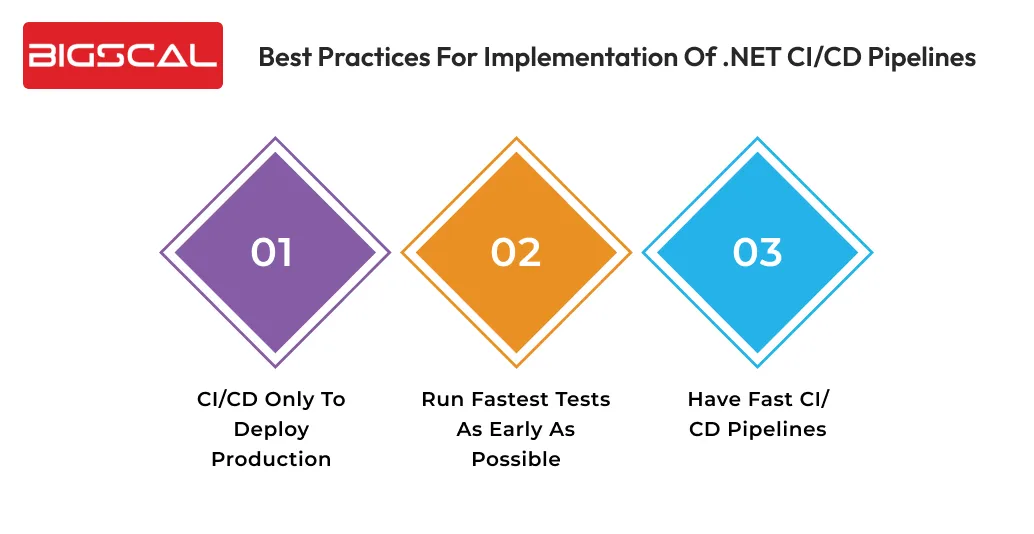
There are several beta practices to follow in CI/CD pipelines to significantly enhance the performance. Hence involving these practices can help you avoid certain problems.
CI/CD only to deploy production
CI/CD allows teams to track failures immediately and pause production until the root cause is identified and resolved. Hence this ensures that the production environment is always stable and secure. This process is especially beneficial for product development, integration and delivery to provide advantages such as automation and faster deployment as compared to traditional approaches.
Run fastest tests as early as possible
There are certain tests that are easier and faster to run than others. Hence running those faster tests earlier can help identify errors quickly in the primary phase of software development lifecycle. Finding errors as soon as possible can help avoid complications in the production enhancing overall quality assurance practices.
Developers should test their code locally before committing it to the shared repository or CI/CD pipeline. This technique aids in making sure that the code should be ready to be further used in the CI/CD process, and unnecessary mistakes will not occur in the testing environment and this technique will assist the developer.
Have fast CI/CD pipelines
The pipeline is the heart of the CI/CD process, which helps to achieve faster integration and delivery. In order to ensure prompt feedback and automated testing, one must always seek ways of enhancing performance as well as optimizing the pipeline environment. A quick deployment pipeline increases productivity and improves the overall CI/CD workflow.
Conclusion
Modern software development has now made it crucial to employ .NET CI/CD. CI/CD pipelines. It can help a team to create high-quality Automation of integration, testing, and deployment makes.NET applications faster and less error-prone. Continuous Delivery allows deployment of applications at all times whereas Continuous Integration ensures that bugs are detected promptly. They combine to boost productivity, reduce deployment risks, and improve code quality.
.NET CI/CD has a scalable development workflow that offers a reliable and scalable development workflow in combination with best practices such as quick testing, lean pipelines, and locally validated. Ultimately, CI/CD assists businesses in launching software confidently and responding to changes promptly and maintaining a substantial competitive edge.
FAQ
How can DevOps reduce .NET deployment errors?
DevOps reduces deployment errors by automating builds, testing, and deployment through CI/CD pipelines, ensuring issues are identified and resolved early.
What is .NET CI/CD?
.NET CI/CD is an automated process that continuously builds, tests, and deploys .NET applications to deliver stable and reliable updates.
Why is CI/CD crucial for .NET applications?
By automating testing and deployment, .NET CI/CD improves code quality, accelerates releases, and prevents human mistake.
What tools are commonly used for .NET CI/CD pipelines?
Commonly used CI/CD tools for .NET include Azure DevOps, GitHub Actions, GitLab CI/CD, Jenkins, and TeamCity.
How does Continuous Integration benefit .NET development?
Continuous Integration helps detect issues early by frequently integrating code changes and running automated tests.
What is the difference between Continuous Delivery and Continuous Deployment?
Continuous Delivery ensures the application is always ready for release, while Continuous Deployment automatically pushes every successful change to production.
Can CI/CD pipelines enhance .NET application quality?
Yes, automated testing and validation at every pipeline stage significantly improve code quality and reduce defects.
How often should code be integrated into the CI pipeline?
Ideally, developers should integrate code multiple times a day to avoid conflicts and detect errors early.
Is CI/CD suitable for large .NET applications?
Yes, CI/CD scales effectively for large .NET applications by standardizing workflows and improving team collaboration.
How does CI/CD support faster .NET software delivery?
By eliminating manual steps and reducing integration delays, CI/CD enables faster and more predictable software releases.