Implementing Secure Authentication and SSO in .NET
Quick Summary: Logging in must not feel like a burden and daily obstacle. Hence to avoid this you can employ SSO for .NET applications that are simple yet safe. Through this blog let’s explore how SSO streamlines access while reinforcing authentication security. It includes all the core concepts, key protocols and real benefits for modern applications. This will be your clear guide for building secure, user friendly and scalable .NET systems.
Introduction
Using passwords, logins and repeated verifications often can grow to be the weakest links while using modern applications. Hence users expect faster and easier access while businesses generally worry about airtight security and balancing both seems impossible.
Here’s where Single Sign-on changes the game. It balances this equation by simplifying the access without making any compromise on protection. Through this blog we aim to explore how secure .NET authentication and SSO works hand in hand. We will also understand why it is necessary for growing applications and how the right implementation can strengthen user trust.
No matter if you want to manage an enterprise platform or cloud based application, this guide will show you how smart authentication strategy can enhance security and scalability with professional .NET development services.
What is SSO?
Single sign-on is an exceptional technology that lets you gather all the screenshots of different application logins under one roof. Hence when they use SSO they only have to enter their credential once on a page to have access to all their SaaS applications. Additionally SSO is majorly useful from a business perspective when user applications are managed and assigned to internal IT experts. Also remote workers that employ .NET application development can also reap benefits of SSO login.
Imagine if an authorized customer is asked to submit their identity proof each time they want to make a purchase. Eventually it will make them extremely frustrated with these continuous checking. Moreover they might even move towards a new vendor or try some other ways to sneak in.
Hence the majority of establishments will only verify a customer’s identity once. Later they will serve customers as many times as they want avoiding extra frustration. This is what SSO login means. Rather than verifying identity over and over a user does it once and can access different services. Hence lesser hassle spent on .NET authentication.
SSO is one of the crucial aspects of different Identity and Access Management or Access Control Systems. User identity verification is necessary for understanding what permissions each user must gain.
Understanding the importance of SSO in .NET
SSO removes the need for users to remember plenty of passwords and credentials. Hence it eliminates friction while enhancing productivity. When it comes to enterprises it can centralize authentication, strengthen security with the help of protocols and simplify compliance concerns.
ASP.NET core along with its modular middleware and extensible authentication handlers can support a huge variety of SSO methods. Hence it is the best choice for both enterprise and consumer applications. No matter if you want to develop internal tools, customer facing apps or B2B platforms, SSO can work with all. .NET core framework has interoperability with providers such as AuthO or Microsoft Entra ID and more.
What are the advantages of SSO?
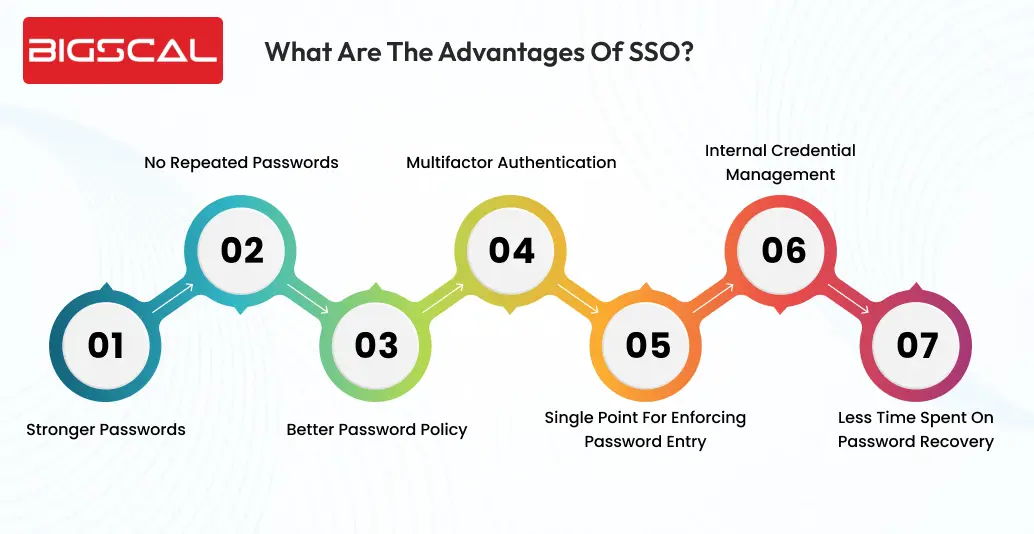
SSO is not only simple and convenient for users but is also considered as a secure option across the world. It might feel contrasting that how can signing in once with a password rather than multiple times with multiple passwords feels secure? But here are reasons that will help you understand better:
Stronger passwords
As users generally have to use their password once, SSO makes it easier for them to create, remember and use a password that is strong enough. It is practically the case while using SSO that users end up having a strong password.
So what are the standards for a strong password? A strong password is one that one cannot easily guess and is random to avoid bruce force attack. “Xc#vrfz” is an example of a strong password while password@2910 is not.
No repeated passwords
When users have to remember different passwords for different apps and websites they become prey to a condition called “password fatigue”. Hence it means that users will keep on using the same password across different services. Employing the same password everywhere can create massive security risks. It indicates that all services are only as much as secure as the services that weakest one has.
Hence if the database of that service is hampered, attackers can use it to get to all your services. So SEO eliminates this issue by removing individual login and using only one to get into all services.
Password reuse generally leads to “credential stuffing” attacks and SSO breaks this attack chain by eliminating multiple login endpoints.
Better password policy
As there is one place for entering password, SSO ensures that IT teams can enforce best security rules. For instance there are companies that make it compulsory to reset passwords after a certain time. Additionally when you use SSO password reset is easier to implement. Rather than changing passwords across different services you ought to change them only once. Although the importance of regular password is still questionable, certain IT experts feel that it is an essential part of security strategy.
Multifactor authentication
Multifactor authentication is a way that uses more than one identity to ensure the authenticity of a user. For instance rather than just using a user name and password you might have to connect a device or enter code shown in your smartphone. Hence having this second object by your side establishes the trust that they are who they say. It is a reliable approach when you are using a single password.
SSO makes it feasible to activate MFA at a single point rather than doing it twice, thrice or dozen of times which is practically not possible.
Single point for enforcing password entry
Administrators can set a limit of time after which login expires and you have to enter the same password again to ensure that the same user is active. When they use SSO in .NET software development they have a central place to enable this for all apps. Rather than enforcing it multiple times while many apps might even not support it you can feel a sign of relief by just doing it once.
Internal credential management
Majorly user passwords are stored on a remote basis in an unmanaged manner. Additionally those services might not follow best practices for security. Hence when you use SSO you can store it internally in an environment that an IT team has great control of.
Less time spent on password recovery
Along with the above stated advantages of using SSO it can also reduce the time spent by internal teams on recovering passwords. Hence the IT team has to spend very less time on recovering or resetting their passwords for dozens of applications. Also users spend less time signing into different applications and work on their crucial tasks. This can eventually increase business productivity.
How does SSO login in .NET work for .NET authentication?
When it comes to SSO the minute that a user logs in, it generates an authentication token that indicates that the user is verified. An authentication token is seen as a piece of digital information that they store in the browser of the user or SSO server. It is just like a temporary verification card for a user. Hence any app that a user tends to employ will cross check with SSO services. Later the SSO service will provide the user’s authentication token to the app and then the user can sign in. If the user by any chance fails to sign-in they will be able to do so through SSO service.
An SSO service will not everytime remember who the user is as it does not store any identity credentials. Most of the services will cross check user credentials against an identity management service that is set separately. You can consider that SSO login is a mediator that can check if a user’s login credentials match with the database.
Moreover it does not have a database of its own. You can view it as a librarian looking for a book front shelf for someone else with the title. The Librarian himself does not have the entire card memorized but can have access to it with ease.
How do SSO authentication tokens work?
The ability for passing on authentication token to the external applications and services is an essential thing in the SSO process. Hence this is what facilitates verification of identity differently from cloud services ensuring SSO is possible.
You can view it as an exclusive event where only a few people can get an entry. Hence this is only possible when the guard at the door to the event ensures to check and approve each guest by stamping on their hand. Later event staff can check the stamps of guests to make sure if they are meant to be here. Additionally not any stamp can work, the staff will be exactly aware of the shape and size of stamp that guards use at entrance.
As the stamp has to look the same for entry, authentication tokens do have their rules and regulations to prove they are correct and legitimate. The primary and crucial authentication token is known as Security Assertion Markup Language (SAML). It is similar to HTML which people use to craft web pages. Hence authentication tokens are written in SAML.
Strengthen .NET authentication today
- Secure SSO and identity solutions
- Expert .NET security implementation
Conclusion
In conclusion, secure authentication and seamless access are the core of any reliable application or service. Hence by implementing SSO in .NET organisations can ensure simpler user logins while having the best security standards in place. They can do so with the help of centralised identity control, better password policies and multi factor authentication.
SSO can also eliminate friction for users and lessens credential related risks for businesses. Hence it is an ultimate and smart choice for modern and distributed systems. When you combine it with proven protocols such as SAML and Kerberos, .NET authentication becomes both scalable and resilient. Hence to ensure that this system is secure and compliant with passing time, continuously monitoring updates and optimizing it through professional .NET maintenance services plays a critical role for a sustainable performance and long term security.
FAQs
What is the best way to implement SSO in .NET?
The best approach to implement SSO in .NET is with the help of OpenID Connect with the help of OAuth 2.0 through trusted identity providers like Azure AD or Auth0.
What is single sign-on and how does it work?
SSO is an authentication process that lets users access different applications with a single credential. The process involves giving an identity provider that further authenticates the user and grants access.
How does SSO ensure better password management than the traditional approach?
SSO removes the need for users to remember a huge amount of credentials for different applications. Unlike those old approaches that store different passwords, SSO needs you to remember and use only one set of credentials.
What benefits does the federated identity system provide with SSO?
It ensures centralised authentication control ensuring that it is easier for organisations to provide consistent security policies across different applications. It also reduces attack surface by limiting the amount of stored credentials.
How does SSO support multi-factor authentication?
SSO systems can easily integrate with multi-factor authentication to ensure that users need an extra verification along with initial login credentials. Hence this ensures multiple layers of security.
What are Kerberos and SAML protocols in SSO implementation?
Kerberos employs symmetric key cryptography and trusted third party authentication for verification of identities. Additionally SAML is an XML based open source standard that exchanges data between service and identity providers.
Why is SSO important for .NET applications?
SSO can simplify login while enhancing security and user experience across multiple .NET applications.
Which protocols are commonly used in SSO for .NET?
Protocols such as SAML, OAuth2.0, OpenID Connect and Kerberos are used.
Can SSO work with cloud based .NET applications?
Absolutely when you combine it with MFA, token validation and strong identity providers.
How does SSO reduce security risks in .NET authentication?
SSO tends to minimize password reuse and centralises security policy enforcement.