
.NET Development Trends to Watch in 2026
Quick Summary: Get ready to explore the best .NET trends that will take over in 2026 and ensure smoother development. This blog highlights all of these trends with necessary details. From .NET 8+ performance gains to AI integration,.cloud native architecture, Blazor and DevOps automation. Hence let’s learn how these trends can help teams create faster, scalable and future ready applications.
Introduction
Team leads from the tech department and developers are under a huge pressure of making decisions about technologies that yield best results. Additionally they have to always stay updated with the latest .NET trends that will contribute tremendously. Plenty of companies already have dependable providers like Bigscal Technologies to take care of .NET development services and trends. Therefore no matter what the arrangement is but having track on emerging trends ensures efficient, safe and competitive pace in a fast moving world.
.NET has grown immensely over years and moved ahead from being only for Windows. It has now become a cloud based platform and even mobile application platform. Not only this but you can use it to develop enterprise applications, AI driven systems, microservices and even cross platform development. Hence the rate of development is continuously growing.
Teams can now make the most out of .NET 8 and 9 for superior performance, tool, security and a rich ecosystem. It supports both small and large business structures. Hence these development trends are surely attractive for team leads and even CTOs. Staying back in trend can lead to increased costs, delay in release cycles and technical debts. Investing in the new .NET development trends can help businesses boost productivity and create scalable systems.
As per a research usage of .NET framework for enterprise development has risen to 34% in 2025, which is an overall 7% increase. This blog has all the latest .NET trends that everyone must be aware of. These trends are worth knowing as they will lay an impact on your functionality and planning.
Understanding .NET development
.NET development is an approach to develop an application with the help of .NET which is Microsoft’s framework. It initially was only for Windows application development but now it supports web, mobile and desktop applications. Moreover it is a unified framework, has libraries and powerful tools letting developers create secure, scalable and high performing applications. Hence over time .NET has turned into a full cross platform compatible and cloud ready system.
With the latest versions of .NET teams can create APIs, Microservices, AI based systems and full stack applications with a single tech stack. It has strong performance, Long Term Support releases and seamless integration with Azure and DevOps. Hence it is a reliable option for businesses of all sizes. Understanding how this framework works can help make better architectural decisions and stay aligned with the latest .NET trends.
Ensure you choose LTS versions of .NET for production apps for better stability, security and long term support.
Top trends every .NET developer Must Know
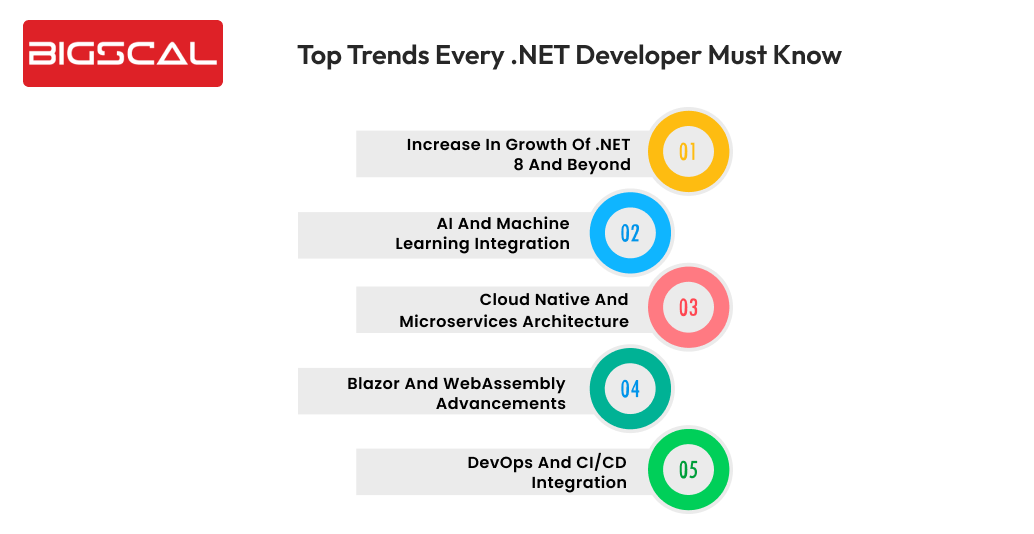
Increase in growth of .NET 8 and beyond
The speed that .NET 8 has is truly enchanting and is the best choice for both small applications as well as larger business applications. Faster runtime, better memory usage and increased scalability even under immense load is crucial for developers. Hence this makes a really great difference for .NET application development teams looking for best performance. This upgrade can be helpful for any company that is in need for long term and high performing applications.
These new updates can provide quick startup times of cloud apps, ensure software resources are used more efficiently and APIs can process data faster. The system can handle distributed workload effectively due to microservices architecture. Additionally all this eventually results in better reliability, fast response times and a scalable system to avoid resource wastage.
Performance is one of the greatest reasons why people still want to opt for .NET and .NET 8. It maximizes rate of garbage collection and lessens memory assignments and works faster for activities that exhaust CPU. It also has access to patterns of data that helps applications in answering promptly and swiftly even at peak hours. The future of .NET 9 looks brighter and each update makes it even easier to create apps by teams. Additionally people generally appreciate long term support versions as it can let companies have a sigh of relief.
AI and Machine learning integration
.NET boasts an ecosystem of services where a developer can train, test and deploy machine learning models without needing to switch. This framework also has a huge numeric library, great support for processing large scale datasets and generative AI that can create ease for advanced AI load of work. There is also continuous improvement in ML.NET for more accuracy, training faster and easy to mix.
It additionally has automated pipelines ensuring it is easy to prepare data, test different algorithms and deploy models into production. Hence it ensures that the workflow of teams is more efficient when it comes to creating AI powered systems useful for enterprise systems.
Azure cognitive services is further developed on this basis that facilitates ready made AI functionality to integrate it directly into .NET applications. This support can ensure saving costs and time while accelerating product development with intelligent features with less effort. Using predictive analysis is also becoming beneficial for businesses to predict the behaviour of customers. It helps them inform choices, anticipate and react smartly to market changes. Combining work of .NET and AI can be called as smart automation that can ensure complex workflows, less human efforts and better precision.
Cloud native and microservices architecture
The .NET facilitates creation of systems that you can scale to add more users. All thanks to the evolution in the .NET development trends it is possible to create large scale, distributed and microservices applications with lesser complexity than before. This platform helps businesses to work with more users without overhauling the architecture. Additionally it ensures better scalability, communication and deployment.
Additionally characterful is a better functionality of Docker and Kubernetes. .NET has made workload distribution uniform across Kubernetes clusters and reduced the size of Docker images, accelerating the process of creating containers. Applications can be used in more contexts, load balancing is enhanced more, and scaling is simplified. Hence the organizations can support high levels of functionality despite the increase of the systems due to the enhancements.
Moreover, serverless architecture and microservices are better supported by.NET. GRPC is faster and more reliable when their communication is concerned and Azure Functions simplifies the process of creating serverless applications that respond immediately to events. In fact this provides more freedom to the teams to create lightweight, responsive and economical solutions.
CTOs benefit in a number of ways due to these improvements in .NET software development services. Also, it is more available and reliable because cloud native features allow systems to recover fast and effectively manage traffic spikes. However with enhanced scalability, the companies will be able to build up their infrastructure at a gradual pace that is predictable and continue to perform extremely well in any setting.
Blazor and WebAssembly advancements
Blazor applications these days are known to ensure greater performance as it loads faster,.has smaller build size, manages components easily, and better tools for developers. Hence these enhancements ensure Blazor is a more appealing choice for web application. Most of the companies use .NET development services to migrate old systems to this platform so that it can provide better stability and less maintenance.
WebAssembly enhancements also ensure significant improvements, it ensures load times are lower, and better speed for better sense of responsiveness in application. Balzor is also increasing its support for development of mobile applications. When using Blazor hybrid developers can create UI components and reuse them on both mobile and desktop. It saves time and efforts spent in development and ensures user experience is similar.
With the help of tougher tooling it is easier to develop hybrid apps that are native, fast to load and that don’t need more effort from an engineering perspective. This speed, agility and reuse of code ensures that developers can provide applications for different devices. So why is it crucial?
- Lesser use of JavaScript frameworks
- Enhances full-stack development
- Ensures that .NET maintenance services and updates are easier.
DevOps and CI/CD integration
GitHub Actions and Azure Devops provide some extra features that facilitate the work of DevOps. It does so with the help of more advanced workflow templates, better dependency tracking, faster build and release pipelines, and better monitoring. Hence these enhancements assist teams to automate more of their development cycle and also shorten the time to go through a code testing process to production. The whole pipeline has enhanced its predictability and efficiency. Therefore, it is possible to deliver faster and to manage cleaner versions of the project.
Another method to enhance test automation is to be closer to unit testing, integration testing, and load testing tools. Additionally, more powerful automation and better testing help companies to issue updates without fear and facilitate a smooth development cycle. Its list of benefits includes:
- Faster time to market.
- Enhancements in code quality
- Lesser error rates
- Easier rollback if any problem pops up
Modernize your application with .NET
- Future ready .NET apps
- Expert team and support
Conclusion
In conclusion as .NET keeps on evolving, 2026 is shaping up to be the year for teams that want to develop faster, smarter and resilient applications. From the performance enhancements in .NET 8 and upcoming versions to better AI integration, cloud native capabilities and modern DevOps workflow, these latest trends focus on scalability, reliability and long term success. Additionally these advancements are not mere technical upgrades rather they are a strategic approach that helps businesses reduce risks, enhance innovation, and stay competitive in the market.
For organization owners and tech leaders it is essential to stay aligned with emerging trends as it is not optional. It can lay an impact on release speed,. reliability and future readiness. By adopting appropriate and a forward looking approach, .NET can continue to be a powerful foundation for growth, innovation and success.
FAQs
What are the top trends in .NET development?
Some key trends to observe include .NET 8 and beyond, AI and ML integration, cloud native deployment, microservices, Blazor advancements and DevOps automation.
Why is .NET important for modern application development?
.NET 8 provides better performance, great memory management, and enhanced scalability. Hence it is ideal for applications with high traffic and enterprise applications.
How is AI impacting .NET trends?
AI integration with the help of ML.NET and Azure Cognitive Services makes automation smarter. Additionally predictive analysis and faster deployment of intelligent applications.
What role does cloud-native architecture play in .NET trends?
Cloud based .NET apps support microservices, containers and serverless models providing better scalability, fault tolerance and cost effectiveness.
Why are microservices gaining popularity in .NET development?
Microservices can enhance flexibility, simplify scaling, and facilitate faster deployments with tools such as Docker, Kubernetes and gRPC.
How is Blazor shaping the future of .NET web development?
Blazor reduces dependencies on JavaScript, enhances performance and supports reusable components for web, mobile and desktop apps.
What DevOps improvements are influencing .NET trends?
You can automate tests with the help of enhanced CI/CD pipelines and GitHub Actions and Azure DevOps, faster releases and better code quality.
Why should businesses stay updated with the latest .NET trends?
By following the latest .NET trends you can reduce technical debt, lower costs, enhance performance and stay competitive in the market.
How does .NET support enterprise application development?
.NET provides better performance, security, scalability and long term performance. Hence it is ideal for enterprise grade systems.
What benefits do CTOs get from modern .NET trends?
CTOs can enjoy predictable scaling, faster recovery, enhanced performance and better data infrastructure planning.