
Building & Integrating APIs in .NET Applications
Quick Summary: API is behind powering all the modern and digital experiences and .NET integration makes building them simpler and reliable. Hence through this blog let’s break down the entire journey of building and integrating APIs in .NET applications. You will also get to know practical steps behind the process, real world practices and smart choices. Get ready to build secure, scalable APIs that connect with systems and bring exceptional performance.
Introduction
APIs function as a silent connector that empowers the entire modern digital experience. Each mobile application, web platform and cloud service rely on APIs to communicate and exchange data. In today’s connected and digital world, building reliable APIs is extremely necessary. It has become the critical requirement for scalable and high performing applications. Hence this is where .NET plays a crucial role.
Microsoft has created .NET to help developers design and develop secure, fast and flexible APIs with supreme ease. It equips you with powerful tools, structured frameworks and built in support for modern development approaches. Developers can now design APIs that look after high traffic, integrate with multiple systems and ensure consistent performance.
.NET development services also simplify cross platform development ensuring that APIs are accessible across devices and environments. This blog aims at guiding you through creating and integrating APIs in .NET applications. You will get to know a step by step approach that is best for scalability and reliability. No matter if you are a fresher or improvising existing services, this guide will surely be helpful.
What are APIs in .NET?
For .NET framework APIs mainly indicate Web APIs that are built with the help of ASP.NET core framework. You can consider them as a set of HTTP endpoints that lets software communicate and exchange data with the server on the internet. Majorly it uses HTTP protocol and data formats such as JSON or XML. So why do developers use these .NET integration with API? Let’s learn:
- Decoupling: APIs help them to decouple the front end from the back end of the application logic. Hence different development teams can work altogether.
- Reusability: One same backend API is capable of powering different client applications such as web, mobile and even IoT devices.
- Integration: These APIs empower your system to seamlessly integrate with other third party systems. It includes payment gateways like Stripe, social media like Facebook or mapping services like Google Maps.
Step by Step guide to build and integrate APIs
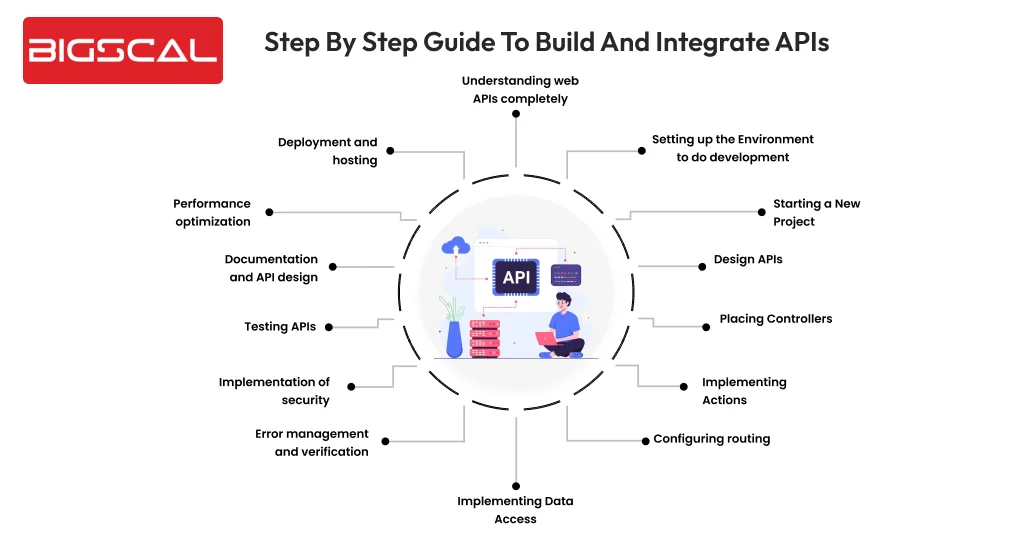
Let’s start with our step by step approach for APIs in .NET application development:
Understanding web APIs completely
Overall, the purpose of web APIs is to enable communication between web-based applications. To facilitate structured communication, the.NET Web APIs are based on the standards of the RESTful design. Therefore the developers manipulate the resources using HTTP methods. Later APIs interact with each other using request and response models.
Data interchange is standardized through such data formats like XML and JSON. Authentication and authorization protect the API resources against unauthorized access. Moreover, having documentation also helps developers to better understand the endpoints and the request forms.
These concepts can assist developers to develop consistent and reliable APIs. Additionally the appropriate understanding of the integrated systems provides a smooth communication among the systems.
Setting up the Environment to do development
Visual Studio for .NET programming is the initial step to be done by the developers. They install the version of the.NET SDK required in the project. Visual Studio has templates of web, desktop, and mobile applications. In the course of setup, developers select a suitable project template.
Later they install dependencies and required packages. In such an arrangement, a developer is capable of beginning to code. Moreover Visual Studio offers project management, testing and debugging tools. These features make APIs more productive when they are developed.
Having a clean Visual Studio setup with the right .NET SDK and templates can help you save hours of debugging and sets your API for long term stability.
Starting a New Project
The developers use the .NET Web API template to start a new project. Later Visual Studio creates the structure of the project automatically. The template contains controllers, models and configuration files. The project’s name and location are specified by the developers. At the end the implementation of the API is ready with the project. The step prepares the foundation of developing a working API. The developers then make routes and implement logic.
Design APIs
The API design is based on creating the API Finding. Hence this reveals the resources available. The developers provide each resource with the appropriate HTTP methods. Later they define data models with regards to requests and answers. The developers also plan versioning and error-handling techniques. Additionally security requirements are considered during the design stage. Good design ensures good maintainability and API usability in the long run. Properly designed APIs facilitate client-side integration.
Placing Controllers
In .NET Web API Incoming requests are processed by controllers. Moreover the developers can develop controllers by inheriting the ApiController base class. Each controller is made up of action methods of specific endpoints. Attributes define routing behavior and also define HTTP methods. Controllers provide responses in response to requests. They handle processing information and business reasoning. The controllers make up the basic functionality of the API.
Implementing Actions
Each API endpoint is characterized by its actions. Attributes of the HTTP methods are regarded by the developers to enhance activities. Each of the actions checks request data and processing input. Actions perform actions and offer adequate responses. Actions interact with repositories and services when they are needed. Security in API behavior can be predicted through appropriate implementation.
Configuring routing
Routing can help in mapping incoming requests to controller actions. Hence it can be used by developers to configure routing through attribute based or conventional routing. Routing rules help specify URL patterns and parameters. Hence proper routing facilitates correct endpoint resolution. Effective routing can ensure API clarity and accessibility.
Implementing Data Access
The APIs are linked to the databases and external services through data access layers. Hence you can use ADO.NET or Entity Framework in these operations. They map tables to entities in the database and LINQ queries are used to do CRUD. Additionally these tools enhance integration and data management. API operations are also reliable due to proper data access.
Error management and verification
This step in .NET software development is used to make sure that incoming information is governed by established rules. Validation attributes such as MaxLength and Required are used by the developers. Modelstate contains validation errors automatically. The API provides appropriate status codes and definite error messages.
Exception handling in the global sense deals with runtime faults which are unanticipated. Hence this will enhance the experience of the client and the reliability of the API.
Implementation of security
The extensive security measures will guarantee that APIs are not accessed by unauthorized individuals. Moreover the identity of the client is first authenticated and only after that, access may be granted. Resource permissions are then enforced on authenticated users. JWT or OAuth is normally utilized by developers.
Sensitive endpoints are secured using role-based and policy based authorization. Therefore strong security guarantees integrity of data and confidentiality.
Testing APIs
The API testing is completely done to check the reliability and proper working. Unit tests are coded using NUnit or xUnit and integration tests can be used to check on component interaction.
You can assess API responses with tools such as Postman and Swagger. Testing leads to identification of errors and the general quality of API. Further this makes sure the performance and behavioural requirements are satisfied.
Documentation and API design
You must have documentation of API endpoints, usage, parameters, responses and authentications. Interactive Swagger generated API documentation can help the developers. REST principles and good API design have a naming convention. Versioning provides long term maintenance benefits.
Turn your APIs into growth experiences with Bigscal
- Scalable .NET integrations
- Built for speed and security
Performance optimization
Responsiveness and scalability is enhanced by performance tuning, frequent data dynamic behavior caching, asynchronous programming and database indexing. There are tools to monitor and identify the bottlenecks of the performance. Later a developer can perform execution smoothly under the load.
Deployment and hosting
With deployments, users can access APIs through all dependencies. Moreover typical choices of hosting solutions are IIS, Kestrel and Azure App Service. Cloud hosting is reliable and gives it a scaling effect. Hence connection strings and secrets are handled by environment-specific applications which ensure constant API availability.
Conclusion
To conclude building and implementation of APIs in .NET applications needs a clear strategy followed by structured implementation. With the help of ASP.NET core developers can now build secure, scalable and high performing APIs that cater to the needs of modern businesses. From setting up projects and routing to security and deployment, every step has its own importance in API success.
Consistently testing, documentation and performance optimization can provide long term reliability. In addition .NET maintenance services will ensure APIs are secure, updated and efficient as the applications scale. Organizations can offer APIs that enable simple integration, easy communication, and long-term growth by utilizing best practices and the.NET ecosystem.
FAQs
What are best practices for API integration in .NET?
You can use REST standards, secure endpoints, proper routing, versioning and consistent error handling for smooth .NET Integration.
What is .NET integration?
.NET integration lets applications connect, share data, and communicate with internal or third party systems with the help of APIs.
Which framework is best for building APIs in .NET?
The best option for creating scalable, protected, and efficient APIs is ASP.NET core.
How does .NET support cross platform API development?
.NET lets APIs run on Windows, Linux, and MacOS that ensures seamless integration on different environments.
How can security be implemented in .NET APIs?
Developers can use JWT, OAuth, authentication and role based authorisation for protection of APIs.
What tools can help test .NET APIs?
Tools such as Swagger, Postman, NUnit, and XUnit can help in validation of functionality and reliability.
Why are .NET maintenance services important?
They ensure APIs are always secure, updated, optimised and compatible as system scales.
Why is versioning important in .NET APIs?
Versioning will ensure backward compatibility and smooth updates while API evolves.
Why are .NET maintenance services essential?
These services ensure APIs are secure, optimised, updated and reliable with growth in application.
How does .NET handle database integration?
Entity Framework and ADO.NET manage database access and CRUD operations.