Building Modular .NET Applications Using Plugin Architecture
Quick Summary: Building a modular application these days does not mean rebuilding it from scratch. With the help of plugin-based architecture, .NET applications can grow seamless feature by feature. Additionally it ensures that the core is clean and stable. This blog will help you uncover each detail about plugin architecture for .NET modularity. It will help your team design flexible and scalable software that evolves to adapt to changing needs.
Introduction
Modern applications require architectures that can scale and grow, but do not change the system itself. Hence you can satisfy this requirement with the help of the approach based on the use of the plugins. Through this a developer can extend the functionality of a given platform without the need to rewrite the core functionality of that platform.
Since each of the plugins is a self-contained solution, the dependencies are less, and the application stays stable as it evolves. Such a method not only reduces the development times for .NET applications but also simplifies the upgrades and troubleshooting much easier.
The development of any system with the components of the plugin-driven system is easier. Additionally it is more effective with the support of trusted .NET development services. Moreover the .NET ecosystem offers strong tools to the version control tool, performance tuning tool and modular development tool.
Hence it enables teams to develop an application that changes with additional features. These all can together help companies create versatile software that can respond quickly to new needs and changes in the market. Let’s understand how through this blog.
What is plugin based architecture?
Plugins in an application development work as independent units that enhance functionality without altering the core system. It enables developers to add more features to the application while ensuring that the application is stable and clean. Each of these plugins in .NET modularity performs its own function and lays emphasis on only one responsibility.
Developers generally prefer plugins for enabling payments, enhanced search and add features for analytics. This approach allows faster development along with simple long term .NET maintenance services.
.NET plugin systems majorly depend on interfaces or abstractions for defining clear contracts. Later plugins tend to implement these contracts for ensuring consistent communication with the primary application.
Hence this design is best for modularity as it keeps application loosely coupled leading to smooth maintenance. Developers can easily update or replace plugins without need to deploy complete applications. It is commonly used for extensions, third party integrations and customizable workflow. In short, plugin architecture can enhance scalability, flexibility and long term application stability.
Build modular .NET apps
- Extend features without core changes
- Scale faster with plugins
Understanding components of plugin-based architecture
At the heart of any modern architecture lies modularity which is possible with plugins. Hence in .NET application development employing plugin based modularity can let you divide a huge application into smaller and independent parts. So now you can develop, test and deploy smaller independent units easily.
Rather than developing a tightly coupled application you can now create a flexible ecosystem. It will enable you to add and remove features without interfering with the program as a whole. Hence this technique ensures application is easier to maintain, grow and extend over time.
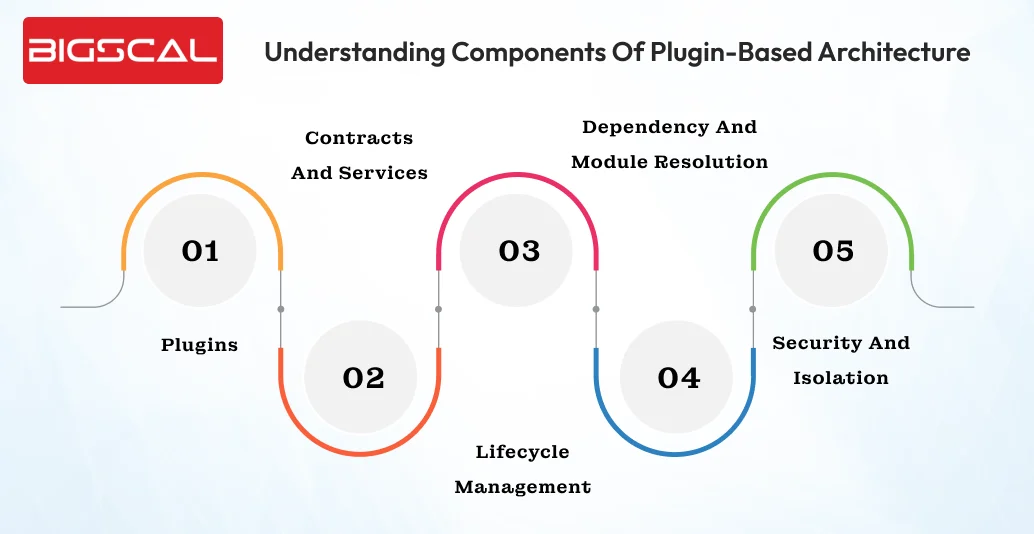
Having a well structured plug-in architecture depends on different components that come together to support this design.
Plugins
Plugins mark the solo components that developers create. Each of these plugins completes its particular responsibility and provides its functionality through user interface. When it comes .NET each plugin lives in separate assemblies. Hence it keeps them away from the main application and each other.
Contracts and services
Services between the main application and the plugin work as the communication layer. Hence interaction between the host and the plugin can be characterised through common contracts or interfaces. Additionally to this elastic connection the plugins are able to evolve with causing no harm to the entire system.
Lifecycle management
Lifecycle is responsible for handling how plugins must load, initialize, activate, deactivate or unload at runtime. Therefore in .NET it consists of dynamic assembly loading and controlled startup logic. Further it allows applications to enable or disable features without need to restart.
Dependency and module resolution
It is the layer responsible to define how plugins reference shared code and external dependencies. Having a proper module resolution can prevent version conflicts and ensures that each plugin can only get access to whatever it needs. This architecture also supports features like Auto post, allowing automated publishing or updates without disrupting dependency boundaries.
Security and isolation
Security mechanisms are responsible for restricting the things that plugins can access within the host environment. This isolation ensures that the core application is safe from faulty or untrusted plugins and creates clear boundaries.
Why use plugins within your present implementation?
When you think of adding plugins to your existing .NET application it helps you enhance functionality without needing to rewrite or destabilise your existing system. Rather than making changes to main code every time you need a new feature, you can introduce them as independent plugins. These can integrate seamlessly with the application.
One another reason to use plugins is it provides the ability to add features dynamically. No need to stop the main application as the plugin lets you add, update or disable any feature easily. Hence this approach eliminates downtime and ensures continuous delivery in production grade .NET systems.
These plugins also let you manage dependencies in an effective manner. Each plugin tends to carry its own dependency such as libraries and infrastructure. Hence this feature ensures that the application is easy to maintain and code is even in readable form.
Another crucial advantage of plugin is clear separation of problems. The main application will only focus on shared logic and infrastructure and plugins work only on specialised features. Hence from a practical point of view plugins simplify implementation of targeted enhancements such as:
- Automating content delivery to CDNs without affecting the main workflow.
- Adding multilingual support with translation services.
- Enhancing search capabilities by integrating third party services along with existing data sources.
By using a plugin with your existing implementation you create a system with minimum risks.
Design plug-in interfaces first and keep the core .NET application dependency free to make future extensions painless and risk free.
Benefits of using plugin based architecture for .NET modularity
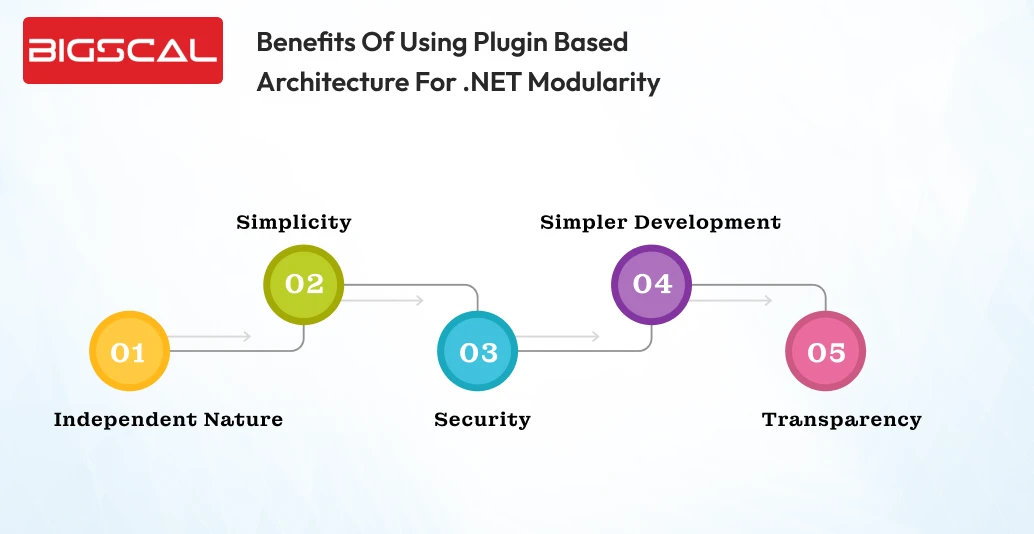
Plugin architecture lessens the complexity by creating modular archit for both modern distributed and embedded applications. Plugins can also help eliminate complexity and development expenses with component based systems. Similarly modular architecture can lessen operating costs and integrate many devices in a networked environment. Hence enabling management of services remotely. Let’s have a quick look at some advantages of plugins:
Independent nature
As we all know that these plugins are independent they provide agility, property to change, remove and add plugins quickly. The manner in which you can develop, deploy and test each plugin depends on pattern implementation.
Simplicity
Plugins have powerful dependency management and yet they are simpler to use. The plugin code almost feels similar to Java code. Hence it makes it easier to develop and enable use of more advanced features.
Security
The security and usability of.NET’s features are among its most important attributes. Plugin architecture lets developers specify the security instructions while being completely in-charge, ensuring a secure and cloud hosted app environment.
Simpler development
When you develop an application with a plugin it means you use modules that carry out communication with the help of well defined services. As the internals of each plugin is developed separately, they enjoy better freedom to create different features as they need.
Transparency
The administration APIs make it easier for developers to access the bundle’s internal state. Additionally they have a view to how plugins are connected amongst themselves. Most of these frameworks have a command shell that shows details regarding internal affairs. And if any problem related to plugins arises your developers can debug it or add diagnostic bundles without impacting core software.
Conclusion
In conclusion, plugin based architecture plays a very important role in creating scalable and adaptable applications. Moreover they are the best choice when you are in need of modularity. By breaking functionality into small independent plugins, .NET applications get easier to extend, maintain and evolve without risking core stability. Hence this lets the team stay adaptable to increasing business needs while ensuring that the system is clean and well structured.
When you combine it with modern .NET software development practices, plugin architecture lets developers deliver flexibility that provides long term growth. It lessens technical debt, simplifies upgrades and provides continuous improvements without disruption. For organisations that are looking forward to creating future ready applications using plugin based modularity is not a design choice but a strategic move.
FAQs
What is the plugin architecture in .NET applications?
It is a modular design approach where independent plugins can extend the functionality of an application without changing the core system.
How does plugin architecture .NET modularity?
Plugin ensures to divide the entire .NET system into smaller, self-contained modules that you can build, launch and maintain independently.
Why is plugin architecture useful for already existing .NET applications?
It helps developers to add or update any feature without needing to rewrite entire core logic or redeploy entire application.
How do plugins communicate with core applications?
They employ shared interfaces or contracts that provide clear communication rules between the host and plugins.
Can plugins be loaded or unloaded at runtime in .NET?
Yes, .NET provides dynamic assembly loading. Hence it enables to activate or deactivate plugins without need to restart.
How does plugin architecture improve maintainability?
By isolating features into plugins, debugging, upgrades and replacements get faster and less risky.
Is plugin based architecture suitable for long-scale .NET systems?
Yes it is majorly used in enterprise applications for better scalability, flexibility and long term stability.
What are common use cases for plugins in .NET applications?
Payments, analytics, search enhancements, third party integrations and customizable workflows are some common examples.
How do plugins help reduce downtime in .NET applications?
Plugins allow you to update features and fixes without having to stop the program altogether.
Do plugins affect the performance of .NET applications?
When you design it appropriately, plugins run in an independent fashion and have minimal impact on performance of .NET applications.