
How to Design .NET Applications for High Load Scalability?
Quick Summary: The deciding factor that determines whether a.NET application flourishes under expansion or fails under strain is scalability. With increasing user demands applications must look after providing best performance and lesser downtime. This blog aims at highlighting the main principles, tools and architectural decisions necessary for high load and scalable .NET applications. Let’s learn how to future proof your system while ensuring speed, reliability and user satisfaction.
Introduction
Think of a situation when thousands of users are hitting your application at the same second. Lots of clicks, queries and transactions all at the same time and each of them is expecting instant responses. And what if your system can handle it exceptionally well without slowing down even once. This is not about luck rather it’s about .NET scalability. Higher performance is not a nice feature for modern applications, instead it is a basic requirement.
The choices you make even before a traffic spike happens shape the scalability of .NET applications. From selection of infrastructure to making choice of databases and monitoring each parameter, every decision counts. Through this blog we will understand how to develop resilient, high performing systems that grow with demand and stay reliable under pressure with .NET development services.
Understanding .NET scalability
Scalability refers to an application’s ability to adjust to changing demands and user needs. It can also be described as an application’s capacity to handle an increasing user base and load without sacrificing performance or interfering with user experience. Therefore, software’s scalability refers to its capacity to expand or modify in response to user demands.
Moreover, the number of queries an application can effectively process simultaneously measures its scalability. But it is a long process that can impact almost everything on your stack, such as software and hardware of the system. Thus, it is possible to scale these resources by any combination of network bandwidth, CPU and physical memory requirements, and hard disk modifications.
This implies that, to support a high number of requests per minute (RPM), you must configure your application with appropriate hardware and software protocols. A scalable architecture helps reduce downtime caused by server failures and enables you to continue serving users during periods of high demand. Lastly, scalability is meant to guarantee that the amount of users of your software does not affect the user experience.
Build .NET apps that scale
- Fix performance gaps
- Prepare for growth
Why is load scalability crucial in .NET applications?
Regardless of the number of other users seeking to use your online application, users now insist on an extremely-fast load time. Moreover, applications must provide high availability 24/7 with minimal disruption to the user experience. People will unavoidably stop using your app unless it is built correctly and can manage the rise in users and effort. Users will prefer more scalable applications that improve the user experience.
- Scalability is an important part of software because it influences the ability of an organization to meet the constantly changing needs of its network infrastructure.
- Therefore the company might experience interruption of its services, which will drive away customers.
- When the demand is low and the off-season is in place, you can reduce your IT costs by reducing the size of your network.
Majorly companies prefer features over scalability. Nevertheless, it has to be scalable, otherwise it would not be able to survive, which is a priority during the initial phases of the process. If taken care of then it would lead to lower .NET maintenance services costs, better user experience, and a higher degree of agility.
Top 7 Things to consider for .NET scalability while application development
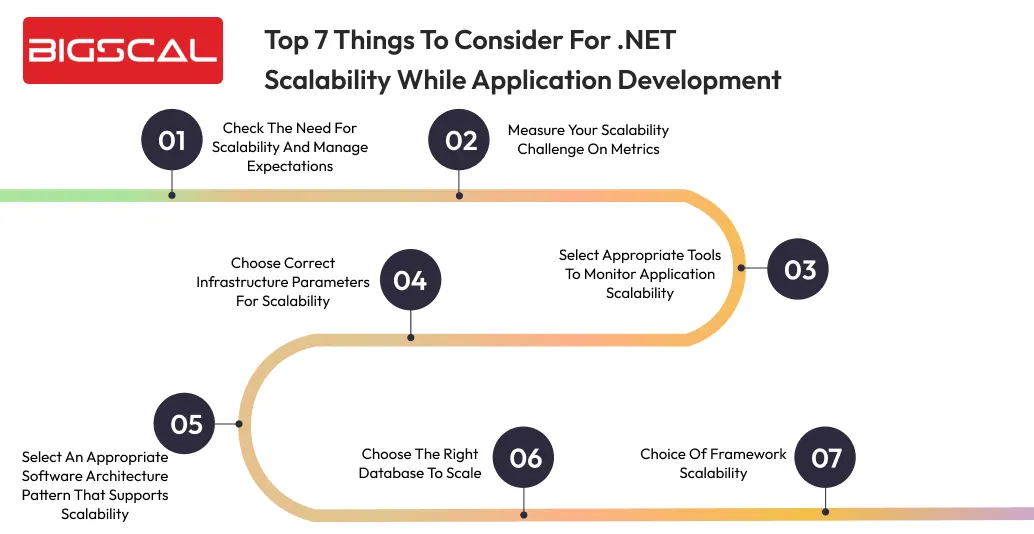
As now you are aware of what .NET scalability means and why it is necessary let’s get into steps to build scalable web apps:
Check the need for scalability and manage expectations
You must avoid attempting to scale your .NET application development if you don’t require it. Scaling could be expensive. Ensure the expenses are justified by what you desire to be able to scale (and not merely that everyone is talking about scalability). These are just some of the reasons that can help you in your choice:
- Find out information to ensure that your web application will supplement your expansion strategy. Have you seen an influx in the number of users? How much, and when?
- What do you expect to accomplish in the coming weeks and months?
- Does the storage plan that you are using allow you to change in size?
Hence you must explain your decisions in case the user and data traffic has a tremendous growth.
Measure your scalability challenge on metrics
After you have assessed the need, it’s time to scale your online application. Hence now you need to make decisions regarding the scalability issues to focus on. It can be done with these four measures of scalability, which include:
- Memory utilization: It is the amount of RAM a certain system consumes within a particular time.
- CPU usage: A high CPU usage is normally an indication that something is wrong with some performance in your application. Most app-monitoring systems are able to trace.
- Network Input/Output: This is one of the most important parameters.It explains the time it requires to move data between tracked processes.
- Disk Input/Output: Check the longest running cases and input/output on a disk. It includes every action that takes place on a physical disk.
Select appropriate tools to monitor application scalability
Let’s move ahead and think about this concern. After deciding on the metrics to focus on, now you have to select app-monitoring tools to monitor the metrics related to it. The major IaaS (such as AWS) and PaaS (such as Heroku) offer decent application monitoring (APM), making the task easier. As an example of such monitoring, Heroku has its New Relic add-on, and Elastic Beanstalk (AWS) has a built-in monitoring system. Additional Good AMP market solutions such as Datadog AMP, New Relic AMP, AppDynamics, and others could also be helpful in .NET software development.
Enable distributed tracing across all services at an early stage. If you don’t do so you will miss out on many performance bottlenecks when CPU and memory metrics look healthy.
Choose correct infrastructure parameters for scalability
Suppose you are a start-up building a webapp. Since cloud services provide a lot of functionality in the creation and maintenance of web apps, a PaaS (such as Heroku) or an IaaS (such as AWS) is recommended. Infrastructure and storage, servers, networking, databases, middleware, and the runtime environment are examples of components. PaaS and IaaS can support scalability because they offer auto-scaling, besides the availability and reliability of SLA.
Select an appropriate software architecture pattern that supports scalability
One of the most crucial parts to ensure scalability of .NET application is its infrastructure. Having scalable architecture will ensure that applications will adapt according to user needs and ensure great performance. Hence having architecture issues can have a significant impact on scalability. Here are two primary patterns that you must consider for scalability: monolithic and microservices architecture.
- Monolithic architecture: Monolithic applications are usually developed on one codebase and one enormous system. Hence in small projects, monolithic structure is an ideal choice since it offers the advantage of having a single codebase with a variety of functions. This however can be easily disorganized and unmanageable when the program is developed with new features and functionalities.
- Microservices Architecture: Contrary to monolithic design, microservices are developed as a set of independent services each having its own codebase. Therefore, they have their respective databases and logic and perform their specific tasks. The microservices system is very flexible since the modules are not rigidly dependent. The upgrades on specific features are now easier to carry out without affecting the whole application. Hence this is why numerous companies are shifting towards microservices framework making the addition of new features and scaling of its system a lot easier.
Choose the right database to scale
Once you resolve infrastructure and architectural concerns, you should also focus on the database when addressing scalability. Hence the type of data that you have to store is what will dictate the type of database you choose that may either be relational (MySQL, PostgreSQL) or unstructured (MongoDB, a NoSQL database). Inclusion of relational or unstructured databases in your application should be easy.
Choice of framework scalability
Frameworks significantly affect an application’s scalability, and the framework you choose directly impacts performance as the application scales. Hence the choice of development language gives you a lot of options. As an example, some of these frameworks, such as Django and Ruby on Rails, are good at building scalable web applications.
However, in contrast to Ruby on Rails, Node.Js has an outstanding feature of handling large projects with asynchronous queries. There are other frameworks such as Laravel, Angular JS and React.js. However, remember that the effectiveness of your infrastructure and architectural choices ultimately determines how successfully your application scales under high load.
Conclusion
Designing a scalable .NET system needs to be planned, monitored, and optimized continuously. It is possible to ensure your application will work reliably even under heavy load by choosing the right architecture, infrastructure, and tools. Hence the scalability at an early stage encourages long-term expansion, impacts cost reduction, and improves the experience of the users. As long as correct strategies are adopted your .NET application will be ready to adapt and flourish with the change of demand.
FAQs
How can I ensure my .NET apps scale effectively?
You can ensure effective .NET scaling with the help of scalable architecture, monitoring performance metrics, optimisation of databases and using cloud auto scaling features.
What is .NET scaling?
.NET scaling refers to the ability of .NET app to handle increasing users, traffic and workloads without having an impact on performance and user experience.
Why is scalability important for .NET applications?
Scalability provides .NET applications with ability to handle growth, reduce downtime, enhance performance and provide consistent results even at high traffic.
Which architecture is best for scalability: Monolithic or Microservices?
Because it enables the scaling of independent components without affecting others, microservices architecture is primarily the best option for.NET scaling.
What metrics should be monitored for .NET scalability?
Key metrics to keep a watch on are CPU usage, memory usage, network I/O and disk I/O for detection of performance issues.
How does cloud infrastructure help in .NET scaling?
Cloud platforms such as AWS and Azure provide auto scaling, better availability and flexible resources for scalability in .NET applications.
What role does database choice play in .NET scaling?
Selecting an appropriate database, be it relational or NoSQL, can ensure efficient handling of data and avoid performance issues with application growth.
Are monitoring tools necessary for .NET scalability?
Yes monitoring tools can help you have a track on performance of the application, detect problems at an early stage and support proactive scaling decisions.
Can scalability reduce .NET maintenance costs?
Yes, having well planned .NET scaling can help avoid system failures, enhance efficiency and lose long term maintenance costs.
When should scalability be considered in .NET development?
Scalability must be thought of at the early stage of development to avoid repeated redesign and performance issues later.