
.NET vs Node vs Java: Which Tech Wins for Enterprise Apps?
Quick Summary:This blog will encompass all the critical points that a CTO or business owner must be aware of regarding .NET vs Node vs Java. From its general overview to its strength and its abilities we have covered it all for you. For legacy systems, Java is the ideal option., .NET is reliable in terms of cloud readiness, speed and modernization while Node is popular for its speed and performance. Read the blog to find out which platform matches your business goals and facilitates your growth.
Introduction
The tech stack that you choose while your application is under development matters the most. It will decide agility, cost, productivity and even ability to innovate in the coming time. As a business owner or CTO it is quite difficult to sort out the best framework for your development concerns. Many believe that .NET development services are best for agile applications. Rather it’s always a tough call to compare .NET vs Node vs Java.
Every one of these frameworks offers benefits of its own. Java is known to be the force behind almost 3 billion mobile applications across the globe. Hence it’s a platform for reliability and cross platform access. On the other hand .NET is powered by Microsoft and is the first choice for about 55% of fortune 500 companies. They employ it to develop secure, reliable and cloud ready solutions.
Again Node has been a preferable choice for developers over the years. So how do you choose between three best performing platforms? It solely depends on the aims of your business, your ecosystem and what you want from it in coming years.
This guide will be a comparison for you in terms of .NET vs Node vs Java. We will measure it in every term for you to have a better understanding and pick the right one.
Overview of .NET

.NET has gained popularity for being a software development framework that is open source and supports cross platform development. It is the brainchild of Microsoft known for its unmatched reliability. With diverse libraries and tools available it is easier to develop an application that works across all the platforms such as web, mobile or desktop. It can function with varied set of tools and programming languages such as C#, F# and more.
This framework makes it feasible to develop a reliable application that performs exceptionally well and grows as needed. Its main components are Common Language Runtime to look after code execution and a framework class library that has a set of pre written code for regular tasks.
.NET application development has evolved a lot from its first version that was only for windows released in 2002. A latest and newer version is .NET that supports cross platform compatibility. With a huge developer community it can be potentially a great choice to go with.
Overview of Node
Once again, Node, also referred to as Node Js, is an open-source platform that offers a cross-platform JavaScript runtime environment. Moreover, it lets you run the code outside the browser preferably on servers employing V8 engines powered by Chrome for better speed. Even, it facilitates server side development, powers event driven programming and can manage scalable applications efficiently.
It boasts higher performance due to the fact that it can process multiple requests without waiting through event driven architecture. Additionally it can manage tasks through a single thread making it less complex. It’s an ideal choice to develop microservices and deal with high traffic applications without hassle.
When you choose Node you can gain access to plenty of open source libraries with the help of NPM. Hence it is also a considerable option for high performing applications.
Overview of Java
Java is a programming language released in 1995. It is classified as a high level and object oriented language. This framework’s ability to be written once and operate anywhere you choose is another appealing feature. It is possible through Java Virtual Machine. It has been majorly used for developing applications for desktop, Android and enterprise systems. Java allows you to develop using object oriented programming for reusable and modular codes.
With the aid of JVM, Java programs can be executed on any platform. Moreover security is also not a concern due to its exception handling and memory management. It allows execution of concurrent tasks all together for better efficiency. It also boasts excellent libraries for satisfying different programming needs. Additionally, Java enables frameworks that simplify the development of web and enterprise applications.
Java can enhance functionality and add to the development speed due to its extensive network of libraries. Ease of maintenance and growth is possible through the structured pattern of Java.
A quick comparison: .NET Vs Mode Vs Java
| Feature / Criteria | .NET | Node.js | Java |
|---|---|---|---|
| Type | Full-fledged framework | JavaScript runtime | Programming language + JVM ecosystem |
| Primary Language | C#, F# | JavaScript / TypeScript | Java |
| Best For | Enterprise apps, desktop apps, cloud apps, APIs | Real-time apps, microservices, high-concurrency apps | Large enterprise systems, Android apps, backend apps |
| Performance | High performance with .NET Core | Excellent for I/O-heavy tasks | High performance, stable under heavy load |
| Scalability | Easily scalable for large systems | Highly scalable (event-driven, non-blocking I/O) | Very scalable with multi-threading |
| Learning Curve | Moderate | Easy–Moderate | Moderate–Hard |
| Community & Support | Strong (Microsoft-backed) | Massive open-source community | Huge long-standing ecosystem |
| Platform Support | Cross-platform (.NET Core) | Cross-platform | Cross-platform (via JVM) |
| Use Cases | Web apps, enterprise systems, cloud-native, desktop apps | Chat apps, streaming, microservices, APIs | Banking apps, enterprise solutions, mobile (Android), backend services |
| Deployment Complexity | Easy with Azure, Docker | Very easy (lightweight) | Moderate |
| Development Speed | Fast with Visual Studio tools | Fast, flexible | Moderate |
| Cost | Free & open-source (.NET Core) | Free & open-source | Free & open-source |
Pick the tech stack that fits the future of your project and not just the start. Speed is essential but scalability, talent availability and ecosystem also matters.
A Detailed comparison: .NET Vs Mode Vs Java
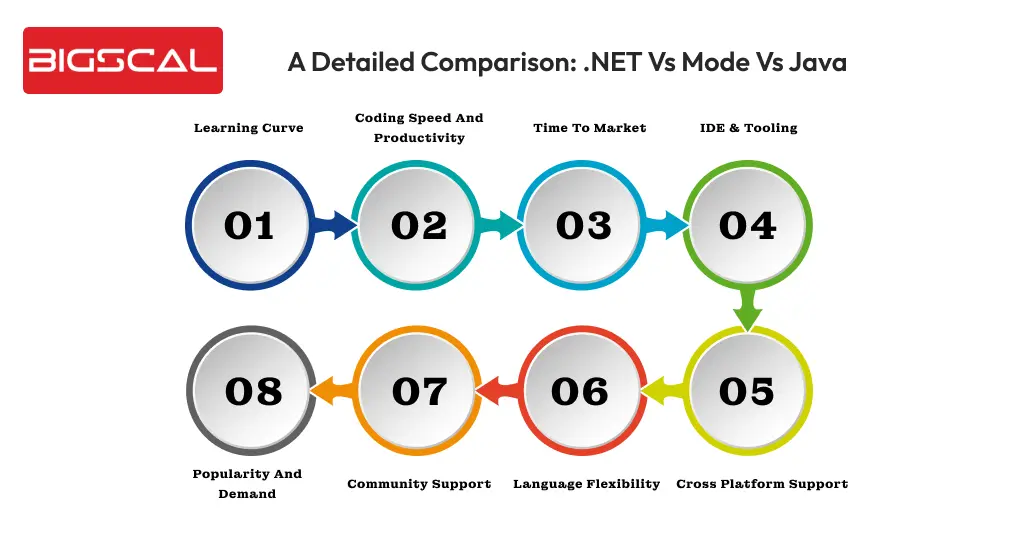
You might have by now learned about the basics of all three of these platforms. Let’s now move to compare their advantages and usefulness to make your choice easier.
Learning Curve
Because of JVM ideas and verbose syntax, Java has a steep learning curve.On the other hand .NET is easier to learn due to its clean syntax and strong tools. Node JS is the easiest choice for beginners to learn as it employs JavaScript but async patterns need additional practice.
Final Verdict: If you want to go easy, Node js is easy to start with. And .NET provides structured onboarding while Java takes longer time but is good for enterprise systems.
Coding speed and productivity
.NET has in-built libraries, templates and features such as LINQ for enhancing speed of development. Node.js is a faster choice for prototypes and Microservices but can become complicated with large databases. Java might be reliable but slower to code due to heavy configuration.
Final verdict: .NET is the best choice for fast enterprise development, Node is great for quick builds and Java is slower.
Time to market
Java has configuration with heavy setup and slower releases. Node.js provides rapid building with deployment. .NET software development provides faster delivery with the help of templates, Azure functionality and smooth integration with DevOps.
Final verdict: .NET and Node js provided faster results. Additionally .NET is a stable choice for enterprises.
IDE & tooling
IDEs provided by Java are powerful but they need more time to set up and use. On the other hand Node.js uses lightweight editors such as VS code. And at the end .NET has the best and strongest IDE ecosystems with Visual Studios and VS Code.
Final verdict: .NET is the top and ultimate choice for tooling and developer experience.
Cross platform support
Java is designed to perform across various platforms through JVM. While Node.js can perform across all different OS systems. .NET core or .NET 8 provides cross platform development but its tools still rely on windows.
Final verdict: Java is the top choice for cross platform support but .NET has shown certain improvement.
Your next project starts here.
- Faster and cleaner development
- Tailored engineering support
Language flexibility
Java primarily employs Java in combination with Kotlin, Groovy, Scala and more. Node works with JavaScript and Typescript. .NET supports 20+ languages that include some popular ones such as C#, F# and more.
Final verdict: In terms of language flexibility .NET wins the entire show.
Community support
Java boasts one of the largest and oldest communities while Node.js has the fastest growing open source ecosystem. Additionally .NET is backed by Microsoft and has active contributors.
Final verdict: Java is the largest, Node is faster growing and .NET is strong for enterprise spaces.
Popularity and demand
Java is the top choice for banking and government systems. Node js works great for SaaS and modern apps. .NET is continuously at the forefront due to its cloud readiness and integration with Azure.
Final verdict: Java is known for leading legacy, Node is a choice for modern web and .NET is top choice for cloud based apps.
Conclusion
Selecting between .NET vs Node vs Java comes down to your business goals, project scale and long term approach. All of these three platforms have their own unmatched capabilities but they shine in different sectors. .NET is the premium choice for enterprise grade stability, cloud readiness, robust tools, and long term maintainability. Node.js is excellent in terms of speed, flexibility and real time performance. Hence it’s great for modern applications. Java is the powerhouse and reliable framework for large scale, secure and mission based apps. Additionally .NET maintenance services are easy to access and can be extremely beneficial for long term saving.
Rather than seeking what’s the best choice, as a business owner you must ask which one works best with my project roadmap, team skillset and future needs? When you match it correctly with these aspects it can ensure sustainable growth of your enterprise.
FAQ
Which is better for enterprise software, .NET or Node.js?
Although both are strong choices, .NET is generally preferred for enterprise applications due to its strong security and cloud readiness. Node.js is a great pick for lightweight and highly scalable apps.
Is .NET faster than Node.js?
For CPU-intensive workloads, .NET often delivers better performance. For I/O-heavy or real-time applications, Node.js is usually more efficient.
Which tech stack is more cost-effective: .NET or Node.js?
Both are free and open-source. Node.js often enables faster development with smaller teams, whereas .NET can reduce long-term maintenance costs.
Which is easier to learn: .NET, Node.js, or Java?
Node.js is typically the easiest for beginners. .NET has a moderate learning curve, while Java is more complex due to its large ecosystem.
Which technology scales better for high-traffic applications?
Node.js handles concurrent users exceptionally well. .NET scales strongly for enterprise-grade systems, and Java excels for large, long-running, high-load applications.
Which is more suitable for microservices?
Both .NET and Node.js are excellent for microservices. Node.js offers lightweight deployment, while .NET provides long-term security and stability for complex architectures.
What should I pick for cloud-native development: Node.js or .NET?
.NET integrates seamlessly with Azure and other major cloud platforms. Node.js is lightweight and well-suited for containerized cloud applications. The best choice depends on your cloud strategy.
Is Java still relevant for enterprise applications?
Absolutely. Java continues to be a top choice for banking, finance, telecom, and large enterprise systems thanks to its stability, strong security, and robust JVM ecosystem.
Which stack offers the best long-term support?
All three have large communities. Java and .NET are well-known for strong enterprise-level long-term support, while Node.js benefits from rapid open-source innovations and frequent updates.
What is the best overall choice between .NET, Node.js, and Java?
Choose .NET for secure, cloud-ready enterprise apps; Node.js for fast, scalable, real-time applications; and Java for mature, stable, and high-load enterprise solutions.