
.NET vs Python: Which Is Better for Enterprise Projects?
Quick Summary: In this blog we will analyze .NET vs. Python to help companies decide on which technology to use to have high-performance and scalable applications. It splits significant differences in applications, scalability, security and performance. You will find out the best use of Python in data-driven and AI projects, and where.NET is most useful in corporate systems. When it comes down to it, companies can make a confident and goal-oriented decision regarding technology.
Introduction
Choosing the best tech stack for enterprise application development can lay a huge impact directly on reliability, growth and operational efficiency. Additionally businesses that manage high volumes and demand higher efficiency have to select the technology wisely to strengthen performance and avoid limiting scalability. Among plenty of options, .NET and Python are rising stars and leading yet contrasting choices.
.NET development services are ideal for large scale businesses and have the trust of many fortune 500 companies. It lays emphasis on best performance, security, and structured development. Hence it is an ideal choice for an enterprise application that is a complex, long term enterprise system.
On the other hand Python is used for its reliable syntax and rapid development. Hence it is a good choice for data driven systems, automation and AI based projects. So which one to choose among .NET vs Python? Hence understanding these differences can help organizations choose the most suitable platform. Let’s start our journey to uncovering these two platforms.
Understanding .NET framework
Microsoft came up with NET, which is an open source and flexible development platform. It allows programmers to develop diverse applications. Moreover it supports a wide range of programming languages, libraries, and tools. In 2002, Microsoft released .NET where scalability and flexibility were heavily emphasized. Hence it is easy these days to make enterprise grade, desktop, mobile and web applications, and there is ease in production by the developers. One of the key benefits of .NET is multilingual support. Apps can be built in Visual Basic, C#, or F#, with the choice of language depending on the needs of a project being developed by a specific team.
This flexibility ensures maintenance for a longer term. Also, there are good frameworks in the .NET which facilitate creation of applications. Although Xamarin can allow developers to make native mobile applications based on the use of a single codebase, frameworks such as ASP.NET can help a developer create high-performance online applications.
These structures make the entire productivity higher and the development period reduces. Additionally the other important advantage of.NET is that it is cross-platform. Programmers can develop applications that work perfectly with Windows, Linux, and macOs without any changes in the logic. Due to such a characteristic, it is a reliable platform in modern, cloud-based and business applications of.NET.
Moreover, an effective environment is beneficial to.NET development services. The presence of high-quality libraries, innovative tools, and the energetic and open global community is all enabled through.NET development services. This environment ensures frequent updates, detailed documentations and reliable support to the developers at each level.
Select .NET when you are in need of cross platform compatibility and performance with long term scalability and strong enterprise support.
Understanding Python
Python is a high level, interpreted programming language which is best recognised for its simplicity and readability. Python was introduced by Guido van Rossum in 1991. The aim of developing this language was to focus on clean syntax and ease of maintenance. Hence Python employs indentation to structure code that enhances clarity and reduces complexity.
It supports object oriented, procedural and functional programming methods. Hence it is a great choice for different use cases. Python also has a rich ecosystem of libraries and frameworks such as Django and Flask, NumPy and TensorFlow. Developers majorly employ Python for web application development, automation, data analysis and machine learning due to its versatility and best community support.
A quick comparison between .NET and Python for enterprise development
| Feature | .NET | Python |
|---|---|---|
| Primary Use Case | Enterprise-grade applications, large-scale systems | Rapid development, data-driven and AI applications |
| Performance | High performance, compiled to IL and optimized at runtime | Slower than .NET for CPU-intensive tasks |
| Scalability | Excellent scalability for large enterprise workloads | Scales well with proper architecture but needs optimization |
| Development Speed | Moderate; structured and strongly typed | Very fast; simple and readable syntax |
| Learning Curve | Steeper, especially for beginners | Easy to learn and beginner-friendly |
| Type System | Strongly typed | Dynamically typed (optional typing available) |
| Ecosystem & Libraries | Rich enterprise and Microsoft ecosystem | Massive open-source library ecosystem |
| Cloud & DevOps Support | Deep integration with Azure and CI/CD tools | Strong support across AWS, Azure, and GCP |
| Security | Built-in enterprise-level security features | Relies more on frameworks and best practices |
| Microservices Support | Excellent with ASP.NET Core | Good with frameworks like FastAPI and Flask |
| AI & ML Capabilities | Growing with ML.NET and Azure AI | Industry-leading with TensorFlow and PyTorch |
| Enterprise Adoption | Widely used in finance, healthcare, and government | Popular in startups and data-focused enterprises |
| Best Fit For | Long-term, high-performance enterprise systems | Rapid prototyping and intelligent applications |
Detailed comparison between .NET and Python for enterprise applications
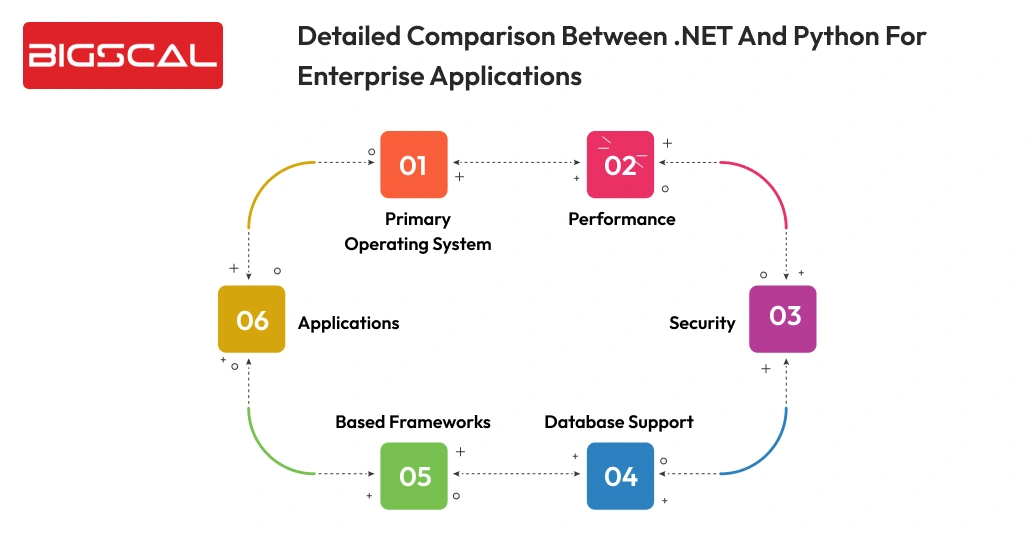
It is extremely confusing to choose one technology when it comes to .NET Vs Python. We have reviewed basic information about these frameworks and even a quick comparison so let’s understand them in detail. Here are some critical differences between these two frameworks for .NET application development.
Primary operating system
Python is one of the most flexible frameworks and a developer can use it for almost each operating system such as Windows, MacOS and even Linux. With the aid of its cross platform compatibility developers can now create and deliver programs for different environments with just few modifications. Hence it is considered a great choice for enterprise application development.
On the other hand .NET was initially limited to development for windows but now it has broadened its boundaries with the introduction of .NET core. It is a cross platform tool that is exactly the same as Python in flexibility. Hence it can now function on platforms such as Windows, Linux and MacOS.
Performance
Unlike .NET, a compiled language, Python is an interpreted language, hence it can occasionally work slowly at times. Additionally Python does not function as well as .NET when it comes to CPU intensive activities. But it is excellent for quick development and prototyping.
.NET programming language is one of the best choices for outstanding performance majorly for enterprise applications. Moreover .NET is a compiled language, hence it can operate faster and employ less memory. Businesses that are in need of high performing applications such as real time systems or services that follow more data must prefer using .NET.
Security
Python actually has some great libraries and security tools but when it comes to enterprise grade security it needs best management and implementation. Additionally it has an open source nature leading to different techniques for securing programs. On the other hand they have to update libraries more often and remain aware of dependencies to avoid vulnerabilities.
Additionally .NET is a secure and out of the box framework majorly for businesses. Microsoft provides long term security features such as integrated data protection, authentication and authorisation systems. Additionally this framework is a great choice for businesses that need stringent security rules because security patches must be released very often. .NET also integrates with other Microsoft security solutions.
Database support
Python has great support for plenty of databases all thanks to modules and frameworks. It consists of PyMongo, Django ORM, and SQLAlchemy. It ensures easier database interaction. Python provides strong support for relational databases for MySQL, PostgreSQL, and SQLite, as well as NoSQL databases. Hence it provides management and scalability of enterprise applications.
The primary technology that .NET uses for data access is ADO.NET. It has support for a variety of databases. It also works great with Entity Framework that ensures smooth database interactions in an enterprise application. Get .NET software development services from a firm like Bigscal Technologies to ensure scalability and flexibility for these large scale applications. It also ensures easy integration with MySQL, Oracle, SQL Server and different databases.
Based frameworks
The most well known feature of Python is its huge system of frameworks majorly Django and Flask. Additionally Django is a high level web framework which is best for enterprise grade applications. It is because it facilitates faster development and simpler design with lesser complexity. Moreover Flask is a framework with versatility and lightweight. Therefore it is the right choice for smaller applications or developers that need hold over individual components.
Frameworks such as ASP.NET and .NET Core are the best choice for developing enterprise grade applications. It is one of the most crucial features of .NET applications. You can also develop an application with ASP.NET’s huge range of tools and libraries for creating web pages with dynamicity and intricate web apps. Additionally .NET core’s cross platform functionality ensures that one program runs on Windows, MacOS and Linux.
Applications
Fields such as Data Science, ML and Artificial Intelligence are all prospering and all of them are using Python. Although it is a flexible option, when it comes to support and latest features for applications Python might fall short. Enterprise applications are less built with Python.
As far as .NET is concerned, it is one of the best choices for enterprise applications. You can count on developing massively multi-player apps, cloud based services, and desktop applications. It is more preferable in sectors that require reliable, safe and scalable solutions which is possible with Microsoft.
Build Smarter Enterprise Solutions with Bigscal
- Expert guidance on .NET vs Python
- Scalable, secure development
Conclusion
Making the final choice between .NET and Python will solely depend on your enterprise goals, technical requirements and long term vision. Both of these technologies are powerful, mature and widely trusted but they serve different problems. Python is an exceptional choice for rapid development, automation and AI based systems. Hence it is ideal for data based and experimental projects.
.NET stands out to be the great choice for enterprise grade performance, security, and scalability. Hence it is a strong choice for complex and mission critical applications. Businesses that handle higher workload, strict compliance and long term growth can gain more advantages. Additionally .NET maintenance services are extremely beneficial for enterprise applications. Evaluate your performance needs, scalability expectations and future plans to make confident choices. Select the technology that best supports sustainable enterprise success.
FAQs
When should I choose .NET over Python?
You must choose .NET when you want high performing applications, enterprise security and scalability for the long term.
What is the main difference between .NET and Python?
.NET primarily lays emphasis on performance, security and enterprise scalability. On the other hand Python focuses on speed of development and simplicity.
Is Python suitable for enterprise application development?
Yes Python works well for data driven applications, AI and automated systems.
Which is easier to learn .NET or Python?
Python is easier to learn as it has simpler and beginner friendly syntax.
Which technology provides better performance .NET Vs Python?
.NET delivers better and higher performance majorly for CPU intensive and real time applications.
Does .NET support cross platform development?
Yes, .NET core ensures applications can run on Windows, MacOS and Linux.
Which is more secure for enterprise use .NET or Python?
.NET provides stronger built-in security features that are best for strict enterprise needs.
Is Python good for AI and Machine Learning projects?
Yes, Python is the best choice for AI and ML with powerful libraries such as TensorFlow and PlyTouch.
Which is better for cloud based enterprise applications?
.NET integrates deeply with Azure on the other hand Python works well across different cloud platforms.
Which is more scalable for enterprise workloads .NET or Python?
.NET handles large scale enterprise application workloads more effectively and has built in scalability.