.NET Architecture & Code Review: Why It Matters
Quick Summary: Code review is way beyond just routine checkpoint, it’s the backbone of scalable and reliable .NET applications. Hence through this text we will walk you through .NET review for code and architecture. We will understand how it matters and step wise guide us to conduct them effectively. You will also get to know how to provide feedback that doesn’t feel like criticism. Fasten your seat belts to learn review strategies that will surely be helpful.
Introduction
Review is a terminology that holds great importance when you carry out different processes including building an application. There are plenty of alluring reasons that help you understand how necessary it is to carry out code review. Having a regular review strategy in your architecture can spot bugs at an early stage and make the rectification process simpler. It also ensures that .NET development services have the best coding standards with consistency.
Additionally, conducting a solid code review can be an indication towards how skillful your developer is. It is a test that requires both knowledge and management capabilities.
Through this article we will understand .NET review practices for maintaining best quality code. We will also get to know its benefits and guide you with essential steps to make the process better and efficient.
What is Code Review?
A code review is a sort of an examination carried out on the source code with a planned and systematic approach. The main aim behind this process is to spot bugs and have an estimation of the quality of code. Reasons behind the process of code reviews is:
- Enhancing practices in a manner to complete daily tasks more efficiently.
- Detecting logical errors and problems at an early stage.
- Finding and isolating vulnerabilities.
- Detecting suspicious code pieces or malwares that are integrated in the system.
It’s a beneficial practice in application development that can eliminate the hassle during .NET maintenance services. Code reviews make sure that the task is efficiently done avoiding chances of overlap or misunderstanding.
What are reasons to perform code review in a .NET application?
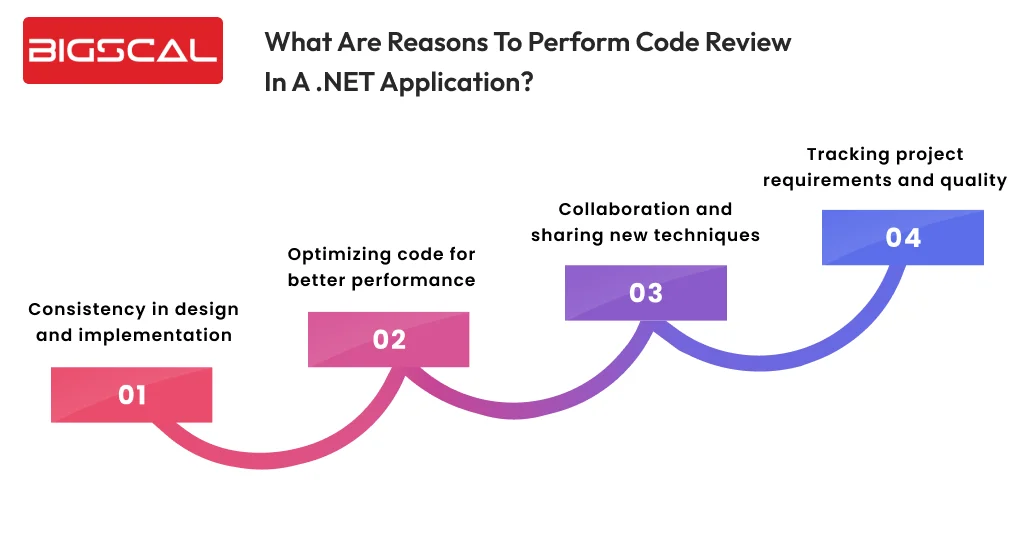
Looking for reasons to perform code review in your .NET application? Here are some of them?
Consistency in design and implementation
All developers have their unique approach towards programming. If these developers use their own style for coding this can lead to issues in collaboration and delay progress. Code reviews ensure that developers use particular coding practices. Using this approach any developer can understand source code with ease. It is valuable as team members might change throughout the development process.
Optimizing code for better performance
Many times there are chances that experienced developers might create a mistake in programming due to monotonous nature. Hence when a different person with technical knowledge reviews code units it can help cut down errors. As per source it has also been seen that formal code reviews can help detect around 60% of latent defects.
Collaboration and sharing new techniques
The majority of times developers work all alone and they are prone to making mistakes. With the code audit from providers like Bigscal you have an opportunity to learn better techniques for writing code and learn how to do it in a better way. Developers can upgrade their skills by learning regarding new technologies.
Tracking project requirements and quality
Projects have a clear scope and requirements. Additionally some unnecessary things can happen when a project needs different developers. Imaginary cloud works closely with project managers to ensure that processes are in alignment with client needs.
Code review involves a comparison of the development against its expectations to regulate a situation. It confirms characteristics that have been created. By doing so, any misinterpretation of the requirements or scope is resolved in time. It also ensures that features of importance are not neglected.
Hence reviewing of a code is a lot more than a standard check. Code reviews also improve teamwork, training, timely checking and effective development.
Upgrade your .NET code today
- Expert .NET reviews
- Reliable application development
How to conduct a code review?
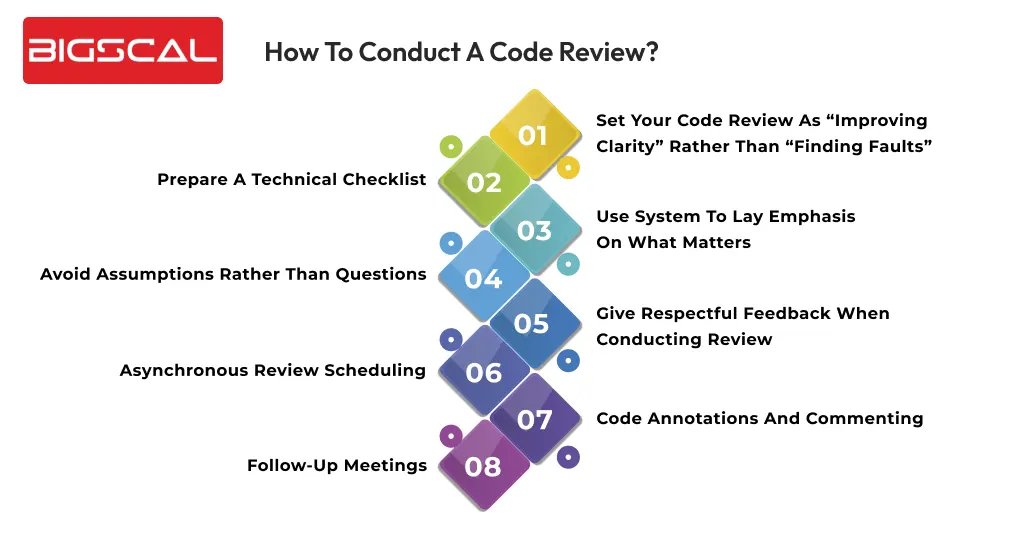
Set your code review as “improving clarity” rather than “finding faults”
The point is that before reading code, think about it in a different way. You go there not to show that the work of the other developer is imperfect. You are there to show how the code can be made simpler and easier to handle. Hence this technique changes the review of code from “ uh oh, you did something wrong” to “Wow, you are brilliant, uh, we can improve it, we will do it together.
Ultimately this can enhance the connections and the code. Next, there is the need to have a systematic plan. Therefore the most effective way is to go through in a logical way beginning with the general view, then the details and a conclusion. Further this leads you to the second step that is to follow a checklist specifically.
Prepare a technical checklist
To ensure maximum coverage, there are various technical aspects you must consider carefully when going through code. First check the functionality of the code.
“Are edge situations properly managed and does it work well with the expected inputs?”
Later move towards evaluating the architecture and general design:
“Are components logically incorporated into the existing system, follow good design principles and are well structured?”
Readability is crucial since the code is read much more often than it is produced. So think about:
“Would your peers instantly grasp the objective of the code without having to do much cerebral dissection?”
Additionally you must ensure that it has sound error handling capability, and proper exception handling and graceful response to unplanned situations. Consider the performance impact, and examine where there are obvious bottlenecks, nonproductive algorithms, or unnecessary utilization of resources that can have a scalability effect.
Moreover focus on disregarding such security concerns as sensitive information that is exposed, injection, and input verification. Ensure that the code is in compliance with set conventions and team standards. Finally, review testability with a question:
“Does the structure of the code allow it to be easier to write detailed unit tests?”
Let’s get you a quick review checklist!
- Functionality and edge cases are covered
- The architecture and design are tidy
- The code is readable and straightforward
- Error handling is robust
- There are no obvious issues with performance
- Security issues are addressed
- Complies with team rules
Use system to lay emphasis on what matters
Your and your team’s time is precious. Hence there are just too many other things you cannot afford to sacrifice like essential debates with lame details. Routine stuff can be circumvented through automation of minor details and setting up of clear rules.
Organize your CI pipeline in .NET software development with linters and formatters like Prettier or Black. Additionally use a static analysis tool so that you will never have to discuss the line length or the way of placing braces and indents. Moreover, prepare a simple team document that describes the requirements that are good enough, what you want to have tested and what percentage of test coverage you want. Also include what makes a minor suggestion and what makes a blocking issue.
In the case of the non-blocking comments, prefixes such as [nitpick] should be used. It ensures that all the people know what requires immediate attention and what is just a good suggestion. Here are few simple steps to use:
- Lay emphasis of review time on logic rather than style.
- Ensuring formatting is automatic with the help of Linters/Formatters in CI pipeline.
- Set a bar for good enough standards.
- Ensure to use prefixes for comments such as [blocker] and more.
Avoid assumptions rather than questions
Confusion of unclear code and inept coding is a habit of code reviews. You must ask questions in case of confusion, and even understand what the developer intended in a better way. One can ask questions like I can see here that the function is not thread-safe. Will it simply be used in cases of single thread?
Hence not only can it help you not say something wrong but it also proves to the interviewer that you can read between the lines. Moreover, giving unchecked statements based on assumptions can lead to you finding things not actual problems which in the situation, they are not.
You must treat unclear code as a context gap to clarify rather than an assumption to judge.
Give respectful feedback when conducting review
How you talk to the developer is as crucial as finding out the problem. When you cater your feedback in a bad manner it can result in friction between you both or either demotivate them. Moreover, another worst thing is to leave some unclear comments for the person who made the code. It nullifies the aim with which you decided to review code. At the end due to confusion the developer will be clueless.
Hence if you want the receiver to make changes to the code you must provide them with some clear instructions. Additionally if you feel that something is extremely necessary, they must understand that from your comments.
For instance if you mention it in a review that it is just a suggestion that means you don’t emphasize that this issue must be corrected. Hence you can follow up with the comment like “ I don’t strongly feel the need for this, however you can use your experience to make a choice.” This comment helps the receiver understand that they have a free end on whether to act or not.
The main idea behind this is to ensure that you are exceptionally clear to the person you are reviewing code for. Hence this way they can understand better and don’t feel blocked. This is a crucial step when you are dealing with a remote team. This practice will also positively impact your team and enhance collaboration.
Asynchronous review scheduling
Set time slots of reviews and consider different time-zones to deliver continuous input. Additionally to ensure a non-disruptive continuity of work, consider such devices as shared calendars or scheduling software. It ensures that all people understand when they need to check and provide feedback.
Code annotations and commenting
Team members are supposed to be encouraged to comment and annotate the code or review platform immediately. Therefore this must consist of general comments, questions on specific parts of the code, and reasons why changes are being proposed. It is to encourage better understanding and discussion.
Follow-Up meetings
Establish a series of sessions during which crucial or complex issues arise following the first evaluation. To keep all on the same page, the focus of such sessions should be on clarifying the misunderstandings, agreeing on solutions, and coming up with implementation plans.
Conclusion
A strong review culture is extremely necessary for providing high quality, scalable and secure solutions in .NET application development. From architecture evaluation to reviewing code thoughtfully, every step plays a crucial role in avoiding errors, enhancing performance and maintaining long term success.
When reviews lay emphasis on clarity, logic and collaboration rather than just finding faults, teams can develop strong software and relationships. By combining a structured checklist, automation, respectful feedback, and a well planned review schedule organizations can turn it into a growth tool. .NET reviews ensure consistent quality and continuous improvement across each project.
FAQs
What is a .NET architecture review and how does it help quality?
A .NET architecture review lets you evaluate the structure.and design carefully for ensuring scalability, maintainability and long term success.
Why is code review crucial in .NET development?
It can help you spot bugs at a very early stage, maintain coding standards and improve overall readability.
How often should a .NET code review be performed?
Ideally you must perform these reviews with every pull request or any major change.
What should be checked during a .NET review?
You must check functionality, readability, performance, security and testability.
How does code review improve team collaboration?
It can encourage sharing of knowledge, better communication and mutual code ownership.
How can automation help in code reviews?
Automation can look after formatting and basic checks that lets reviewers focus on design and logic.
What is the role of feedback in code reviews?
Clear and respectful feedback can help developers in improving code quality and avoiding friction.
How does asynchronous code review benefit remote teams?
It helps revise code across time zones with flexibility without hampering development workflow.
Can regular .NET review improve application security?
Yes this can help you spot vulnerabilities, improper input handling and exposed sensitive data.
What is the difference between code review and architecture review in .NET?
Code review lays emphasis on implementation while architecture review evaluates structure and design of application.