
The Future of .NET: What’s New in .NET 8 and Beyond
Quick Summary:.NET 8 brings a fresh wave of powerful upgrades for .NET developers. From smarter data handling to stronger performance features this release can reshape how modern apps can manage data and query. Through this text we will be on a quest to explore what’s new, what’s better and how these changes will enhance your development workflow.
Introduction
Digital transformation has come a long way and each enterprise is trying way hard to stay ahead in the competition. But this is only possible when you have a scalable and robust application by your side. Demand for such applications has always been on rise. With the latest release of Microsoft, .NET 8 the scenario of such applications have changed. It has empowered developers with tools to create modern solutions. The most awaited update that is transforming .NET development services to a great extent. Also, armed with tools and functional improvement that indicates towards a brighter future.
.NET 8 is not just a simple continuation of the previous versions rather it is a particular shift in the ideology of Microsoft on how software should be modeled. It is aimed with power to resolve common worries of developers and help them innovate scalable solutions.
This blog will highlight all the key improvements in .NET 8 and what future you can expect with it. Let’s get started with the journey where we get to explore future trends of application development with one of the greatest releases from Microsoft.
What’s new in .NET 8? Exploring its features and updates
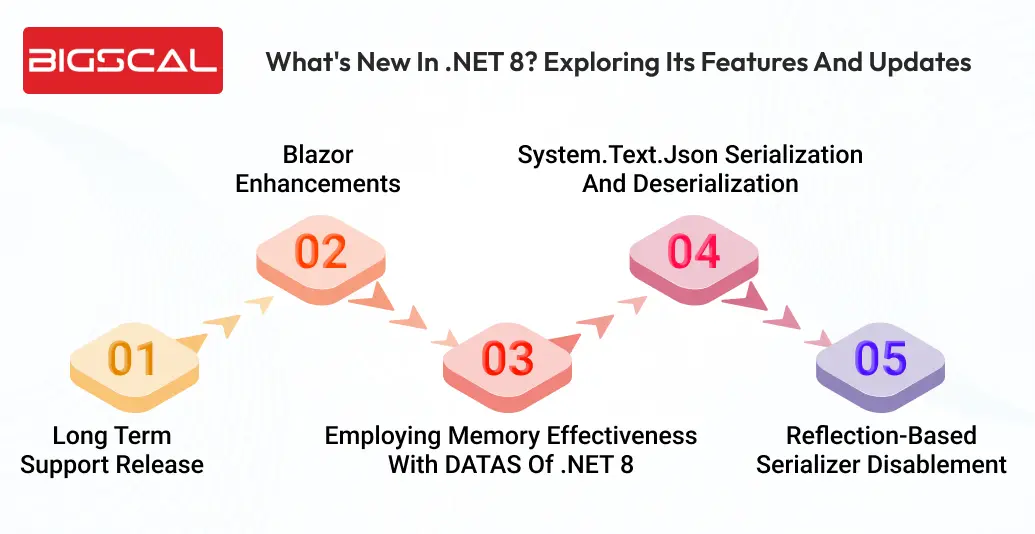
.NET 8 is the latest version after .NET 7 that brings along a bunch of enhancements in terms of performance. These are capable of accelerating development capacities of .NET app developers all through its stack that includes:
- Blazor
- .NET MAUI
- AI
- Simple coding syntax
- Garbage collection
- Leaner image container
- Core and extension libraries
.NET 8 is a strategic solution to full stack web UI development concerns that brings together the best features of .NET core and .NET basic version. Its latest release has all the features you are looking for under one roof. Let’s have a look at this .NET 8 new features and upgrades:
Long Term Support release
.NET is one of the ultimate releases in the cycle of Microsoft releases due to its LTB edition. Additionally the sequence of tabs in this version differs from the older versions in CRM. Previous version .NET 7 was implemented with Standard Term Support that might last about 18 months. .NET 8 has Long Term Support which means that it specifically will receive support from Microsoft for as long as a period of 3 years.
Series with LTS are thought to possess greater stability and less frequent issues. Hence it is the most preferred choice for complex enterprise applications that need years of .NET maintenance services. With this longer support cycle, companies can depend on using .NET 8. Receiving ordinary update patches for security, fixing bugs and updates are not mentioned in standard support.
Opt for .NET 8 LTS to ensure you are future ready. It has extended 3-year support for better reliability and lesser maintenance surprises.
Blazor enhancements
Blazor is a top notch framework that is a part of the .NET ecosystem that has come a long way and updated to a huge extent. It lays a strong base for relationships with gamers. Blazor lets you develop modern and interactive web application by using C# rather than JavaScript. When you switch to .NET 8 you get to use features of Blazor with following upgrades:
- Server side rendering streaming: With the latest .NET 8 pages can easily stream content from server to the browser. Additionally this means that the load times will get faster and clients would receive better responses. It’s an ideal choice for developing applications that need to be SEO friendly and are heavy performance.
- Faster form handling: Blazor’s upgrade in .NET 8 has made form submissions easier, simpler and efficient. It additionally can also reduce boilerplate code. All of these would eventually result in improving overall approach performance.
- Client side routing using URL fragments: Release of .NET 8 has made it possible to link to any section of the page with the help of fragments also known as #sectionID. Hence Blazor will automatically reach the correct element. It’s an exceptional choice for single page applications that have longer sections. This update makes it easier for users to scroll to different sections of pages for better usability of the website.
Employing memory effectiveness with DATAS of .NET 8
Memory management is one of the crucial fields in the software development area along with its growth. With the release of .NET 8 Microsoft has introduced something very useful known as DATAS. Its full form is Dynamic Adaptation To Application Sizes. Hence it is introduced to manage memory from a variety of workloads.
This excellent feature will let .NET 8 to adjust applications memory as per what currently is to be stored. It includes both living and temporary in-flight objects at time of collecting garbage.
- Busty workload with less memory: Apps that might have sudden increase in usage of memory specifically inside memory restricted containers, DATA can be a saviour. It can add or remove memory size to a great extent to avoid exhaustion while employing available memory in a fruitful way.
- Small workloads that use Server GC: When the workload is lesser than expected, DATA can cut down on irrelevant usage of memory. Hence it reduces the heap to adjust to the memory needs. Hence enhancing the efficient usage of resources.
Many developers generally know DATAS as “Dynamic GC” but that’s not an accurate representation for it. GC was dynamic by itself but DATAS has taken it a step ahead by adjusting behaviour of memory as per the real time need of an application.
System.Text.Json Serialization and Deserialization
Along with other system.Text.json has also received a great upgrade in the latest version .NET 8. All credit for this goes to enhanced source generators. Although it began initially in .NET core, it is now present in .NET 8. Hence it helps developers in managing reliability and resolving performance problems with the help of enhancements.
- Built in support for different data types: .NET 8 boasts extra native support for types such as memory, ReadOnlyMemory
, and byte values. This memory and ReadOnlyMemory are now categorized under Base64 strings. And other new types transfer under JSON arrays. Hence the serialisation process gets faster and more consistent. - Chainable source generators: TypeInfoResolverChain is now a part of JsonSerializerOptions which is an advancement over the older TypeInfoResolver. It can help developers link multiple resolvers. Hence it provides greater flexibility and control in customising behaviour of JSON with source generators.
- Enhanced support for Interface Hierarchies: With .NET 8 it is possible to serialize hierarchies more accurately and efficiently. It is possible through improvement in attribute support. Moreover, it has made handling complex object models more efficient.
Reflection-based serializer disablement
It is one of the most notable improvements in .NET 8. Native AOT applications have become more fast and efficient by disabling reflection based serializers. It avoids unnecessary reflection components from being present in the app. Hence, it doesn’t affect overall performance and increase memory usage.
In previous versions of .NET, these serializers developed issues such as:
- Unwanted rooting of reflection components
- Higher memory footprint
- Slower performance majorly in low memory of higher performance cases.
With the launch of .NET 8 developers can avoid these problems. Only necessary components are present that means:
- Better runtime performance
- Lower usage of memory
- More predictable AOT behaviour
Moreover, this advancement has made sure that .NET applications or Native AOT apps are lean, optimized and away from unnecessary overhead.
What does .NET 8 have for developers?
The latest version .NET 8 is fully compatible with entity frameworks core 8. Hence, it packs with all new and enhanced features that aim at surpassing expectations of developers and making productivity and application performance a top priority. Here are key improvements for a developer aiming at .NET application development:
- Better JSON Support: EF core known for add to functionality of JSON in relational databases. JSON columns can now easily work in SQLite. It is now possible for you to map and query collections of primitive types. Operations such as List. Contains can run smoothly and faster.
- Raw SQL for unmapped types: No matter if any CLR is not in your EF model with the latest update you can get return in any CLR model after you run your raw SQL queries. Hence it makes it easier to integrate with legacy systems of third party libraries.
- Better lazy loading for untracked queries: This latest release lazy loading can function more efficiently in case of untraceable DbContext Disposing only functions until DbContext.
- Native support for TimeOnly and DateOnly: No need for extra packages as SQL supports them with new updates. Hence DateOnly and TimeOnly operations are simpler and cleaner.
- Better bulk updates and deleted: Latest version .NET 8 allows bulk updates and delete options for multiple columns, owned entities and complex types. It’s advantageous for high performing data modifications.
- HierarchyId Support: EF core 8 favour “HierarchyId” for SQL server. Hence it lets modeling of data such as Org Charts, file systems, and category structures easier.
Upgrade your .NET tech stack
- Implement EF core 8 with expert help
- Boost performance and streamline your app
Conclusion
EF core 8 is a remarkable step towards how modern .NET software development interacts with data. With extensive JSON support, native handling of DateOnly and TimeOnly, enhanced lazy loading and ability to run raw SQL for unmapped types, developers now have more flexibility and way to outshine in terms of performance.
Moreover features such as bulk updates, enhanced complex type data handling, and built in HierarchyId support also makes it a best choice for future ready and scalable applications for enterprise.
As the .NET ecosystem is continuously evolving, EF core 8 stands as a reliable and efficient ORM that helps developers in creating cleaner code, reducing database overhead and developing architecture that surpasses the test of time.
FAQ
What’s new in .NET 8 and how it impacts developers?
.NET 8 includes major improvements in memory management, performance, Blazor, JSON handling, and Entity Framework Core 8—helping developers build faster and more efficient applications.
Why is Long Term Support release important in .NET 8?
.NET 8 comes with 3 years of LTS, ensuring long-term stability, security updates, and bug fixes—making it ideal for large and complex applications.
What Blazor improvements are present in .NET 8?
.NET 8 enhances Blazor with server-side streaming, faster form handling, and improved client-side routing using URL fragments—boosting performance and user experience.
How does DATAS impact memory management in .NET 8?
DATAS automatically adjusts memory as workloads change, preventing memory exhaustion during peak times and reducing wastage during lighter loads.
What's new in System.Text.JSON in .NET 8?
.NET 8 adds support for more data types, chainable source generators, and better handling of interface hierarchies—resulting in faster and more flexible JSON serialization and deserialization.
How does disabling reflection-based serializers help?
Disabling reflection-based serializers keeps Native AOT apps lightweight, boosts performance, reduces memory usage, and removes unnecessary reflection overhead.
What enhancements does Entity Framework Core 8 bring?
EF Core 8 includes improved JSON support, raw SQL for unmapped CLR types, enhanced lazy loading, TimeOnly/DateOnly support, faster bulk operations, and HierarchyId support.
How does .NET 8 enhance full-stack development?
With Blazor upgrades, .NET MAUI improvements, AI integration, simplified syntax, GC enhancements, and faster container images, .NET 8 provides a unified and powerful full-stack ecosystem.
Is .NET 8 suitable for building future-ready enterprise applications?
Yes, .NET 8 is future-ready thanks to its LTS support, performance upgrades, memory optimization, and modern development tools for scalable enterprise solutions.
Does .NET 8 improve application performance?
With improved garbage collection, leaner container images, enhanced AOT performance, and faster JSON processing, .NET 8 significantly boosts application performance.