
Top Security Best Practices for .NET Applications
Quick Summary:In this day and age, giving applications the necessary security has become important. .NET applications store and transfer sensitive data on a daily basis. And failing to secure applications can result in serious consequences such as data leaks, disruptions in business, damage to the image and financial losses. Hence to avoid such risks you must follow .NET security protocols to guard against online attacks. Are you curious about the best ways to guarantee the security of your application? Be with us till the end and we will together explore best strategies for ensuring security of .NET applications.
Introduction
Cyber threats are no longer a concern for only larger enterprises. It is because today even small applications that connect to the internet have a potential inclination towards these attacks. .NET development services empower everything from applications to customer facing platforms. Hence ensuring security is a critical responsibility rather than a thought saved for later. Having a single overlooked vulnerability can expose all sensitive data, trouble operations and erode user trust within a few minutes.
Hence to develop a software that is resilient, developers must think beyond basic features and ensure that security is present at each layer of .NET application. From secure coding practices, data protection, authorisation to testing and monitoring, right security practices can eventually lessen risk of these attacks. In this blog we will help you walk through the top 10 .NET security best practices that can ensure your application is free from modern threats and provide reliability, compliance and long term stability.
Top 10 .NET security strategies to protect your application
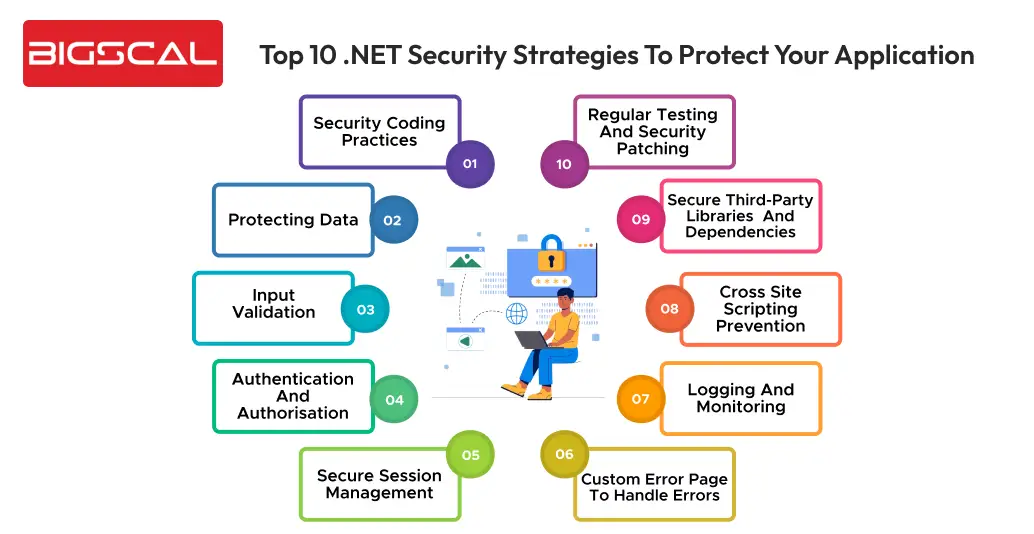
Through this section we will try to discuss certain best practices for .NET software development best practices for security. It will help your application stay protected from vulnerabilities and malicious acts. Hence you can prevent your sensitive information from falling into wrong hands.
Security coding practices
When you follow best practices for secure coding and its guidelines it can eliminate chances of common security issues in .NET applications. Developers ought to ensure strict input validation along with data sanitization at each point. It helps them to block cross site scripting attacks before a malicious script reaches the browser. Teams can also make use of parameterized queries in combination with stored procedures to avoid dynamic SQL execution that further avoids injection attacks.
Organizations must take responsibility for updating and patching the .NET framework, NuGet packages and dependencies. Hence it can actively protect against new vulnerabilities. Conducting continuous security investigation, automated scanning of vulnerabilities and dependency audits can provide protection against increasing threats.
Protecting data
Safeguarding confidential information is one of the best ways to gain user confidence and meet strict data regulations policy. Hence for this purpose the development team must avoid storing this critical data in readable form. Rather they can apply cryptographic methods to protect it from any unauthorised access. They must also use advanced encryption and secure hashing algorithms to ensure that information is safe during storage and transmission.
Organizations must also look forward to applying HTTPS across all endpoints. It guarantees that encrypted communication takes place between client and server teams. They must also use HTTP Strict Transport Security to avoid block protocol downgrade attacks. Hence it ensures that browsers only connect through secure methods.
You must never hardcore encryption keys or secrets in application. If keys are exposed it can directly expose encrypted data and result in serious compliance violations.
Input validation
User input validation is the key to the creation of secure web applications, particularly those based on in.NET. Certain risks such as SQL injection and cross-site scripting and other injection based attacks can also happen to applications as a result of poor validation or inconsistent validation. Hence to stop malicious modules before processing occurs, the developers have to authenticate, sanitise and filter all the incoming data at all points of contact. In order to impose strict input requirements across the application, the teams ought to use .NET provided input validation methods such as server-side validation pipelines, data annotation features.
Authentication and authorisation
Development teams should ensure to establish effective authentication systems. It helps protect user accounts and application resources. Additionally to reduce the chances of losing credentials, organizations must have strict password policies to ensure that are long, complex, and changed regularly. You must use multi-factor authentication to verify passwords at an additional level in order to make them more difficult to crack.
Moreover, to support the flow of safe, scalable, and standards-based authentication processes, developers may integrate cloud-based identity providers based on OpenID Connect and OAuth 2.0.
Engineers have to construct role-based access control (RBAC) to accurately establish the user privileges. Additionally, it guarantees that the protects functions and authorized users access anytime. Systems ought also to have account lockout policies as well as CAPTCHA challenges.
Secure session management
The applications should generate session tokens that are not highly predictable and with a well-known expiration time. It minimizes chances of abuse. Additionally the development teams advise to ensure that users are made to recheck their identity in the case of sensitive session activities and stringent session timeout policies.
The systems should be based on the use of the SSL/TLS protocols which will ensure that all communications between the clients and the server are encrypted and that the session data should not be intercepted. configure secure cookies that use HTTP-only session cookies , preventing access by unauthorized people and reducing exposure to cross-site attacks. Moreover, the applications should also automatically shut down idle or abandoned connections. And, ensure that attackers do not use idle connections.
Custom error page to handle errors
You can configure custom error pages to ensure that your .NET applications are capable of preventing the accidental disclosure of the confidential internal information, including stack traces, server paths, and metadata of the framework. Moreover, developers need to manage the risks of information leakage that may be utilized by a thief by substituting default error responses with managed sites.
Additionally well-designed error panels must have simple messages that anyone can read easily and outline the problem avoiding technical information. Centralized monitoring and structured error logging should also be established. It allows the teams to have comprehensive exceptions information to debug and troubleshoot. Hence under this approach, programmers able to diagnose issues for .NET maintenance services successfully without jeopardizing the security and robustness.
Logging and Monitoring
Logging and monitoring are necessary in order to enhance the security postures of .NET application development. In order to continuously capture the events of an application, development teams include reliable logging systems . For support incident analysis, the systems should have detailed activity logs. These must accurately capture user actions, system behavior, and execution environment.
Security personnel should access these records and monitor them frequently in order to identify odd trends, illegal access attempts or policy violations. Also, it proactively monitoring of logs will help companies minimize the scope and impact of any security attacks.
Cross site scripting prevention
Cross-site scripting attacks pose a critical threat to the current web-based applications and often attack the loosely secured input and output streams. To avoid the XSS threats, developers should use code-based and sanitization of all untrusted data to render it in the UI.NET has inbuilt security options like HTML encoding and other essential libraries.
A powerful Content Security Policy (CSP) should also be enforced by the teams to limit the permitted sources of content and block inline or injected scripts. This multi-level defense has a huge impact in terms of minimizing exposure to XSS and other vulnerabilities of injection.
Secure Third-party Libraries and Dependencies
Dependencies on third parties may unintentionally produce security vulnerabilities in .NET applications provided that teams treat them recklessly. To minimize supply-chain risks, development teams must only choose libraries that are well-maintained and reliable to minimize the risks. Engineers are required to conduct a review of security advisories, and release notes. Additionally, vulnerability disclosures of every external framework to determine the known issues prior to integration.
Teams ought also to reduce the dependency usage by ensuring that only the component that is related to the application functionality is included. This discriminatory practice minimizes the total attack area and the exposure of the third-party vulnerabilities.
Regular testing and security patching
The teams need to conduct vulnerability tests, penetration tests, and formal code reviews on a regular basis to identify security vulnerabilities and points where intruders can enter the system. Security teams should regularly examine application activity to find vulnerabilities before attackers exploit them.
In order to protect applications against any vulnerabilities, it is important that the developers have the latest versions of the .NET framework, third party libraries and dependencies. In efforts to ensure a strong and resilient .NET security posture, organizations must ensure that they update their development environments on a regular basis, and apply the latest security patches.
Develop your .NET application with best security practices today.
- Prevent cyberthreats
- Better compliance and safety
Conclusion
Securing .NET applications these days is not an optional task due to increasing threats in the digital landscape. Applications tend to handle a huge amount of sensitive data and even critical business operations. Hence adopting strong .NET security practices has become extremely essential. It helps you prevent downtime, breaches and financial losses. You must follow secure coding practices, protect data with the help of encryption, get strict authentication and authorisation policy and validate user inputs. The attack surface might be greatly decreased by all of these.
Along with this secure session management, better error handling, continuous logging and monitoring and selecting third party dependencies carefully is necessary. Regular testing, timely patching, and framework updates guarantee that the application is safe from attacks.
FAQ
How can I make my .NET application more secure?
You can secure your .NET application by following secure coding practices, validating inputs, encrypting data, implementing proper authentication and authorization, and keeping all dependencies up to date.
Why is .NET security important for modern applications?
.NET applications often handle sensitive business and user data. Weak security can result in data breaches, financial losses, legal issues, and reputational damage.
What are the most common security risks in .NET applications?
Common security risks include SQL injection, cross-site scripting (XSS), insecure authentication, poor session management, and vulnerable third-party dependencies.
How does input validation enhance .NET security?
Input validation blocks malicious data before it is processed, helping prevent SQL injection, XSS attacks, and other injection-based vulnerabilities.
What role does encryption play in protecting applications?
Encryption protects sensitive data both in transit and at rest, ensuring attackers cannot read or misuse the information even if it is intercepted.
Why should I use HTTPS and HSTS in a .NET application?
HTTPS encrypts communication between the client and server, while HSTS forces browsers to use secure connections and prevents downgrade attacks.
How does multi-factor authentication enhance .NET security?
Multi-factor authentication adds an extra layer of verification, significantly reducing the risk of unauthorized access even if credentials are compromised.
How can secure session management prevent attacks?
Using secure tokens, session timeouts, SSL/TLS encryption, and HTTP-only cookies helps prevent session hijacking and unauthorized access.
Why should a .NET application have a custom error page?
Custom error pages prevent exposure of sensitive system details while still delivering clear and user-friendly error messages.
How do logging and monitoring improve .NET security?
Logging and monitoring help detect suspicious activities early, enabling faster response and mitigation of potential security threats.