Using ML.NET to Bring AI into .NET Applications
Quick Summary: AI is no longer a luxury aspect of modern apps, but a necessity. This blog describes the way the ML.NET enables AI and machine learning to go seamlessly into the .NET environment. Additionally it discusses the basic backgrounds and the finer execution. Also, the extended considerations of developing smart, scalable .NET applications that are able to suit shifts in the business needs.
Introduction
The main forces behind modern software development are artificial intelligence (AI) and machine learning (ML). Hence these technologies are no longer restricted to research laboratories or a big business organization. Moreover they are very much accessible with a powerful framework such as .NET. This development helps businesses of all sizes to embrace smart solutions by way of trustful .NET development services.
Additionally the reason that makes .NET the best solution for AI and ML integration is they are stable and flexible. It also boasts a vast ecosystem of libraries and tools. It can be used together with AI and ML to provide developers the capability of creating smart and data-silent applications. It’s capable of automation, intelligence, and improved user experiences.
The organizations can easily incorporate the intelligence into their applications in an organized manner. By means of the expert .NET services, it enables the companies to deliver scalability and performance. This blog will discuss the ways of successfully integrating AI and ML in the .NET system to build solutions that are future-ready.
How can you integrate ML.NET to bring AI into the application?
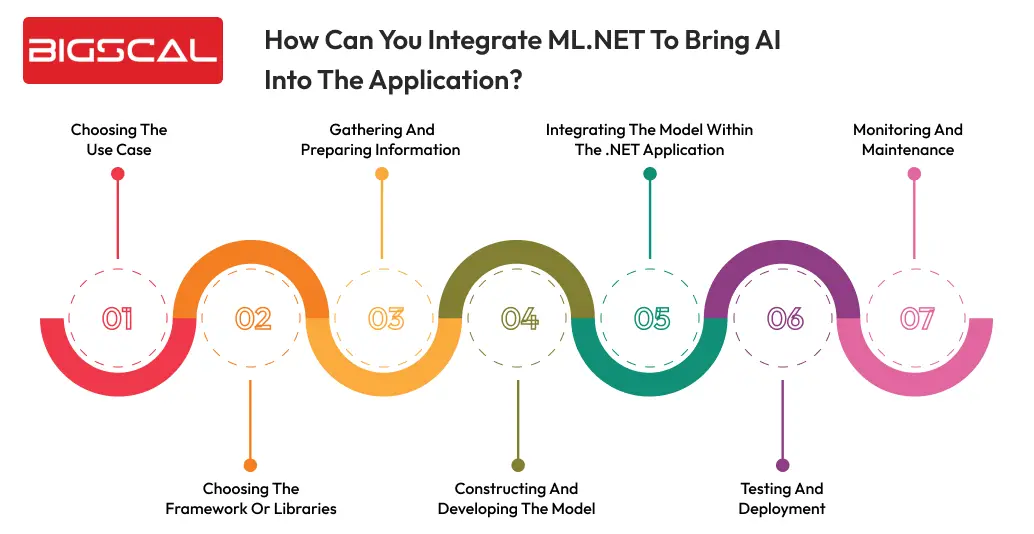
There are several processes involved in integrating AI and ML into a.NET framework. This section explains some of the most important aspects in the process.
Step 1: Choosing the use case
The first and most primary step in using Ml.NET to introduce AI is selecting the particular use case . It enables the opportunity you want to grab. Moreover it could be anything from just bringing automation to a simple business process or adding to the user experience with personalized recommendations. Hence at the end the right approach is to select the use case that matches your business goals and provides better results.
Step 2: Choosing the framework or libraries
As now you have completed selecting the use case the coming step is to decide appropriate AI/ML framework. Additionally the choice might vary as per different factors such as complexity, availability of the data and particular need of your .NET application. Here is a list of best picks:
- ML.NET: It is a machine learning framework which is an ideal choice for .NET developers. Additionally, it guarantees a broad range of tools for developing, honing, and implementing ML models.
- TensorFlow.NET: It is a binding framework for .NET software development. Hence it is the best option for incorporating deep learning models into.NET applications.
- Accord.NET: A comprehensive framework with many tools and algorithms for statistical analysis, computer vision, and machine learning.
Step 3: Gathering and preparing information
Data is one of the crucial parts of AI and ML. The data that you have and its quality and quantity will highly impact the performance of AI/ML models. Moreover the collection of data comprises:
- collecting all pertinent and essential information from many sources.
- processing and cleaning the data.
- getting it ready for model training.
This step is extremely essential for ensuring that the model is accurate, reliable and capable of making informed predictions.
Step 4: Constructing and Developing the Model
The next step after data is prepared is building and training of the AI/ML model. It involves the selection of the appropriate algorithms, adjusting of hyperparameters, and training of the model until the desired level of accuracy is achieved. Hence the time of this step may be considerable and require a significant amount of processing power. In the end, everything depends on how complicated the model is.
Step 5: Integrating the Model within the .NET Application
You must deploy a model using the.NET application once trained. This is done by incorporating the model into the application programming and ensuring that it is able to communicate with the other components. Additionally ensure that it is configured to process either a batch of data or real-time data. The integration phase may require custom code, APIs, middleware, etc. to facilitate easy communication between the application and the AI/ML model.
Step 6: Testing and Deployment
In order to guarantee that the application functions as intended and the integration is successful. Therefore, before releasing AI/ML-enhanced.NET applications, it is crucial to thoroughly evaluate them. This encompasses ensuring that the application meets the requirements of performance, security, or usability and testing AI/ML models in terms of accuracy, reliability, scalability. Hence when testing is completed, users can deploy the application.
Step 7: Monitoring and Maintenance
AI and ML models should be continuously monitored and improved to guarantee optimal performance. Additionally, this entails verifying the accuracy of the models, detecting any drift or decline in performance, and retraining the models as necessary. Therefore, it is crucial to update the software in order to keep the AI/ML models and the.NET application up to date with changing business requirements and technological developments.
Prominent .NET Frameworks and AI/ML Libraries
Several frameworks and tools that make it easier to incorporate AI and ML into applications are offered by the.NET ecosystem. Hence lets learn the most well-known .NET frameworks and AI/ML libraries that developers can use to create clever, data-driven solutions are discussed below.
.NET Frameworks
Several frameworks and libraries that allow developers to incorporate AI and ML into applications are available and are mentioned below as the most popular ones in the.NET ecosystem.
- .NET Framework
The .NET Framework is a stable and mature platform that has been decades old in the .NET application development for Windows. Moreover it also has numerous tools, libraries, and services. Hence this is why it is a good option to incorporate AI and ML into the legacy applications.
- .NET Core
Programmers can make Windows, Linux, and macOS applications with the aid of the open-source, cross-platform framework .NET Core. Thus it is the most appropriate when it comes to modern applications that require AI/ML features due to its modular design and performance improvements.
- ASP.NET Core
An API and web app development framework is known as ASP.NET Core. ASP.NET Core is a useful product to integrate AI/ML models into web-based applications due to its support of cloud-native applications and modern web standards.
AI/ML Libraries
- ML.NET
ML.NET is a machine learning framework that was designed specifically to support programmers in the.NET platform. Therefore it provides a user-friendly API to make, hone, and deploy machine learning models. The techniques that ML.NET offers are regression, classification, clustering, and recommendation, among other techniques, and thus integrate AI/ML.
- TensorFlow.NET
TensorFlow.NET, a.NET binding of the widely used machine-learning framework TensorFlow, exists in the world. TensorFlow.NET provides developers with powerful capabilities of deep learning in.NET applications. Moreover some of the many neural network topologies that it supports include convolutional neural networks (CNNs) and recurrent neural networks (RNNs).
- Accord.NET
Accord.NET is a full-fledged platform of statistical analysis, computer vision, and machine learning. It offers numerous tools and techniques that are used in the development of AI/ML models, such as regression, classification, clustering, and dimensionality reduction support, only to mention a few of them. Additionally Accord.NET is especially useful for algorithms that require sophisticated statistical analysis or image processing capabilities.
- ONNX Runtime
ONNX Runtime is a high-performance, cross-platform scoring engine of Open Neural Network Exchange (ONNX) models that can be used by developers to execute AI models in.NET applications, an open-source standard to represent models. Additionally, ONNX Runtime is an ideal solution to deploying AI models into production because the system is optimized to perform well and can run on multiple hardware accelerators.
- SciSharp STACK
SciSharp STACK is a collection of.NET frameworks providing machine learning and data analysis applications as well as scientific computing. Libraries present in the stack are TensorFlow.NET to implement deep learning, NumSharp to perform numerical operations and Keras.NET to implement a high-level neural network API. Hence it is a powerful developer kit that can be used by developers who wish to use familiar.NET syntax to build AI/ML models.
Overcoming Challenges in AI/ML Integration with .NET
Data Security and Privacy: Data security and privacy is a significant challenge that has to be considered when incorporating AI and ML in.NET applications. Moreover AI/ML models often require access to delicate information, such as bank data or records of a client. Therefore developers should use strong security measures, such as encryption, access limits, and secure data storage, to safeguard sensitive data.
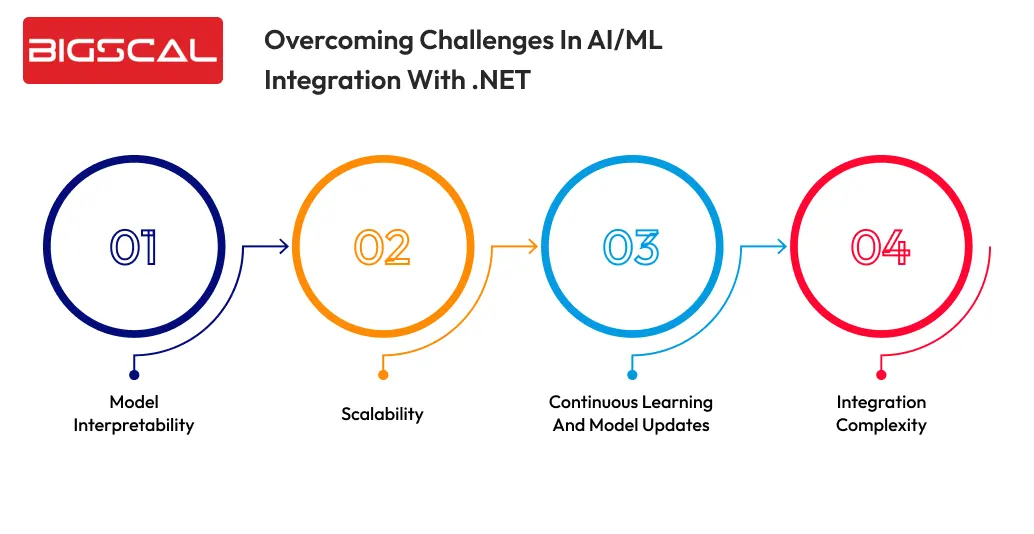
Model Interpretability
The other challenge is to ensure that AI/ML models are transparent and understandable.Complex models such as deep learning networks may be hard to understand and explain. Eventually developers ought to strive to develop models that are realistic and easy to understand in order to enable people to know about the decisions made.
Scalability
The issue of scalability arises when AI and ML models are implemented in production. It is crucial for developers to make sure that their .NET applications can manage high traffic and massive data volumes without experiencing performance issues. Hence this may involve cloud-based services, distributed computing frameworks, or model optimization.
Continuous Learning and Model Updates
To keep AI and ML models accurate and up to date, teams must update them regularly. Developers must implement methods to track performance and identify drift through model performance monitoring, drift detection, and retraining. Hence, teams must use automated technologies along with human oversight to ensure that models continue to perform well over time.
Integration Complexity
Adding AI and ML to existing.NET applications can be challenging, especially when working with older systems. Moreover to minimize disturbance and ensure that the AI/ML models work effectively with the current codebase, developers should carefully consider the integration process. Therefore refactoring the code, creating unique APIs, or creating middleware that allows components to communicate with one another are some examples of this.
Create smarter .NET solutions with Bigscal
- AI powered ML.NET expertise
- Reliable .NET development and maintenance services
Conclusion
To sum up, you can use the .NET ecosystem to develop more intelligent and flexible solutions by adding AI and machine learning to apps with the help of ML. Additionally, the stability and flexibility required to introduce AI into apps with ease are provided by the .NET ecosystem. Moreover each of the stages, including the choice of the perfect use case up to the implementation, is the key to success in the long term.
However, once the program is launched, the implementation of AI is not stopped. Hence the accuracy and performance dictate that it has to be continuously monitored, tweaked, and upgraded. To guarantee the further scalability of AI-powered apps, their safety, and compliance with evolving business requirements over time, reliable .NET maintenance services would also become essential.
FAQs
How can .NET developers integrate AI models easily?
.NET developers can integrate AI models with the help of ML.NET and different compatible libraries. Hence it allows model training, deployment and direct consumption within .NET applications.
What is ML.NET and why is it important?
ML.NET is a machine learning framework designed for the .NET ecosystem. Hence it allows developers to create, train, and deploy AI models without leaving the platform.
Which AI/ML libraries work best with .NET applications?
There are some exceptional options such as ML.NET, TensorFlow.NET, Accord.NET, ONNX Runtime, and SciSharp STACK. However you must choose depending on the project’s complexity and requirements.
What types of applications can benefit from ML.NET?
It is the best choice for applications such as recommendation systems, fraud detection tools, sentiment analysis platforms, and predictive analytics systems.
Is ML.NET suitable for large-scale enterprise applications?
Yes, when paired with appropriate architecture, ML.NET can provide scalable and high-performance AI solutions. Hence making it appropriate for enterprise-grade.NET applications.
What are the key challenges in integrating AI with .NET?
Data security, model interpretability, scalability, integration complexity, and ongoing model maintenance are common issues.
How important is data quality for ML.NET models?
Data quality is extremely necessary. Hence having clean, relevant and well prepared data can impact the reliability and accuracy of ML.NET models.
How can businesses maintain AI models after deployment?
To maintain the accuracy and efficacy of AI solutions, businesses need to continually retrain models, detect data drift, and evaluate model performance.
Is ML.NET suitable for deep learning projects?
ML.NET supports deep learning through integration with TensorFlow.NET and ONNX model formats.
How can AI models be scaled in .NET applications?
Cloud services, containerization, and efficient model execution within .NET apps can all help achieve scalability.