
Why Startups Choose .NET to Build Scalable MVPs?
Quick Summary:This blog will explore why . NET for startups is a strong and recommendable choice to develop scalable and cost effective MVPs. It will take you through what MVP is, why it matters for startups at an initial stage and how .NET can help speed up development without compromising on performance. Additionally you will also get to view a step by step approach towards building and scaling MVPs using .NET framework.
Introduction
Startups have always been a tense thing to manage and the majority of them tend to fail. It is not because of the lack of ideas rather it’s due to poor execution, slow launches and development of products that don’t scale. Rather than opting for deployment of full scale products it’s always a good choice to opt for MVP. It doesn’t only save time and money but let you gain insights on what users like.
Additionally when you opt for MVPs it’s necessary you choose the technology wisely. Opting for technologies that scale can make your tasks easier and efficient. .NET development services is one such technology that can scale with passing time and increasing needs without the need of rewriting entire code.
Through this blog we aim to explore why startups must choose .NET to develop scalable MVPs. How it can support rapid development and how it can help founders to validate their ideology without locking themselves in a fragile architecture. If you are thinking of developing an MVP that can turn into a full scale product, this guide will tell you why .NET for startups is a smart and futuristic choice.
What is an MVP?

MVP stands for Minimum Viable product that is the simplest form of a product which has solely primary features which can resolve customer issues or meet their needs. This type of software is designed for quick launch, seeking feedback from real users and validating assumptions. Hence it lets teams create an exceptional solution while consuming lesser time, money and risk. Let’s dive deeper into knowing MVPs for startups:
- MVP in software development is for development of basic and functional solutions which you can test in the real world.
- It is ideal for startups to experiment their ideas before investing huge amounts into full scale development.
- Custom MVP services will let you develop clean, scalable and user centric solutions.
- The main aim to develop MVP is to gain knowledge from real users at an early phase and employ it as a guide for future development purposes.
- MVPs are the best choice for testing if the product is best fit for market or not, reducing development costs and enhancing time to market.
The main aim behind development of MVP and other methods is:
- Ensuring that your assumptions are valid or not.
- Check if the product is right for the market.
- Avoid chances of overspending money and overcomplicating infrastructure.
By initiating early launch and gaining knowledge from real users, startups can make development decisions faster, lessen risks and create results that people actually desire. It’s not launching a small setup rather making smart improvements.
Build your MVP faster with Bigscal
- Scalable .NET solutions
- Startup focused development
Why is MVP necessary for a startup?
Startups are generally tight when it comes to budget, time and focus. It is estimated that about 90% of startups fail due to not being able to fit in the market, misuse of resources and lack of demand. Hence MVP development is not all about efficiency rather it’s about necessity. When you launch a solution only with necessary features you can have control over resources used, test as soon as possible and lessen the chances of failure in future. Here’s what startups can expect from MVP:
Savings in terms of resources and time
MVPs can help you cut down on the time and money spent on developing unnecessary features in a software. Hence this approach ensures that you validate your ideas before you heavily invest into it. It’s always a wise idea to have a gradual approach towards development rather than investing completely at once.
Seek early market feedback
MVPs as mentioned can reduce the timeframe spent on developing a software. Hence it takes less time to be launched into the market. You can receive instant feedback and make adjustments before it’s too late. MVPs are generally aimed to learn fast where you build on the basis of facts, data and not assumptions.
Faster time to market
An MVP can be presented to your users at a very fast pace mostly in a week or two. Hence it can help you gain access to the ideology of users. Early launch in the market can help you check efficiency of your ideas, user concerns, outshine competitors and create awareness. The fast you launch your solution, the faster you would be able to progress.
Gain sight from early adopters and investors
When you have a working MVP rather than just a plan it can catch more attention. It shows your progressive mindset to adopters and investors. Hence it can help you gain a win over users and attract the best investors. Your real world results will tend to gain more trust than having a presentation.
Understanding MVP Development with .NET
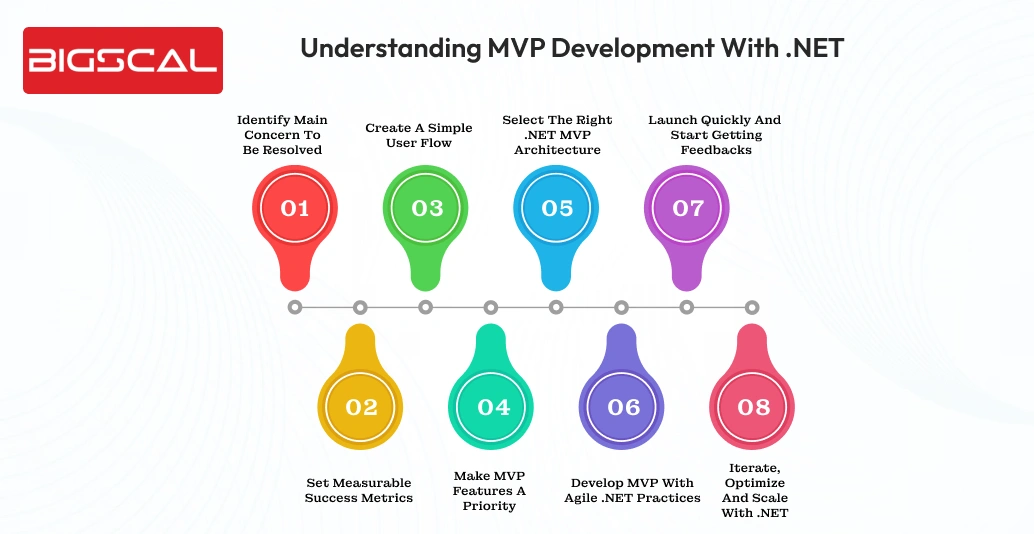
By now you might be aware of what MVPs are and why they are crucial approaches for startups. So now let’s explore a step by step guide for development of MVPs with .NET technology. No matter if you have an in-house team or a partner that will look after MVP development, this guide will help you launch a clean, scalable and lean solution. Let’s learn how to balance cost, time, learning and speed alongside development.
Step: 1 Identify main concern to be resolved
For the first step you must validate the concern of your business that you can sort out with lightweight .NET application development. Before you decide on a particular pain point you must consult with some experts, founders, users or domain specific people. ASP.NET core is an exceptional technology to spin up APIs or web apps for testing ideas without huge investments.
Step: 2 Set measurable success metrics
Before you start the process of MVP development you must be sure about your ideology of success. This KPI guide for .NET MVP will help both the development process and iteration. Common KPI metrics that you can take help from are:
- Usage of API or endpoint hits
- User signups and active sessions
- Feature-level telemetry via Application Insights
Step: 3 Create a simple user flow
By now you must be clear with an idea of how users will interact with your solution from entry to delivering results. Your flow must be minimal to reduce the chances of overcomplicating development. Blazor, Razor page or minimal APIs helping in fast UI development and backend alignment with lesser layers.
Step: 4 Make MVP features a priority
Make sure you are focused only on ideas that can prove your point. Hence avoid creating enterprise grade complexity at this point. Use modular .NET services so you can add features at a later stage without needing to refactor the code.
Step: 5 Select the right .NET MVP architecture
Ensure that you opt for an architecture that will encourage speed today and in coming days. Moreover it must also scale with passing time. Hence with .NET maintenance services you can always be worry free about speed and scalability in future. Here are some common choices of MVP architectures:
- ASP.NET Core + Minimal APIs for fastest to market
- Monolithic app with clean layering for early-stage startups
- Cloud-ready setup using Azure App Services
Step: 6 Develop MVP with agile .NET practices
Make sure you develop your MVPs within a short time and test them continuously. Additionally ensure deployments are simpler and automated. Here are some best approaches:
- Dependence injection which is present in .NET
- Entity Framework Core for rapid data access
- CI/CD using GitHub Actions or Azure DevOps
Develop your MVP as a modular monolith in .NET to move faster and scale later without rework.
Step: 7 Launch quickly and start getting feedbacks
By now you are ready to deploy your MVP to the cloud and start receiving feedback. Here are some recommendations for tools for this purpose:
- Use Azure Application Insights for monitoring
- Employ Serilog for Built-in logging
- Feature flags to test changes safely
Step: 8 Iterate, optimize and scale with .NET
At this point you have user feedback and are aware of what they like and room for improvement. Hence use it to enhance features, performance and even pivot the product. .NET is an ideal choice here because of easy scalability due to performance, long term support and cloud based ecosystem. Hence with .NET you can scale your MVP into a complete product without need of rework.
Conclusion
In conclusion developing an MVP for startups is about speed, learning and scaling smartly. And .NET software development is an ideal choice for that purpose. It fits into this equation for startups. From rapid development with ASP.NET core to built in security features, performance and cloud readiness. .NET will enable your team to launch MVPs faster without compromising on growth for future.
With the help of modular architecture, agile tooling and long term support from .NET startups can quickly validate their ideas and evolve into a full scale product with less rework. If you wish to build fast today and scale later .NET is the perfect choice of technology that grows with your startup.
FAQ
Is .NET a good choice for building startup MVPs?
Absolutely. .NET enables fast development along with strong performance and scalability, making it an excellent choice for building MVPs for startups.
Why is .NET suitable for startups with limited budgets?
.NET reduces development time, supports rapid launches, and minimizes rework, helping startups save significant costs.
Can a .NET MVP scale into a full product?
Yes. .NET’s modular architecture and cloud readiness allow MVPs to scale smoothly into full products without rewriting the entire codebase.
Is .NET secure enough for early-stage products?
Yes. .NET offers built-in security features such as authentication, authorization, and data protection to secure early-stage products.
Does .NET support cloud-based MVP development?
Yes. .NET integrates seamlessly with cloud platforms like Azure for easy deployment, scaling, and management.
Is .NET suitable for both web and API-based MVPs?
Yes. .NET works exceptionally well for web applications, APIs, microservices, and cloud-native MVPs.
Do startups require large teams to build MVPs with .NET?
No. Small teams can efficiently develop and manage MVPs using .NET’s rich ecosystem, frameworks, and development tools.
Can .NET handle rapid feature changes in MVPs?
Yes. Its clean, modular architecture supports fast iterations without disrupting existing functionality.
Does .NET support cross-platform development?
Yes. .NET applications run smoothly across Windows, Linux, and macOS environments.
Can startups integrate third-party tools easily with .NET?
Yes. .NET provides strong support for integrating third-party tools, APIs, SDKs, and external services.