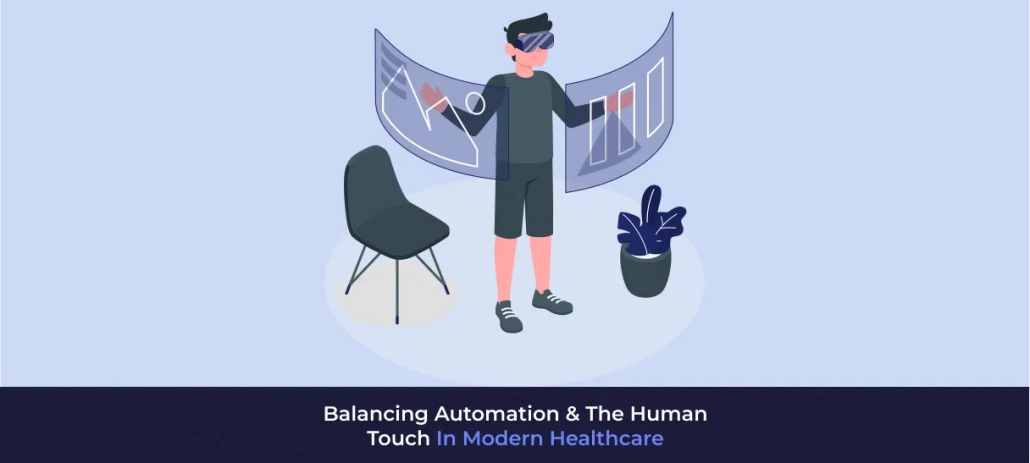
Balancing Automation and the Human Touch in Modern Healthcare
Introduction
Have you noticed that new technologies like smartwatches can know you’re stressed before you do? Could you have imagined this 10 years ago?
AI can diagnose conditions faster than ever and do other health industry-related tasks, such as booking an appointment, creating alerts, and giving support.
We’re living in a tech-driven health revolution! But wait a minute – robots can ease your check-in or read your X-ray but they can’t replace a kind doctor or the feeling of a professional telling you that everything is okay.
So how do we get that balance between digital efficiency and human care? Let’s take a look at what a truly modern healthcare experience looks like, and how you can make the most of it.
The Core Crisis: Overstretched Teams and Systemic Bottlenecks
1. Healthcare Delivery Is Under Severe Structural Strain
Care is ultimately dependent on patients, regardless of how advanced healthcare delivery becomes. The reality is modern healthcare systems are operating under intense pressure. This impacts both staff and patients. Automation can help but alone cannot resolve the crisis.
Why this matters:
- Patient care depends on human capacity
- Administrative overload slows clinical work
- Overstretched teams are more likely to make errors
- Delays affect both experience and outcomes
- Operational strain reduces overall efficiency
2. Severe Staffing Shortages Are Limiting Care Capacity
In the present situation, skilled doctors’, nurses’, and support staff’s availability is less to meet the growing healthcare demand. There is a huge gap between patient needs and available talent. This shortage affects the care journey.
Major impacts of staffing shortages include:
- Longer wait times for patients
- Heavier workloads for existing staff
- Reduced appointment availability
- Slower response to clinical needs
- Greater pressure on support teams
Why this is a growing problem:
- Aging populations need more care
- Complex cases require more time
- Recruitment pipelines are not keeping pace
- Smaller teams must cover more responsibilities
- Clinical capacity is harder to maintain
3. Attrition and Burnout Are Undermining the Employees
Long hours. constant paperwork. and mental health stress are forcing caregivers to step out of the field.
Signs of burnout in care teams include:
- Fatigue and disengagement
- Lower morale
- Reduced productivity
- Higher absenteeism
- Increased turnover
Why attrition becomes a compounding issue:
- Fewer staff remain to handle the same workload
- Training new hires takes time and resources
- Institutional knowledge is lost
- Team stability declines
- Patient care continuity becomes harder to maintain
Divided Responsibilities: Humans vs. Machines
We must not pit technology against human workers if we want to build a dependable healthcare system. Instead, we should allocate tasks to what each is best at.
| Automated Systems Excel At | Human Clinicians Excel At |
|---|---|
| Dynamic appointment scheduling | Diagnosing rare, complex, or multi-system conditions |
| Automated medication reminders | Delivering sensitive, life-altering diagnoses |
| Processing routine lab test tracking | Designing personalized, lifestyle-aligned treatment plans |
| Managing billing and insurance claims | Providing deep emotional support and psychological safety |
| Gathering structured baseline health inputs | Advocating for vulnerable patients within complex healthcare networks |
| Triaging high-volume incoming data | Adapting care for highly unique individual preferences |
The Digital Side Effect: Navigating Data Security Risks
1. Digital Health Tools Bring Real Privacy Risks
Modern healthcare digital transformation has brought both convenience and speed. However, it has introduced a serious side effect: data security risk. Wearables, patient portals, and telehealth platforms convert every digital record. Stored it in the cloud. Therefore, ignoring privacy could raise security risks.
Why this matters:
- Every digital interaction creates sensitive records
- Health data is stored across cloud systems
- Privacy risks increase with more connected tools
- Patients trust providers with highly personal information
- Security gaps can affect both individuals and clinics
2. Health Data Is Target For Cybercriminals
Medical data is not just a normal file. It includes permanent personal identifiers, insurance details, and medical history. This data becomes extremely valuable for malicious actors.
Why attackers target health data:
- It contains permanent personal identifiers
- Medical history is difficult to change
- Insurance and billing data have financial value
- Records can be used for fraud
- Healthcare systems are often under pressure
Common threats include:
- Ransomware attacks
- Network breaches
- Unauthorized access
- Data theft
- Phishing attempts
Your Health Privacy Toolkit
1. Use a Reliable VPN for Safer Access
If you log in to the patient portal. Checking lab results. or transmitting medical forms. Then using a VPN is a smart approach.
When to use a VPN:
- Logging into patient portals
- Reviewing lab results
- Sending medical documents
- Using public Wi-Fi
- Accessing insurance accounts
Benefits of a VPN:
- Encrypts your internet connection
- Helps block unauthorized access
- Protects data on shared networks
- Reduces exposure on public Wi-Fi
- Adds an extra layer of privacy
2. Enable Two-Factor Authentication on Every Health Account
Just relying on a password is not the best approach. Two-Factor authentication further boosts security. It adds an extra verification step. This makes the account more secure.
Turn on 2FA for:
- Medical apps
- Insurance portals
- Pharmacy accounts
- Patient portals
- Telehealth platforms
Why 2FA helps:
- Adds an extra login step
- Protects against stolen passwords
- Makes unauthorized access harder
- Improves account security
- Reduces risk of account takeover
3. Keep Your Devices and Apps Updated
Outdated software gets easily attacked. It is the first intended target of criminals in cyberspace. It is highly advisable to update the necessary features of the smartphone operating system. Regularly check the health app.
Update regularly:
- Smartphone operating system
- Health applications
- Telehealth apps
- Browser software
- Security settings
Why updates matter:
- Fix known security flaws
- Improve device protection
- Reduce vulnerability to attacks
- Support better app performance
- Keep privacy features current
The Evolving Role of the Modern Clinician
1. The Modern Clinician Is Becoming More Impactful, Not Less Relevant
Automation’s real impact is not about replacing clinics. It’s about elevating their role. Automation helps clinicians in many ways:
- Automation reduces administrative burden
- Clinicians become care strategists
- Patients get stronger advocacy
- AI becomes a support tool, not a replacement
- The modern clinician is more impactful than ever
2. Care Strategists: More Time for Prevention and Long-Term Wellness
When clinics get free from manual data entry and routine paperwork. They don’t just focus on immediate symptoms.
Benefits of this shift:
- More personalized care plans
- Better follow-up on health trends
- Stronger prevention efforts
- Improved patient outcomes
- Less time lost in admin tasks
3. Tech-Savvy Collaborators: Working Alongside AI Tools
AI and clinical software are becoming an important part of healthcare teams. Modern healthcare, hospitals and clinics use this tool for support. Not as a replacement.
Tech-savvy collaborators use AI for:
- Clinical decision support
- Pattern recognition
- Risk flagging
- Documentation assistance
- Workflow optimization
What makes this collaboration effective:
- AI provides insights
- Clinicians provide judgment
- Errors can be caught earlier
- Workflows become faster
- Care remains human-centered
Merging the Two as a Mixed Solution
Facing people against machines is the worst idea ever. A better world can be built if we find out how to blend these two powers to create useful results.
What Automation Could Handle
- Appointment scheduling;
- Medication reminders;
- Routine follow-ups;
- Lab test tracking;
- Billing and insurance claims;
- Collecting basic health data.
These are repetitive. Time-consuming. and prone-to-error tasks. Exactly what machines are great at.
What Humans Could Handle
- Diagnosing complex or nuanced conditions;
- Delivering sensitive or life-changing news;
- Crafting personalized treatment plans;
- Providing emotional support;
- Advocating for patients;
- Adapting care for unique individual needs.
Roughly speaking, this division could help health professionals organize tasks and allow clinicians to spend less time on screens and more time with you.
After all, you might be asking yourself, “How can AI be used in healthcare responsibly?” The answer: in a way that enhances human capability, not replaces it.
AI can triage faster, analyze patient history deeply, and identify patterns missed by humans, but humans must guide the process and apply judgment.
The Drawbacks of Improved Solutions
Let’s face the elephant in the room: data security.
Every wearable you wear, every app you download, and every telehealth visit you have-your data is being stored somewhere.
Health data is incredibly valuable and vulnerable. In fact, in 2026, healthcare accounts stood for 17% of all ransomware attacks globally, making it one of the top-targeted industries.
You might be asking yourself: How can I stay safe online? Should I always use a VPN?
Do you want an honest answer? Yes. Especially when accessing and handling such sensitive information as health data. A Virtual Private Network is a great tool to encrypt your internet connection and discourage hackers from accessing your data.
How AI Might Change the Health Industry
We can’t stress this enough across the article: Doctors, nurses, and caregivers aren’t going away, but their roles are evolving. With automation taking over repetitive tasks, health professionals are becoming more. Studies show that strong human connections improve by 50% the chance of longevity. Small human moments matter, and no AI can replicate them.
- Care strategists, instead of just task-doers;
Patient advocates who interpret data and stand by their patients instead of just collecting it; - Tech-savvy collaborators who know how to work with machines, not compete or deny them.
What’s Coming Next?
Prepare yourself if you believe that healthcare is now high-tech. The future holds even more potential:
- AI-driven early detection of chronic diseases
- Digital twins—virtual models of your body to test treatments.
- Genomic-based precision care
- Voice-activated assistants for disabled individuals.
- Augmented reality in surgery and training.
- Generative AI in health care for personalized care plans.
- Surgical simulations or patient summaries.
Future Directions: Technology Will Continue to Revolutionize Healthcare
1. Predictive Chronic Modeling: Identifying Illness Before It Shows Symptoms
In the coming decades, modern healthcare technology will not just stick to digital records and automation. It will be moving towards intelligent systems that can predict diseases. Stimulate treatment. Personalize the care. Help patients in their daily life support.
Predictive models may help with:
- Early analysis of the symptoms of chronic illness
- Tracking health patterns
- Identifying subtle changes in the body
- Identifying subtle physiological changes
- Encouragement of preventive measures
- Reducing avoidable complications
2. Digital Twins: Safer Planning Through Virtual Patient Models
Digital twins are secure virtual patient models. It will help clinicians and researchers in simulating complex surgeries. Help in testing the treatment approach.
Digital twins can be used for:
- Surgical simulation
- Treatment planning
- Medication testing
- Risk assessment
- Procedure optimization
Why this technology is important:
- Reduces uncertainty before procedures
- Helps clinicians test multiple scenarios
- Improves surgical preparation
- Supports safer decision-making
- May lower the risk of complications
3. Genomic-Based Precision Care
Genomic-based precision care will continuously transform oncology. pharmacology and other specialties. Because of this change, medical care is now genuinely customized.
Genomic precision care may improve the following:
- Cancer treatment selection
- Drug response prediction
- Side effect reduction
- Therapy personalization
- Clinical decision accuracy
Key advantages include the following:
- More targeted treatments
- Better medication matching
- Fewer adverse reactions
- Higher treatment effectiveness
- More personalized patient care
Conclusion
The modern Healthcare future will depend on the balance of automation and the human Touch. The best healthcare system is one that combines the power of technology and human kindness. By this point, we should be over the discussion of robots vs. humans. Understanding that it’s about building a system where the two complement each other is the key to success.
Yes, use the apps.
Yes, embrace the convenience.
But always remember your right to warmth, connection and compassion in your care. The future of modern healthcare is exciting and while we need to be watchful, we also need to trust the process.
FAQ
How is AI used in applications?
AI powers virtual health assistants. data analysis. remote monitoring, and patient outcome prediction. and diagnostics. It facilitates quicker decision-making. And can enhance individualized care. Help with early detection of symptoms.
How is generative AI different from traditional AI in the healthcare industry?
Generative AI can generate anything from medical notes. And images, simulated patient data. It’s not like traditional AI. Traditional AI is mostly about analysis.
How can AI be applied to Modern healthcare?
By handling repetitive tasks. data-intensive duties. This will allow medical personnel to concentrate on patient relationships. empathy and difficult decisions. AI should complement human care. They should not replace it.