6 Biggest Hospital Management Software Companies In The Globe
Quick Summary: Hospital management software (HMS) connects patient registration, appointments, clinical records, pharmacy, labs, billing and reporting in one system. This 2026 guide compares 6 hospital and clinic software companies, separating ready-made products from custom development partners, explains the features every hospital needs, what to expect when moving to new software, and the red flags to watch for before you sign with a vendor.
Introduction
Running a hospital means coordinating doctors, nurses, front-desk teams, pharmacies, labs and billing staff, often for hundreds of patients a day. When each department works on paper or in separate systems, information gets lost, patients wait longer and costs rise.
Hospital management software solves this by bringing every department onto one connected platform. But choosing the right company is not easy. Some vendors sell ready-made products you can set up quickly, others build custom software around your workflows, and some focus mainly on small clinics.
This guide explains what good hospital software should do, compares six companies by type and best fit, and shares a checklist of red flags to avoid. A note on transparency: this article is published by Bigscal, which is included in the list, so we recommend booking demos and checking references with every vendor before you decide.
Hospital Management Software Companies at a Glance
| Company | Type | Best for |
|---|---|---|
| Bigscal | Custom healthcare software development | Hospitals and healthtech companies that need software built around their workflows |
| Healthray | Ready-made hospital, clinic and EMR software | Hospitals and clinics, especially in India, wanting a connected product |
| SoftClinic | Ready-made hospital and clinic software | Hospitals that need OPD to IPD management in one system |
| DrPro | Ready-made clinic management software | Small and mid-size clinics moving from manual processes |
| A3Logics | Custom software development | Organizations that want a development partner for custom healthcare apps |
| Tebra | Practice management and EHR for independent practices | Independent US practices and medical billing companies |
Large hospital networks looking for enterprise-wide clinical systems will also come across global vendors such as Epic, Oracle Health (formerly Cerner) and MEDITECH, which are widely used by large health systems, especially in the US.
Why Hospitals Need Hospital Management Software

Hospital staff already work hard. The problem is that paper files, phone calls and disconnected systems waste much of that effort. Good hospital management software reduces workload, cuts errors and gives managers a clear view of what’s happening across the hospital. These are the features that matter most:
Connected Departments
OPD, wards, labs, pharmacy, radiology and billing all share the same patient record, so information moves instantly instead of on paper. The result:
- Faster care for patients
- Less time spent on calls and paperwork
- Lower workload for staff
- Fewer billing leaks and better revenue
- Higher overall productivity
Patient Portal
A patient portal or app lets patients book appointments, view reports, pay bills and message the hospital online. This reduces queues and calls at the front desk and keeps patients informed. Choosing the right hospital software company helps make sure the portal is simple enough for patients of all ages to use.
Secure, Role-Based Data Access
Not every staff member should see every record. Good hospital software gives each role, such as doctors, nurses, billing and front desk, access only to what they need, logs every access and protects data with encryption. Staff get the right information at the right time, while patient confidentiality is protected.
AI-Assisted Documentation
Clinical documentation takes up a large part of doctors’ and nurses’ time. Modern systems use templates, voice dictation and AI tools that turn spoken notes into structured records for clinicians to review, reducing paperwork and keeping documentation consistent.
Appointment Scheduling
Online booking, doctor calendars and automatic reminders prevent double bookings, reduce no-shows and let patients choose times that suit them.
Complete Integration
The best hospital management software connects with lab analyzers, imaging systems, pharmacy, insurance, payment gateways and national health networks such as ABDM in India. Pharmacists and specialists can check prescriptions and history directly in the system instead of relying on paper slips or phone calls.
6 Hospital Management Software Companies To Consider in 2026
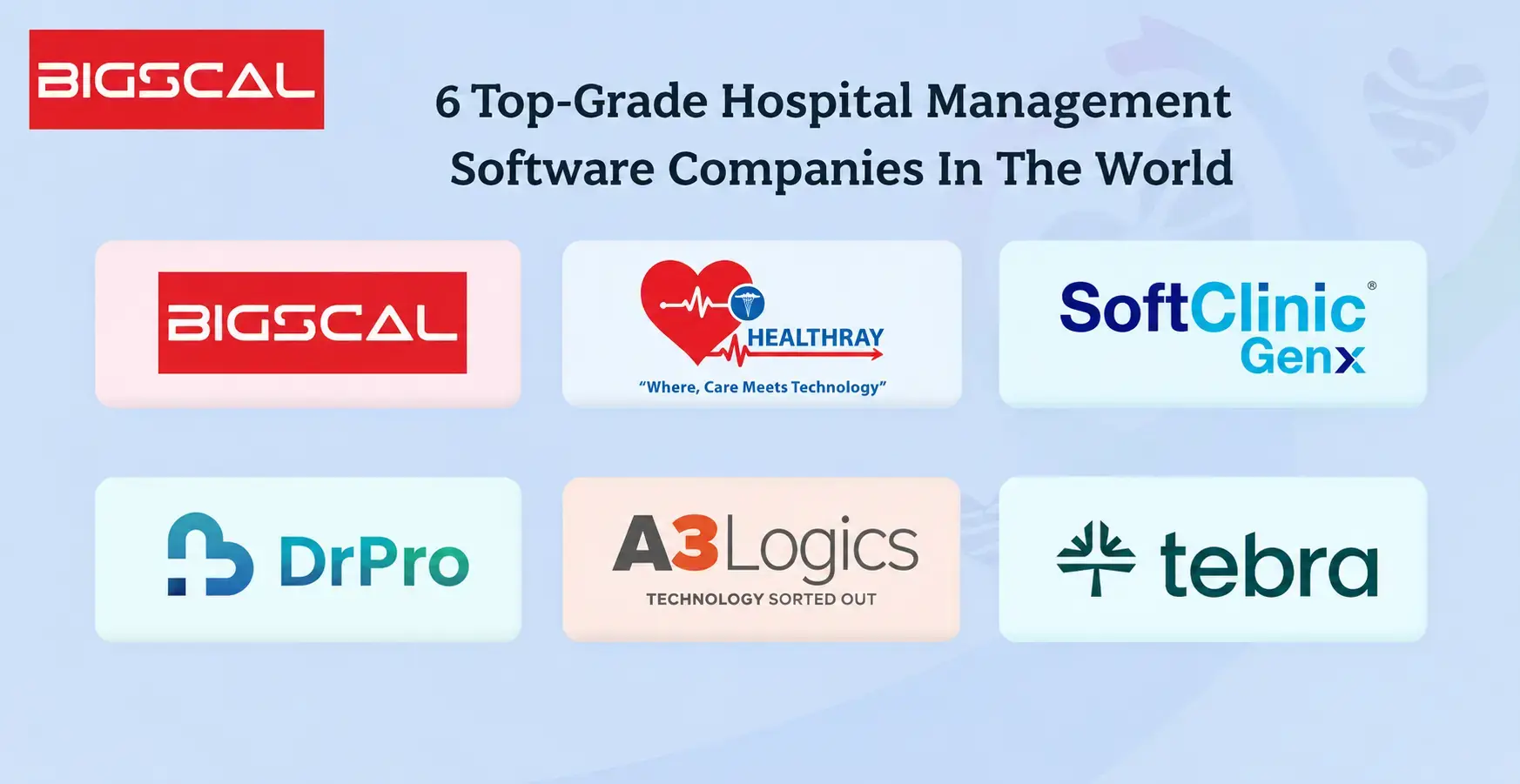
The companies below fall into two groups: ready-made products you can configure and deploy, and development partners that build custom software for you. The right choice depends on how standard or unique your hospital’s workflows are.
1. Bigscal
Bigscal is a software development company based in Surat, India, with an office in New York, that builds custom hospital management software. With 12+ years of experience and ISO 27001 certification, its team develops hospital, clinic, patient management, EMR, telemedicine and lab software designed around each client’s workflows.
Bigscal suits hospitals and hospital groups whose processes don’t fit off-the-shelf products, as well as healthtech companies building their own hospital software product. It also integrates new systems with existing lab, pharmacy, billing and insurance tools.
Best for: custom hospital software and healthtech products.
2. Healthray
Healthray offers ready-made healthcare software for India, including hospital information systems, EMR, billing, patient records, laboratory (LIMS) and pharmacy modules that share data across departments. Hospitals can start with the modules they need and configure them to their processes, with onboarding and training support.
Best for: hospitals and clinics in India that want a connected, ready-made product.
3. SoftClinic
SoftClinic offers hospital and clinic management software covering the full patient journey from OPD to IPD. It supports patient registration, clinical records, staff and department management, billing and reports, helping hospitals assign duties clearly and track each patient’s progress from first visit onward.
Best for: hospitals that want OPD and IPD management in one product.
4. DrPro
DrPro is a healthcare management platform for clinics and practices. Its clinic management software brings appointment scheduling, patient management, EHR/EMR, billing, prescriptions and reporting into one system, helping clinics reduce paperwork and move away from manual processes.
Best for: small and mid-size clinics going digital.
5. A3Logics
A3Logics is a software development company that builds custom applications, including healthcare solutions such as hospital workflows, patient portals and integrations through APIs. Like Bigscal, it is a development partner rather than a ready-made product.
Best for: organizations looking for a custom healthcare software development partner.
6. Tebra
Tebra, formed from Kareo and PatientPop, provides practice management, EHR, medical billing and patient engagement tools for independent practices in the US. It is designed for physician practices and billing companies rather than large hospitals.
Best for: independent US practices and medical billing companies.
Moving to Modern Hospital Software: What To Expect

Rising costs, staff shortages and patients’ expectations of digital services are pushing hospitals to replace paper and outdated systems. Done well, the move improves efficiency across departments, shortens waiting times, reduces errors and gives managers real-time data to control costs.
A successful transition usually involves:
- Mapping workflows: document how each department works today and what needs to change.
- Data migration: plan how existing patient, billing and inventory data will move to the new system.
- Phased rollout: start with one or two departments, such as OPD and billing, before expanding.
- Training: train each role on the tasks they perform every day, not just general features.
- Measuring results: track waiting times, billing accuracy and staff time saved after go-live.
5 Red Flags When Vetting HMS Vendors
No Live Demo or Sandbox
Never finalize a vendor without testing the software. Without a live demo or sandbox, you can’t judge usability, workflow fit or real-world performance.
Check these points:
- Live demo availability
- Sandbox access
- Workflow testing
- User experience review
- Performance validation
Vague SLA Terms
The service level agreement (SLA) is the basis of vendor accountability. If uptime, response times and resolution times aren’t clearly defined, you risk long delays when something goes wrong.
Look for:
- Uptime guarantees
- Response timelines
- Resolution timelines
- Support coverage hours
- Escalation process
Unclear Answers on Compliance and Security
Healthcare data is highly sensitive. A serious vendor explains its compliance and security standards clearly and can show evidence.
Ask about:
- Security certifications
- Data encryption
- Access controls
- Audit trails
- Compliance with local laws such as HIPAA, GDPR or India’s DPDP Act
Closed APIs
Hospital software must connect with labs, billing, pharmacy and third-party tools. Closed or limited APIs make future integrations slow and expensive.
Verify support for:
- Lab integrations
- Billing and insurance systems
- Pharmacy tools
- Third-party applications
- Healthcare data standards such as HL7 and FHIR
Hidden Costs
A low upfront price isn’t always the best deal. Many vendors add charges later for implementation, upgrades, training, storage and customization.
Watch for:
- Implementation fees
- Upgrade charges
- Training costs
- Storage expenses
- Customization costs
Conclusion
The right hospital management software company depends on your hospital’s size, workflows and plans. If your processes are fairly standard, a ready-made product such as Healthray, SoftClinic or DrPro can get you running quickly. If your workflows are unique, you need deep integrations, or you’re building your own healthcare product, a development partner such as Bigscal can build software around the way you work.
Whichever route you choose, test the software with real workflows, check security and integrations, read the SLA carefully and compare the total cost, not just the starting price.
FAQ
What is hospital management software?
Hospital management software is a system that connects a hospital’s departments, including registration, appointments, clinical records, wards, pharmacy, labs, billing and reporting, so they share one patient record and work from the same information.
Which are the biggest hospital software companies in the world?
Among the largest providers of hospital clinical systems are Epic, Oracle Health (formerly Cerner) and MEDITECH, which are widely used by large health systems, especially in the US. Hospitals in India and other markets often choose regional products or custom software that fits local requirements and budgets.
What features should hospital management software have?
Key features include patient registration, appointment scheduling, electronic medical records, ward and bed management, pharmacy and lab integration, billing and insurance, a patient portal, role-based access control, audit logs and reporting dashboards.
Should a hospital choose ready-made or custom software?
Ready-made software is faster and usually cheaper to start with, and suits hospitals with fairly standard workflows. Custom software suits hospitals with unique processes, complex integrations or plans to build their own healthcare product, and gives full control over features.
How long does it take to implement hospital management software?
Ready-made systems for clinics can go live in a few weeks, while full hospital implementations usually take a few months, depending on the number of departments, data migration and training. Custom software takes longer because it is designed and built for your needs.
What should I check before choosing a hospital software vendor?
Ask for a live demo or sandbox, read the SLA carefully, check security certifications and compliance, confirm open APIs and support for standards such as HL7 and FHIR, and ask for a full breakdown of costs, including implementation, training, upgrades and storage.