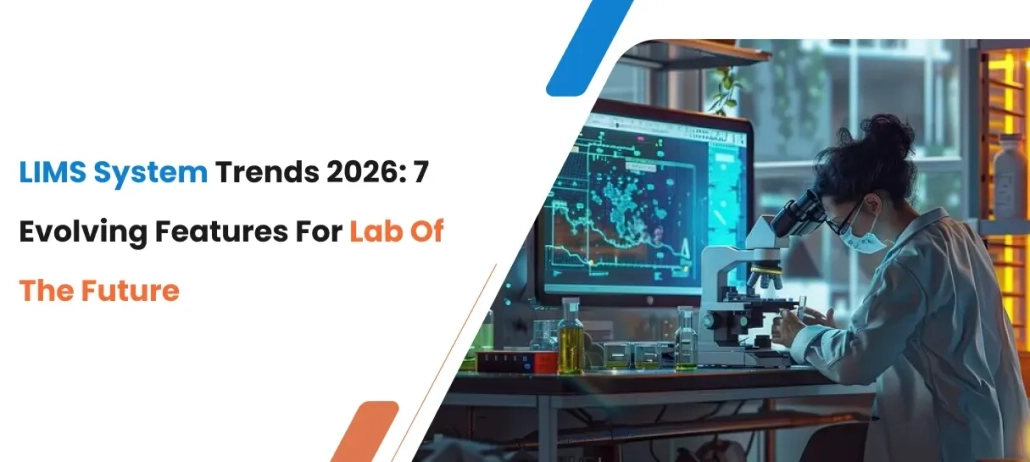
LIMS System Trends 2026: 7 Evolving Features for Lab of the Future
Introduction
Laboratories are entering a transforming phase, which is highly different from the digital upgrades of the previous decade. In 2026, challenges are not just limited to replacing spreadsheets. Adding a new software module or digitizing the manual workflows. It is a structural shift that requires labs to redefine their entire working process in the situation of increasing sample volumes, stricter compliance requirements, and faster turnaround times. Traditional laboratory information management systems’ primary role is about storing sample information and generating reports.
A LIMS system creates a digital, interconnected ecosystem. Lab teams can seamlessly manage samples. Check instruments’ availability. Manage a high volume of users’ data. Seamlessly connect all the workflows. Artificial intelligence. Cloud-based architecture. Predictive analytics. Interoperability. Workflow automation. These are not technologies of the future. That’s a basic requirement of any modern laboratory. Moreover, the best laboratory information system software refines the lab data and captures a safe manner after applying the mathematical computation.
7 Evolving Features of LIMS System 2026
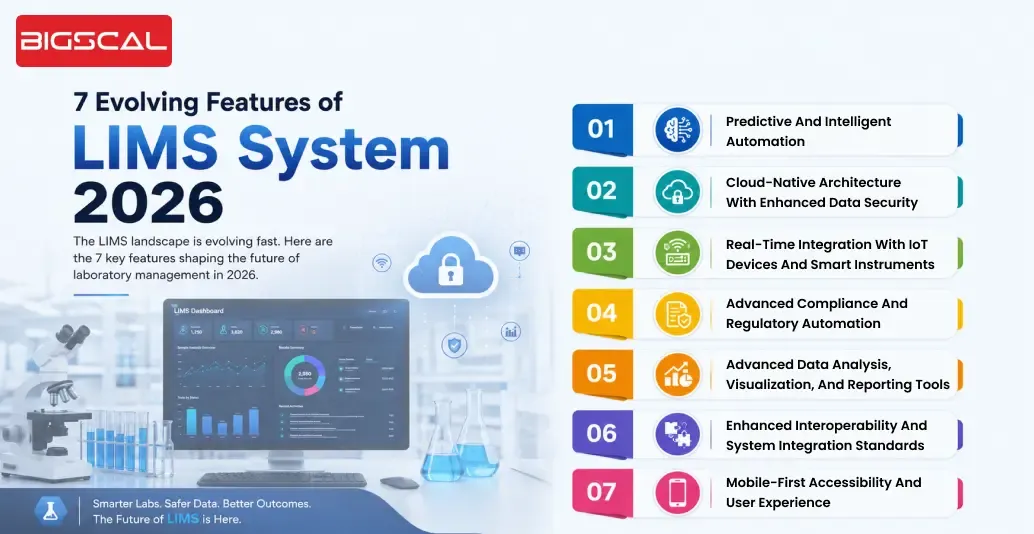
1. Predictive and Intelligent Automation
Artificial intelligence is no longer merely a catchphrase. It has become a fundamental and essential pillar of LIMS architecture. Let’s check some remarkable features of AI in LIMS.
AI Predictive Models Redefining Laboratory Decision-Making
Modern laboratories are becoming data-rich environments. However, data abundance becomes valuable only when LIMS systems are capable of converting them into meaningful predictions and timely recommendations. In addition, AI models include the following features:
- Predictive maintenance planning systems
- Intelligent workflow optimization engines
- Historical pattern recognition models
- Real-time anomaly detection mechanisms
Equipment Failure Prediction Before Operational Disruptions
Laboratory downtime is not just a productive issue. It also creates compliance risks. Leads to delayed reporting. And increased operational costs. An AI-integrated LIMS system continuously monitors the performance patterns. AI is developing the ability to predict failure before it happens. Additionally, AI models include the following features:
- Continuous equipment health evaluation
- Sensor-driven performance analytics platforms
- Failure probability assessment models
- Preventive maintenance scheduling workflows
Intelligent Capacity Planning and Resource Forecasting
Fluctuations in testing volumes create complexity in the practices. Also, staffing requirements create major operational barriers for laboratories. Predictive analytics help labs understand future demand patterns. Help them strategically allocate the resources. Further, AI models include the following features:
- Dynamic workload forecasting capabilities
- Automated staffing requirement predictions
- Sample volume trend analysis
- Resource allocation optimization frameworks
Human Expertise Augmented Through Intelligent Automation
AI’s objective is not about replacing lab professionals. Its primary purpose is to augment human expertise. Strengthen decision-making capabilities. Additionally, AI models help in the following:
- Enhanced scientific decision support
- Reduced administrative workload burdens
- Improved employee productivity outcomes
- Focus on Higher-value analytical task
2. Cloud-Native Architecture With Enhanced Data Security
In 2026, cloud-native LIMS adoptions are increasingly growing. Let’s check some enticing features:
Cloud Migration Beyond Infrastructure Upgrades
The cloud adoption objective is not just about replacing servers. Laboratories are now building ecosystems that support future growth. Remote collaboration. And real-time data visibility. Additionally, it includes features such as
- Flexible infrastructure scaling capabilities
- Centralized laboratory data access
- Faster system deployment processes
- Improved operational resilience frameworks
Zero Trust Security Becoming Standard
Distributed work environments and multi-site laboratory operations are making traditional perimeter-based security models inefficient. Zero-trust architecture continuously verifies every user’s access. Additionally, it includes more advanced abilities. Let’s check:
- Continuous identity verification mechanisms
- Role-based access control frameworks
- Multi-factor authentication implementation strategies
- Granular user permission management
Advanced Encryption Protecting Sensitive Information
Laboratory data is increasingly becoming a valuable and sensitive asset. Modern LIMS system uses advanced encryption protocols and next-generation security standards to protect clinical records, research findings and proprietary formulations. Further, it includes the following features:
- End-to-end data encryption protocols
- Secure information transmission channels
- Protected data storage environments
- Adopt quantum-resistant security algorithms
Blockchain Strengthening Audit Trail Integrity
Data authenticity and traceability are critical components of regulated laboratories. Hybrid blockchain approaches combined with traditional cloud infrastructure create immutable audit trails. This strengthens sample handling and analytical procedures’ integrity. Further, it includes the following features:
- Immutable record verification systems
- Tamper-resistant audit trail mechanisms
- Enhanced regulatory compliance support
- Trusted sample tracking frameworks
3. Real-Time Integration with IoT Devices and Smart Instruments
The Internet of Things (IoT) revolution has fundamentally transformed the lab operations. Let’s check out some remarkable features:
The Connected Lab Ecosystem
Modern laboratories are increasingly evolving. Every instrument, sensor and workflow is sharing data with each other. LIMS has become a central intelligence layer of these ecosystems. It aggregates multiple data streams. Provide unified operational visibility. Plus, it includes the following features:
- Continuous device-to-LIMS communication frameworks
- Integrated sensor network architectures
- Centralized real-time data aggregation
- Unified laboratory visibility platforms
Direct Instrument Integration Eliminating Transcription Errors
Manual data transcription is becoming a major source of laboratory errors. Smart instrument integration helps labs directly transfer the analytical outputs into LIMS systems. This lowers transcription errors to almost zero. Improve data integrity significantly. Further, it encloses the following features:
- Automated instrument data capture
- Direct result transfer capabilities
- Improved laboratory data accuracy
- Reduced human error risks
Smart Instruments Delivering Operational Intelligence
Modern lab instruments are not just limited to providing test results. It continuously shares detailed diagnostic information such as reagent quality, calibration status, performance metrics and predictive maintenance indicators. Further, it includes the following features:
- Real-time instrument diagnostics monitoring
- Calibration and reagent status tracking
- Predictive maintenance intelligence generation
- Comprehensive equipment performance analytics
End-to-End Traceability Strengthening Regulatory Readiness
A significant benefit of IoT integration is creating true laboratory traceability. From sample receipt to final result reporting, all actions, environmental parameters, and quality checks are automatically recorded. This level of automated documentation provides unparalleled audit trails to laboratories. Additionally, it includes the following features:
- Automated end-to-end sample tracking
- Comprehensive audit trail generation
- Enhanced regulatory inspection readiness
- Complete operational traceability frameworks
4. Advanced Compliance and Regulatory Automation
Regulatory requirements are evolving and expanding every year. Let’s check some evolving features of LIMS systems:
Intelligent Audit Trail Automation
Documentation in regulated environments is not just limited to record-keeping. It’s a foundation for operational credibility and inspection readiness. Modern LIMS systems are taking audit trail generation to extraordinary intelligence levels. Additionally, it includes advanced features. Let’s check:
- Automated activity documentation workflows
- Context-aware audit trail generation
- Inspection-ready reporting structures
- Enhanced data traceability mechanisms
Proactive Compliance Management Replacing Reactive Processes
Traditionally, compliance is a retrospective activity where documentation is assembled at the time of inspections and audits. In 2026, LIMS systems are completely transforming compliance into continuous operational discipline. This approach’s strategic benefit is allowing labs to build sustainable compliance cultures along with adhering to regulations. Additionally, it includes the following features:
- Real-time compliance risk monitoring
- Automated corrective action recommendations
- Continuous regulatory readiness assessment
- Proactive governance and oversight frameworks
Automated Quality Control and Assurance Workflows
Quality control and quality assurance processes are vital requirements for regulated labs. The advanced LIMS system automates these workflows substantially. A LIMS system can automatically identify deviations. Trigger investigation protocols. And continuously maintain required documentation for issue resolution. This level of automation reduces administrative pressure on QA teams. Further, it includes the following features:
- Automated deviation detection capabilities
- Intelligent investigation workflow triggering
- Continuous compliance documentation management
- Enhanced quality assurance readiness frameworks
5. Advanced Data Analysis, Visualization, and Reporting Tools
Data collection has become an essential part of lab operation in 2026. Let’s check some evolving features of the LIMS system:
Intelligence at Your Fingertips
Modern LIMS systems are equipped with advanced data visualization tools. This helps leaders and scientific teams to quickly interpret complex information. Customizable dashboards present information according to different user roles. Additionally, it includes the following features:
- Role-based dashboard customization
- Real-time operational performance visibility
- Scientific and management-specific reporting views
- Interactive data visualization capabilities
Note: Always design role-based dashboards so that every user gets relevant information.
Embedded Statistical Analysis Democratizing Data Science
Statistical analysis capabilities that previously demanded specialized expertise. Now, it is widely accessible through an intuitive LIMS system interface. Scientific and operational users can generate insights across organizations independently. Able to make information-driven decisions. Decode complex datasets. They no longer need programming skills to decode complex insights. Further, it includes features:
- Built-in trend analysis and pattern recognition tools
- Automated outlier detection and exception reporting
- Method comparison and validation analytics
- Inter-laboratory benchmarking
- Performance comparisons
Predictive Reporting Enabling Proactive Planning
Traditional reporting systems primarily reveal the present situations. Modern LIMS system significantly increases these capabilities. It projects future trends and expected outcomes as well. Further, it includes the following features:
- Future workload forecasting models
- Predictive sample volume reporting
- Resource planning intelligence tools
- Trend-based operational projections
6. Enhanced Interoperability and System Integration Standards
Modern labs rarely work in a single software environment. Most laboratories work with the combination of multiple instruments. Databases and third-party tools. Let’s check more about it.
Intelligent Data Mapping and Transformation
Interoperability challenges are not just about connecting systems. Real complexity emerges when different platforms display the same information in different formats, terminologies, and coding structures. Advanced LIMS applications use context-dependent data transformation features. It can automatically understand and execute complex mappings. Further, it includes the following features:
- Automated data mapping abilities
- Context-aware transformation engines
- Intelligent terminology translation procedures
- Reduced manual data reconciliation specifications
Unified Operations Across Multiple LIMS Platforms
In 2026, modern interoperability frameworks help labs create federated data environments. Different LIMS platforms can provide centralized visibility and unified reporting support by maintaining operational independence. Further, it includes the following features:
- Multi-LIMS federation capabilities
- Unified enterprise-wide data visibility
- Cross-site reporting and analytics integration
- Operational independence with centralized access
Interoperability As A Strategic Advantage
Future labs will increasingly depend on interconnected ecosystems. Enhanced interoperability provides more than operational efficiency to the lab. It provides a foundation for faster decision-making. Improved collaboration. And scalable digital transformation initiatives. Additionally, it includes the following features:
- Faster cross-system decision-making
- Improved collaboration across departments
- Scalable digital transformation readiness
- Future-proof laboratory technology ecosystems
7. Mobile-First Accessibility and User Experience
LIMS features are increasingly becoming mobile-first. This helps labs function efficiently beyond traditional workstations and physical boundaries. Let’s elaborate on more features.
Laboratory In Your Pocket
Modern laboratories are allowing users to carry out their routine activities even on a smartphone or tablet. They no longer rely on the desktop to complete their daily workflows. Mobile-first LIMS system provides the capability for labs to conveniently carry out their essential operations literally in their pocket. Additionally, it provides the following features:
- Real-time access to laboratory data from any device
- Mobile-based sample registration and workflow initiation
- Instant access to reports and approvals
- Remote monitoring of laboratory operations
Mobile-Optimized Workflow Management
Modern LIMS platforms are redesigning workflows. From the ground up level, they rebuild every feature. As a result, every mobile phone interaction becomes faster. More intuitive. And Easier to use. It is not necessary for laboratory staff to physically be present at designated workstations. They can carry out critical tasks from anywhere. Further, it includes the following features:
- Mobile-friendly sample collection workflows
- Barcode scanning and digital documentation
- Task assignment and approval management
- Automated workflow notifications and alerts
Offline Functionality For Uninterrupted Operations
All laboratories do not have reliable internet connectivity. Field collection sites, mobile diagnostic units, and remote research facilities often face challenges with network limitations. The modern mobile LIMS system effectively addresses these challenges. It provides robust offline capabilities to help the lab team carry out their daily operations seamlessly. Further, the LIMS system offers the following features:
- Offline sample collection and documentation
- Local data storage and synchronization
- Automatic updates when connectivity is restored
- Continuous workflow execution without internet dependency
Pro tip: While designing mobile workflows, always include synchronization. This will make the field connectivity always consistent and dependable.
Smart AI Functions of LIMS System
Each activity has been running smoothly and performing tasks before the deadline. Moreover, it is executing with a great mindset and enthusiastic behaviour. Smart functionalities to predict patients’ future obstacles and necessary amount of stock levels. Moreover, it provides a better path to track laboratory information and examines meta data within the few taps.
Device integration
Amalgamation of medical devices is the greatest thing with the AI integration in the laboratory system. The LIMS platform registers varied types of details, generally difficult to record manually. Furthermore, it incorporates safety protocols, executes the medical device smoothly. A formidable system to reduce complexity in the management of laboratory devices.
Provide a full support in maintaining devices, whether it is related to research or conducting a patient’s medical test. Furthermore, it is a crucial factor to improve test quality and increase device efficiency. This robust synergy creates an intense effect on laboratory output level and related costs.
Storage optimization
Administer your laboratory operations in such a way that would be difficult to increase cost and empty space. Each lab instrumentation and other minor laboratory products have its own dimensions. Therefore, it is a hard enough accurate allocation of laboratory resources. The effects of proper storage management includes :
- Lowers costs
- Enhance efficiency
- Proper tracking
- Reduce efforts
- Mitigates waste
Tracking samples
Maintaining exhaustive details of laboratory samples and applying mathematical computation to get the required data output. Moreover, the information has been circulated, automatically receiving the best graphical sample reports. A complicated procedure creates consolidated sample data reports of a single patient or all patients’.
Recorded data in top-tier format during the journey of patient test, which begins from taking blood aliquot to examine samples. Therefore, it creates a sophisticated way to monitor laboratory samples. Laboratory information management systems create a superior effect on lab research.
Data integrity
In the prevalent digital environment, it is easy to get electronic data, maintain information with less errors and null data is a typical job. It is not a cup of tea for manual hard working persons. The AI-powered LIMS system leaps into a scene and regulates entire lab data in the most fascinating format.
Flexible and trustworthy information is a deadly combination that cannot be achieved without sophisticated technology. Additionally, it embeds diverse data regulations at the desired place and provides structured values.
Regulatory compliance
The laboratory information management system helps to create a foundation for administering information and creating attractive reports, concentrating more on complex and critical information and more attentive, making a decision. Moreover, it reduces massive hurdles and acts as a catalyst for reducing laboratory expenses.
Additionally, the laboratory information system pursues standard lab regulations like ISO/IEC 17025. Mitigates the potential risk of legal penalties.
Invoice Management
Reconciling laboratory bills along with vendor information and maintaining a better communication with the customers. Moreover, the electronic laboratory notebook retains invoice records in a template or any other feasible formats. Patient medical bills have been visualized by them and monitored from any distant location.
Extensive relief to laboratory staff by providing a convenient LIMS system to create digital invoices and maintaining them properly. Therefore, the laboratory management system streamlines to reckon the exact figure and fetch the specific data.
Team management
Staff is the internal resource but eventually it is hard to administer and allocate them in a literal way. Moreover, they have a lot of complaints, which remain unresolved due to the limited amount of time. This issue has been handled carefully with the LIMS software and executing employee related operations swiftly. Additionally, it has a superior user-friendly interface, works for the dynamic teams and expedites to assign tasks.
Advancing Practice With The Laboratory Information Management System
The laboratory information management system (LIMS) executes lab practice with scientific tools like machine learning models. Moreover, it requires a technical knowledge of statistics, python programming, and other data visualization software. Basically, it facilitates an aesthetic practice, demanding no technical knowledge to run it. The fundamental strategies of the AI-based LIMS system are:
Data modelling
AI-based LIMS solutions convert your confusing data to structured information, not required to learn advanced technology due to its easy interface.
Categorized data assists to make the right decisions at the right time. Additionally, it enhances a good interaction among lab team members.
Natural Language Processing (NLP)
In the digital economy, we require a human interactive model like natural language processing (NLP), comprehending the human language and providing an exact result.
In the AI-integrated LIMS system, it is easy to get the test name after recording the test reports and current disease symptoms. Therefore, it increases operational efficiency due to the precise work.
Deep learning
Only AI has the potential to think like humans and match with their capabilities. Computers are for storing details but not examining medical images.
However, this technology helps to understand images and resolves critical work.
Machine learning
It is the sub-component of artificial intelligence. Moreover, it is profitable for laboratory researchers. Deploying to resolve critical information and can handle any type of big data.
Also, it classifies information and training data to minimize repetitive data.
LIMS Software For Instant Availability of Lab Records
In laboratories, a single document typically takes hours and sometimes days to create in word format. It is necessary to prepare authentic, structured, and correct information without missing values. However, the new LIMS system has AI-integrated models, assisting to clear information with the advanced AI algorithms.
Designed laboratory documents are effective for well-communication with the other laboratory divisions. Additionally, it records the entire laboratory policies, receives instant alerts on wrong information, reduces repetitive work, and receives lab documents immediately.
Why a Careful LIMS Vendor Selection Process Matters
While selecting a LIMS system, just relying on a software demo is not sufficient. Hospitals should also focus on lab accuracy, compliance, integration and long-term scalability. Hospitals should check the following:
1. Core Functional Requirements
Before shortlisting the vendor, the hospital should check whether the platform can handle daily operations or not.
Must-have features:
- Sample lifecycle management
- Instrument integration via SiLA/OPC-UA and direct capture
- Test and result workflows
- QC/QA automation
- Audit trails
- Reporting and dashboarding
- ELN/EMR interfaces via FHIR/HL7
- Inventory and consumables tracking
2. Non-Functional Must-Haves
Strong LIMS are evaluated based on both their features and architecture. If the platform is not secure and scalable, then the hospital may face problems in future growth.
Check these requirements:
- Cloud-native scalability with horizontal scaling
- Multi-region high availability
- Clear RTO/RPO targets
- Encryption at rest and in transit
- SOC 2 and HIPAA compliance
- Data residency options
3. Key Vendor Questions
Don’t just check the features at the time of the demo. Ask questions related to Real implementation. Compliance and support.
Ask the vendor:
- How do you handle data migration and historical records?
- Do you provide IQ/OQ/PQ and CSV support?
- What protocols and standards are supported?
- What are your data breach notification timelines and incidents?
- What’s your AI, analytics, and mobile roadmap?
- What is your roadmap for AI, analytics, and mobile?
- Who are your reference customers in similar regulated environments?
4. Budgeting and Commercial Terms
The LIMS system’s real cost is not a licensing fee. Hospitals should clearly calculate the 3–5 year total cost of ownership.
Review these costs:
- Licensing
- Implementation
- Integration
- Training
- Annual maintenance
- Connectors and customizations
5. SLA and Support Expectations
If the support model is weak, then even the best software can be risky. SLA terms should be clearly defined in the contract.
Define these expectations:
- 99.9%+ uptime
- Support tiers
- Response and resolution targets
- Scheduled maintenance windows
- Backup and retention policy
- SLA breach credits or penalties
- Exit and data-export clauses
Conclusion
In today’s laboratory environment, competitive advantage is not only determined by testing capabilities and infrastructure. Laboratories that are adopting modern LIMS systems are achieving significant gain in operational resilience and scientific agility. Future laboratories are not just a hypothetical concept and long-term aspiration. Its foundational technologies are accessible and are evolving into industry standards.
FAQ
How does AI based Laboratory Information Software help a lab?
AI-based labs simplify every hectic workload of labs. An AI-integrated LIMS system constantly tracks and analyzes the performance trends. AI can forecast breakdown before it happens.
Why is a cloud-based laboratory automation platform important?
Cloud-based LIMS systems provide flexible infrastructure scaling capabilities, centralized laboratory data access, faster system deployment processes and improved operational resilience frameworks.
How does IOT integration help labs?
Iot Integration helps the lab in many ways. It offers full operational traceability frameworks, automated end-to-end sample tracking, thorough audit trail generation, and improved regulatory inspection preparedness. Also, it reduces transcription errors.
How does modern lab automation software improve compliance management?
To increase compliance adherence in the practices, LIMS systems offer proactive governance and oversight frameworks, automated corrective action recommendations, continuous regulatory readiness assessments, and real-time compliance risk monitoring.
What are the benefits of mobile-first LIMS systems?
Mobile-first LIMS system provides the capability for labs to conveniently carry out their essential operations literally in their pocket. Furthermore, mobile-first LIMS offers instant access to reports and approvals, mobile-based sample registration and workflow initiation, real-time access to laboratory data from any device, and remote monitoring of laboratory operations.
How to minimize time to create laboratory documentation?
Ans. Generally creating laboratory documents takes hours and sometimes days. However, the laboratory information management system assists to tackle hard situations like big records and large laboratory documents. Additionally, the LIMS system improves operational efficiency, mitigates lab costs, and advances research lifecycle.
Do LIMS systems generate precise sample reports?
Ans. Absolutely, LIMS Systems generate precise sample reports. Incorporating basic to advanced steps for accurately processing laboratory information. Furthermore, it stores sample reports and patients’ data in a more effective manner. A sample report has been created with the related regulations and accurate elements, embedded in the template.
What are the advantages of standardized lab documents?
Ans. Standardized lab documents embroil a definite procedure, beginning from data segmentation, processing, classifying to analyzing effectively. Creating standardized documents by applying python language. Incorporating advanced algorithms on structured information and then, creating interactive reports.
What is the procedure of managing big data in LIMS software?
Ans. In the LIMS Software, big and complex information has been tackled with ease and integrated algorithms. Furthermore, it accelerates the experience of clinical workers and reduces stress on tough decisions. The procedure mainly includes data cleaning, applies modern algorithms, and enforces clinical standards.
What are the reasons to automate data processing?
Ans. Data is the root cause for implementing right action and subsequently, taking a clinical related decision at the appropriate time. Furthermore, the LIMS software or other associated AI-related software to your field works to manage the data world. The right information improves your business procedure, assisting to grow unexpected money.
Does the AI-enabled LIMS solution provide aesthetic practice?
Ans. Indeed, the AI-enabled LIMS solution provides aesthetic practice. It is a game-changer practice for laboratories. Furthermore, process clinical information and can save unlimited skin related images, impacting on the speed of clinical treatment. Additionally, it is a superior lab software for better communication with the clinical provider.
What are the core elements of a laboratory information system?
Ans. The laboratory information system comprises superficial elements that reforms the financial system and client management system that drives more revenue with the lower investment value. Furthermore, it includes workflow management system, scalability, business intelligence dashboards, and sample quality management.
Does LIMS software provide an immediate record to third parties?
Ans. Absolutely, Laboratory information management systems provide an immediate record to third parties. It provides effective test results, prepares a large lab documentation, strengthens reports, and enhances workflow efficiency. It has an interoperable attribute that improves communication and eases to transfer documents even though it is third party.
What are the strategies for advancing lab practice?
Ans. Advancing lab practices simplify complex data points, supervise information, and smooth running for increasing profits. Furthermore, a single lab software employs a number of strategies such as data modelling, machine learning, regulatory compliance, and sample monitoring.
What is the greatest significance of an electronic laboratory notebook?
Ans. The electronic laboratory notebook collects garbage type information to qualitative data. It deals with the sample information, test results, data quality, and precise laboratory bills. Furthermore, the major advantage is to administer laboratory equipment from small lab tools to large equipment. Therefore, it augments sample quality, facilitates an accurate prediction, and reduces expenses.