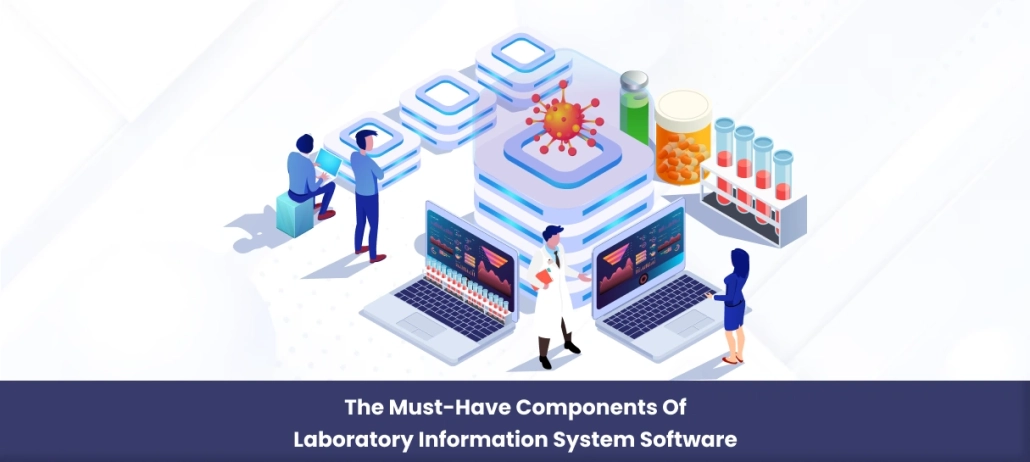
The Must-Have Components of Laboratory Information System Software
Quick Summary:Modern laboratories are filled with data; they have way too many tasks to cover. From specimen tracking to patient reporting and the laboratory information system, it is the digital backbone that keeps all the data organized. Along with recordkeeping, it manages workflow, assures data accuracy, and bridges the gap between instruments, technicians, and physicians.
In this blog, we will demystify how laboratory information systems have become the digital core of the lab, and end-to-end sample tracking is a non-negotiable factor. We will also be checking how workflow automation drives efficiency and integration allows bi-directional communication.
Introduction
Laboratories are today dealing with massive volumes of information, specimen tracking, to patient reporting. As testing volumes increase and regulations tighten, the Laboratory Information System (LIS) has become the backbone of modern lab operations. In clinical diagnostics, in pathology, in research, a powerful LIS cannot be limited to recordkeeping a powerful LIS should be able to cope with the workflow, maintain data accuracy and streamline information flow between instruments, technicians and physicians.
To meet these expectations, a Laboratory Information Management Systems should include several key components that make it reliable, compliant, and ready for the digital demands of healthcare.
Sample Tracking and Workflow Management
A good LIS starts with accurate tracking of the specimens. All the samples, that are sent to the lab, should be traceable to the collection and disposal point. These involve labeling, barcode reading, chain-of-custody tracking to avoid confusions or samples that may be lost. The LIS must document the entire action associated with a specimen such as the time it was received, handled and tested hence the staff can be able to trace the outcomes of all the steps in the process.
Workflow management supplements tracking by determining the flow of cases to departments. The prioritization of urgent samples and even distribution of work can be performed through automation rules, and a notification of technicians about overdue steps can be provided. A system that will fit the specific structure of individual lab (high-volume clinical or specialized research) is essential in terms of efficiency and elimination of mistakes.
Information Cohesion and Data Dynamics
Laboratories of the modern day are dependent on numerous tools and analyzers that generate streams of data of varied quality. A feature that is required in any LIS is the ability to integrate with this equipment. Bi-directional communication of LIS and instruments guarantees that the transfer of orders, results and calibration data do not have to be entered manually.
This connection minimizes the mistakes in the transcription and also accelerates the testing processes. It also supports interoperability between departments—connecting hematology, microbiology, chemistry, molecular diagnostics, and pathology. The LIS must be able to interact with the electronic health record (EHR) in a healthcare environment, and therefore, the results would be disseminated in real time to the care team.
Quality Control and Assurance
There should be high standards of laboratory labor. An extensive LIS must have tools to do quality control (QC) and quality assurance (QA). It implies monitoring control samples, confirming the results, and automatic notifying of out-of-range results.
The system can introduce QC checks as a part of the everyday workflow, which will signal the staff about the issue prior to its systemic occurrence. As an example, it can avoid release of results in cases where the calibration information is not available or when a batch of reagents is out of date. Documentation of regulatory inspections and accreditation requirements is also created through quality modules which are also time saving when the auditors request the records.
Configurable Reporting and Result Management
The end product of any laboratory is reports, which have to be accurate, available and easily interpretable. A powerful LIS enables tailored report templates that accommodate the various types of testing, including routine blood panel and complicated molecular tests.
These reports ought to be backed by structured data fields in order to have results that are analyzed and compared over time. Meanwhile, they must be liberal enough to the free-text comments where professional judgment needs to be applied in interpretation. Result validation, i.e. retention of results pending approval by qualified personnel, and the originator and date of release should also be managed by the LIS.
In cases where labs are linked to clinical systems, automatic delivery of results to EHRs or referring physicians, delays in communicating the results to clinical facilities are eliminated and patient care is improved.
Security and Regulatory Compliance
All laboratories are required to work within rigorous regulations, whether it is CLIA and CAP in the US or ISO and GDPR in foreign countries. A good LIS must facilitate such frameworks by having audit trail, encrypting data and access control.
A log of all actions taken in the system should be recorded in the audit logs such as edits, deletions, and approvals. This will guarantee transparency and accountability in case of an internal review, or an external audit. The security should also be provided through user authentication, permissions, and safe transmission of patient information.
In a society where cyber threats are on the rise, both stored and transmitted data must be encrypted to ensure patient confidentiality and trust is preserved.
Inventory and Resource Management
Operating a lab means dealing with samples as well as materials, supplies and equipment. A LIS that has in-built inventory control assists laboratories to maintain healthy stocks and avoid cases of interruption.
The system must record the lot numbers, expiration dates, and reorder quantities and it automatically informs staff that the supplies are depleting. In the case of equipment, it is able to record maintenance, calibration, and maintenance records. This guarantees that the instruments are in good conditions and also meet the regulatory requirements.
Resource tracking efficiency eliminates waste, cost control and ensures that the testing activities are within schedule.
Intelligence and Analytics in Business
Outside the operations, laboratories require understanding of performance and productivity. Turnaround times, testing volumes and error rates are visualized with real time dashboards on analytics modules in an LIS.
Through trend analysis, managers are able to establish the number of bottlenecks, manage staffing as well as quantify the effects of changes in the workflow. Costs per test, client billing trends, and rate of reimbursement might also be followed with the help of financial reporting tools and provide the administrator with a better understanding of profitability.
Combined with data visualization tools, such analytics can assist the leaders of laboratories to make evidence-based decisions and plan further growth.
Interoperability and Standards Support
A contemporary LIS has to use the same language as other systems in healthcare. The communication standards such as HL7, FHIR, and ASTM are supported, which is important to ensure the data freely flows between the lab, hospital systems, public health agencies and external partners.
.Interoperability reduces the need for duplicate entry and helps laboratories participate in large-scale data initiatives. For instance, disease registries and research collaborations. Secondly, the system must facilitate electronic ordering and report results in multiple organizations. It’s also becoming more relevant to reference laboratories and multi-site networks.
User Accessibility and Experience
The most advanced LIS will be futile when it is not easy to use. Friendliness is now a fundamental need. Dashboards are clear and easy to navigate, and the views can be customized. Also, offers access to information to technicians, pathologists, and managers that they need without having to worry.
Web-based or cloud accessible interfaces are common in modern systems. Providing authorized users with an opportunity to log in at various points. Such flexibility facilitates remote and multi-site work, after-hours work, and review. A positive workplace culture in a healthcare organization improves the retention rate of employees by increasing job satisfaction, engagement, and long-term loyalty. It’s also easy to train new staff; the shorter the time one has to spend knowing the system the sooner he or she can concentrate on testing and analysis.
Scalability and Customization
None of the two laboratories are the same. A scalable LIS must expand with the organization. Moreover, it supports new testing departments, new users, and support an increased volume of data. Also, it offers customizable features, including user-defined fields, workflow based on rules, and dynamic reporting templates to meet specific operational requirements.
This is due to the scalability making sure that the software will be relevant. Although the expansion of the lab to include new services or new technologies. For instance, the introduction of molecular testing or digital pathology.
Cloud and Data Backup Provision
As the number of labs embracing cloud-based models increases, data storage and backup has become a critical fact. The advantages of cloud deployment include lowering infrastructure expenses, simple software updates and remote availability.
Nevertheless, regardless of the on-premises and cloud-hosted, the LIS should contain automated data backup and disaster recovery features. This is to ensure that the patient outcomes and records are not lost during system crash or natural disaster. Additionaly, cloud software boast data encryption features that protect your data form cyberattcaks.
The Future of Laboratory Information Systems
With healthcare still evolving, LIS software will be even more important to determine the effectiveness and credibility of diagnostic testing. Artificial intelligence has already been implemented to anticipate workloads, propose interpretations of results, and enhance decision-making. Quality trends can be analyzed using machine learning tools. Predictive analytics can be used to predict resource shortages prior to their occurrence.
The next generation LIS systems will probably have closer integrations with digital pathology, genomics and point-of-care testing systems. Not only will they manage data but also be useful in population health initiatives and precision medicine programs.
Conclusion
A laboratory information system is more than just a data management tool—it is the digital nerve center of the lab. Secure specimen tracking, integration of instruments, regulatory compliance, analytics and scalability are the must-have features. All these factors combined will enable labs to provide correct, prompt, and conforming results. Also, it matches the constantly increasing demands of modern medicine.
With the trend toward digital and data-driven environments in laboratories, the LIS will persist in bridging people, instruments, and information. Enabling the teams to provide improved results to the patients and more sustainable processes in the future of healthcare.