
Your Complete Guide to Know When and How to Switch to Automated SEO
Quick Summary: Have you ever wondered if there is a magic button that can do all your SEO work while you concentrate on building your business? Welcome to the world of automated search engine optimization, where easy rankings and overnight success claims run rife. Rather than thinking, “Can SEO be automated?”, you need to ask yourself, “How can you distinguish the marketing hype from the actual assistance you can receive?”The reality of automated SEO is not as clear-cut as most would have you think. In this definitive guide, we will explore exactly what automated optimization can and cannot do for your business in 2025 and beyond.
What Is Automated SEO Anyway?
Automated optimization is the application of technology and software programs to execute routine search engine optimization with little or no direct human involvement. Imagine having a virtual assistant that can execute routine, time-consuming SEO tasks, so you can focus on strategy and creativity.
Automation SEO essentially covers several concepts. It can execute technical audits that would take hours to do manually, monitor keyword positions for dozens of phrases, create reports from several data sets, and even help optimize content. Many agencies fail because they can’t find efficient means to manage multiple client campaigns without being bogged down by manual work, which is why partnering with a saas link building agency can help streamline scalable SEO efforts. This is where understanding the best SEO software for agencies becomes crucial. The issue is not finding tools that claim to automate SEO—there are hundreds of them.
That is why most successful agencies spend considerable time reading and comparing review sites that rank the best SEO software. These reviews allow them to understand which tools deliver real automation and which ones simply resell core functionality with fancy dashboards. The secret is to find platforms that can actually reduce manual work while delivering the quality and customization that different client industries require.
When Automation May Not Serve You Well?
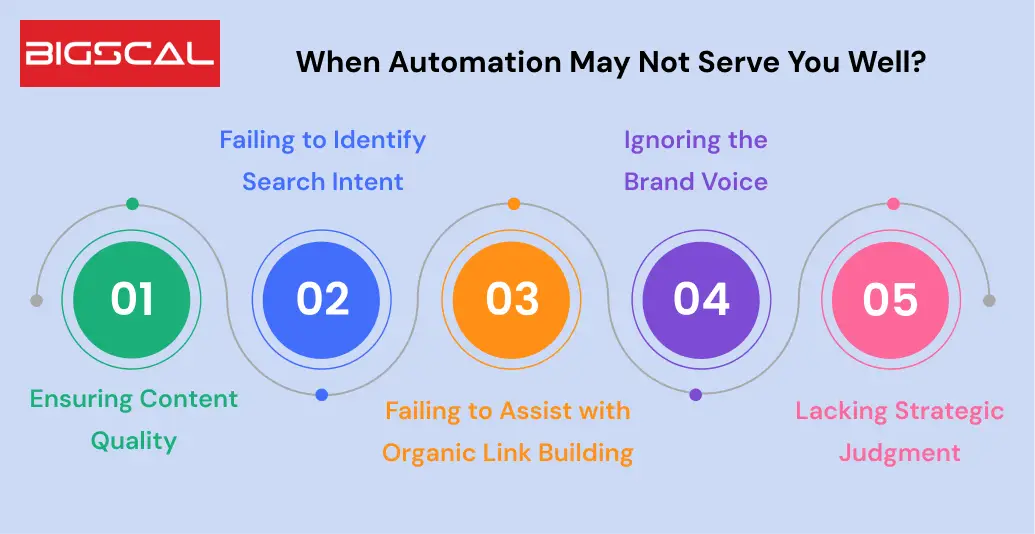
Even with dramatic improvement, automation SEO has limitations that can result in expensive errors if used carelessly. Be aware of these limitations in order to make informed decisions on where and how to implement automation for your SEO.Partnering with an experienced SEO company can help you strike the right balance between automation and human expertise for long-term search success.
Ensuring Content Quality
While the AI role in content writing is huge, these articles are typically riddled with several big errors. They are generic and lack the special insights and perspectives that make content truly valuable to readers. Automated content is also lacking in the demonstration of expertise, experience, authoritativeness, and trustworthiness (E-E-A-T) that Google is becoming more focused on.
Google’s quality raters now verify whether or not content is AI-generated and even rate it as low quality, which would be catastrophic for sites that rely heavily on an inordinate amount of AI-generated content without human oversight and editing.
Failing to Identify Search Intent
Automated algorithms have a tendency to concentrate on keyword metrics without user experience and emotional intent. They may see that a keyword has a great search volume and suggest without taking into account that the intent of the keyword is not fulfilling business objectives or the target market’s needs.
Failing to Assist with Organic Link Building
Automated systems usually cannot estimate the true authority, relevance, or safety of potential link sources. Errors in automated link-building can have serious and permanent repercussions. Sites may be subject to manual penalties that require months of cleanup and disavowal procedures.
Lacking Strategic Judgment
They are unable to consider the long-term brand consequences of short-term ranking strategies or know when to forgo some optimization for usability or brand continuity.
Moreover, when algorithmic adjustments take place or competitive situations change quickly, human planners are able to quickly modify their strategies, which automated systems just can’t do.
Know When to Switch to SEO Automation
Automation plays a vital role in technical SEO services, helping businesses monitor website health, detect issues quickly, and manage large volumes of SEO data with ease. Content optimization receives strong support from automation with generative AI tools, including an AI Blog Writer, that scan top-performing pages and give very specific suggestions. Content automation for SEO translates to being able to automatically determine optimal keyword density, discover semantic keywords, suggest internal linking possibilities, and even alert you to content that is potentially too thin or duplicated.
Automated SEO software is especially strong in competitive analysis. The software can scan competitor sites, track competitive ranking changes, detect new content, and even look at the patterns around link-building. Monitoring at this level would be impossible to keep up with manually, especially with multiple competitors; however, automation makes it standard and thorough.
Decoding the Right Process to Use Automated Optimization
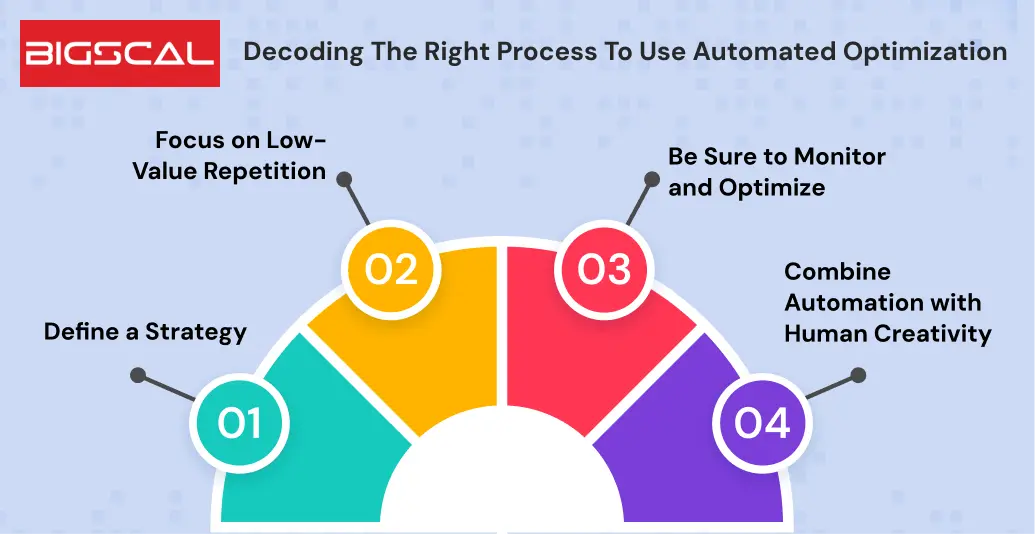
Step 1: Define a Strategy
Begin by defining precise strategic objectives and success metrics. Do an in-depth audit of your existing SEO procedures to understand what tasks are good candidates for automation. Manually map the customer journey and user intent patterns before automating.
Step 2: Focus on Low-Value Repetition
Start with technical monitoring and reporting tasks for automation. There is the greatest return on investment in automation in these categories because they’re labor-intensive, need frequent execution, and have well-defined success metrics. Do automated keyword research and competitive tracking as your second wave. Use automation for initial content optimization recommendations, but never for final content decisions.
Step 3: Be Sure to Monitor and Optimize
Subject all automated output to necessary human review processes. This is particularly relevant to content creation, where AI can produce technically accurate but strategically awry content. You must also use data validation methods to validate automated insights and conduct recurring audits of automated processes to make sure that they remain in line with your strategy.
Step 4: Combine Automation with Human Creativity
Create processes that utilize automation for identifying data and humans for strategic decisions. For instance, apply automated solutions to find content gaps and trending topics, but apply human brainpower to decide which opportunities fit business objectives and how to pursue them in a creative manner. Don’t forget to create feedback loops between automated and human control.
Identifying SEO Red Flags to Ensure Automation Success
Identifying the warning signs is important to maintain your search rankings. Negative and meaningless automation can result in penalties, traffic loss, and long-term harm to your online reputation. Knowing the warning signs can prevent you from committing expensive mistakes that may take years or months to correct.
Some significant warning signs show that automated SEO can do more harm than good:
- AI-powered mass content generation: Having hundreds of pages generated overnight by AI tools leads to thin, copied content that adds little value to the user, which eventually triggers Google’s quality detection mechanisms and penalties.
- Over-optimization of keywords: Overuse of automated software to artificially optimize keywords in content, following old methodology that current search engines actively penalize, can hurt.
- Link building schemes automation: Algorithms that create links from low-quality directories, comment spam, or paid networks can be easily identified by search engines and severely penalized
- Automated reporting with no context: Just using automated reporting and no human interpretation, resulting in making strategy decisions based on incomplete or misread information
- Brand voice abandonment: Focusing more on automated technical tuning at the expense of brand voice by creating content that gets good rankings but does not establish authority and trust is not a good idea.
The biggest automated SEO optimization error is doing it as a full SEO solution instead of as a supporting tool. Companies that try to automate every part of their SEO plan without any human input end up succeeding in the short term but witness catastrophic long-term outcomes and performance decline.
Understanding the Future of AI and SEO Automation
If you follow the latest technology news, you’ll realize that AI is here to stay. As SEO continues to develop, the optimal approach will combine artificial intelligence with human discernment and not allow one to dominate the other. Currently, almost half of all marketers employ AI-based SEO tools to simplify workflows, and an even greater percentage use these tools to identify emerging trends.
Key developments shaping SEO’s future include:
- Predictive SEO insights: The right AI SEO tools make these workflows practical rather than theoretical.
- Real-time personalization: Automation can dynamically alter content, calls to action, and page designs based on each visitor’s actions, boosting engagement and rankings.
- Visual and voice search at scale: Workflows now naturally support conversational search and multimedia content, as more and more searches are conducted by voice or image.
- No-code environments and AI integration: AI-powered business intelligence connects server performance to search visibility in real time, and automated tools are simplified to enable non-technical staff to create complex processes.
Measure the Right SEO Results
1. Why Rankings Alone Do Not Tell the Full Story
In seo, checking rankings is highly important. However, judging success with position number is an incomplete approach. You may notice the keyword on top. But unable to convert the traffic. That’s why measuring automation and seo efforts on the basis of ranking can be misleading.
Why this matters:
- Rankings show visibility
- Conversions show actual value
- Traffic quality matters more
- Business growth cannot be measured by position alone
- Real impact must be evaluated
2. Track Organic Conversions First
If your website is getting organic traffic. However, the user is not fulfilling the form. Not taking purposeful action or not signing up for the forms. Then SEO’s real impact is weak. Organic conversions show how search traffic drives meaningful actions.
Track these conversions:
- Form submissions
- Product purchases
- Demo requests
- Newsletter signups
- Phone calls from organic traffic
3. Focus on Lead Quality, Not Just Lead Volume
Sometimes SEO brings a high volume of leads. But a lot of them are largely meaningless. High volume of leads seems impressive. But if the sales team gets unqualified leads. Then you need to improve the strategy.
Lead quality indicators:
- Relevant industry fit
- Higher purchase intent
- Better qualification scores
- Lower drop-off in the sales funnel
- Stronger conversion potential
4. Connect SEO To Business Impact
The SEO final goal is not about bringing traffic. It’s about business growth. Therefore, connect every campaign with revenue. pipeline and customer acquisition.
Business impact metrics:
- Revenue from organic traffic
- Pipeline generated
- Customer acquisition cost
- Lifetime value contribution
- Assisted conversions
Conclusion
After delving into the potential of automation for SEO, one reality stands out: the human factor is still priceless when it comes to creating truly effective SEO strategies. Take this simple mantra to heart: your SEO strategy should be assisted by automation, not dictated by it. The most effective SEO automation deployments are those in which human beings are still very much in control, leveraging technology to carry out their vision more effectively than by letting technology drive their strategy.