What is A/B Testing and how to do A/B testing?
Quick Summary: Quick summary: Explore the significance of A/B testing in refining marketing tactics, enhancing ROI, and fortifying campaign effectiveness for success.
Introduction
Marketing campaigns will only sometimes be successful, no matter how much research you do. A/B testing is an excellent medium to promote products online and help you prepare the best marketing strategies for your business. A/B testing converts guesswork into data-driven decisions.
Real users were shown two different versions of a single page. Further, marketers measure which version is performing better. Platforms like Google Optimize and tools such as VWO help businesses develop the mindset that optimization is not a one-time task. It’s a continuous process. A website copy test or a sales email test can be conducted using this tool.
A/B Testing optimizes a way to create an online business by comparing two variations of a webpage to determine which performs better. Many custom ecommerce solutions leverage the most impactful A/B testing to elevate ROI, reduce failure risks, fortify marketing strategies, and foster success. This blog emphasizes A/B testing significance in refining marketing strategies, how to boost ROI, and how to strengthen campaign effectiveness for success. Let’s get started!
What is A/B Testing?
A/B Testing(or split testing) is the process of comparing two versions of the same webpage with each other to determine which one performs better. Furthermore, A/B test software is nothing but a user experience research methodology. In the field of statistics, we call it statistical hypothesis testing or “two-sample hypothesis testing.”
A/B tools are used to identify the user’s satisfaction and also find out the user’s engagement with new online features or products. Additionally, AB testing means not only testing between two variants; we can test against multiple variants, called the A/B/C test.
Benefits of A/B Testing
The A/B Testing framework helps you test the variations in your website, such as analyzing buttons used for calls to action, headlines, and alternative images. Additionally, it evaluates how trade association logos and icons generate trust among users. You can, however, benefit from optimizing other parts of your site not included in the above recommendations.
However, remember that it ultimately depends on how many changes you plan to make to your website. The A/B Test tool is ideal for evaluating a single alteration to the current user interface. Multivariate data analysis is a better testing methodology if you intend to introduce multiple changes.
How Does the A/B Test Work?
Suppose you want to create a personalized e-commerce website and perform an A/B test where you want to change the Add to Cart button and determine which is influencing the user.
- Define test hypothesis(Goals): In this step, you set up the goals you want to achieve from this test.
Example: Our goal is to get the maximum number of click actions compared to the control and get a conversion rate.
- Design the test: In this step, we research a website and create something attractive where users influence more.
Example: In our design, we have changed the size and color of the Add Cart button.
- Old Design:

- Updated Design:

- Gather data: We run the A/B test on testing tools like Google Optimize, vwo, Optimizely, A/B Tasty, etc., for some time, splitting traffic between both versions.
A/B Testing Tool
Check out a few tools that will help you to conduct A/B tests:
1. Google Optimize Tool For A/B Test
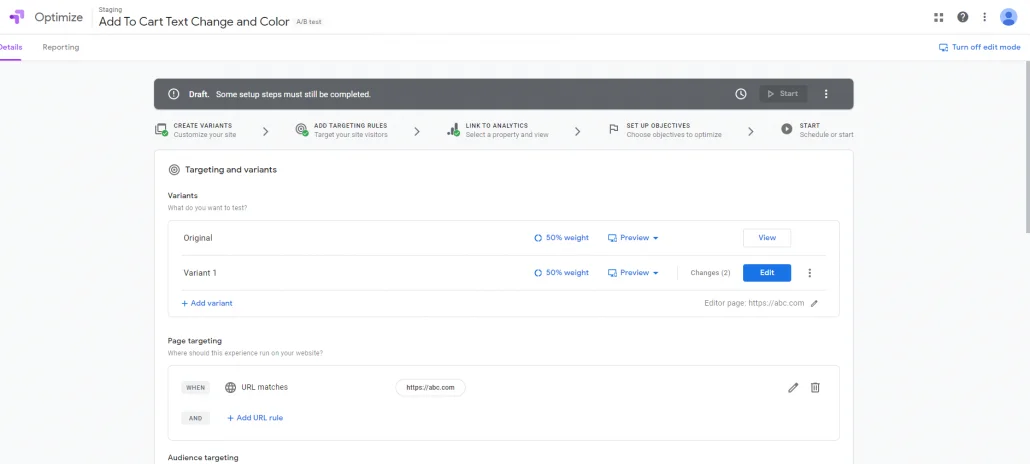
Google Optimization provides a free website optimization tool that online marketers and webmasters use to increase user conversion rates and user satisfaction by continuously testing different combinations of website content.
To make any test on Google Optimize is a very simple process. You don’t need to have any extra prior knowledge of any technology. Any non-technical person is also able to work on Google optimization.
Google Optimize provides us with target devices by their category, where we can set targets for specific devices.
Google Optimize also allows us to create a Split test, redirect test, and personalization test.
The main advantage of using Google Optimize is to create separate pages of a single test if we have multiple URL tests.
2. VWO Tool
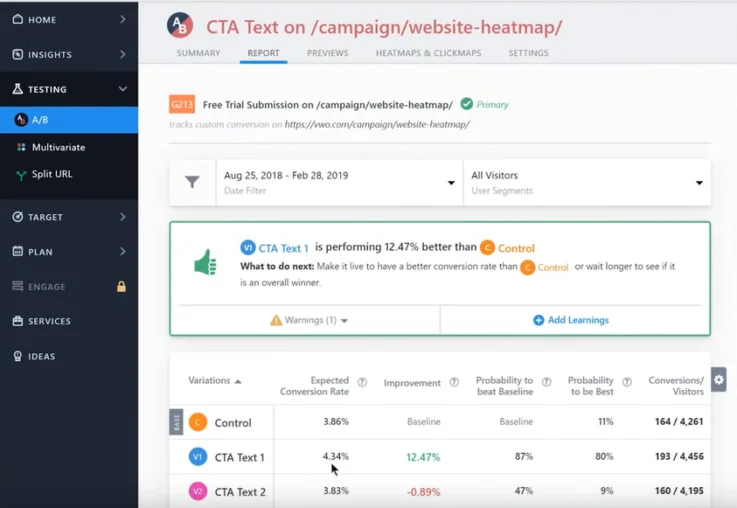
Recently, fast-growing companies have used the VWO tool for AB testing to implement AB testing on their websites and calculate conversion rates easily.
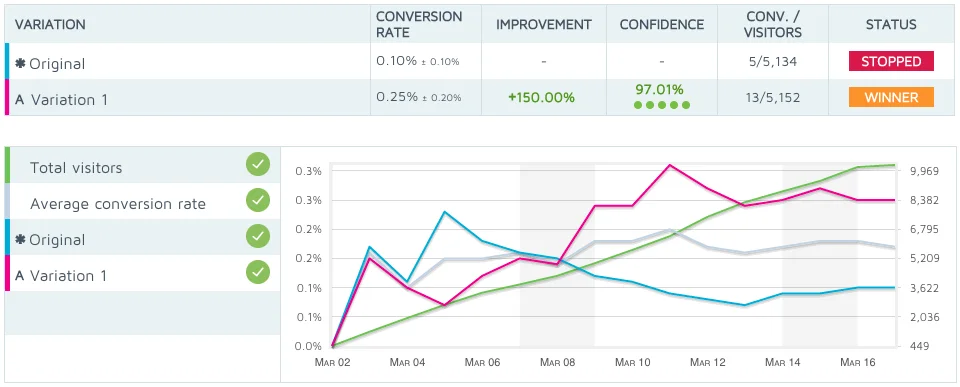
To use VWO, you only need to add SmartCode to your website and make tests on vwo.
When any user loads a page, the vwo servers interact with the code you added to your website and act accordingly.
Analyze the result: In this step, we calculate the conversion rate of which version has performed better.
Why you should do an A/B test
Let’s check why you should conduct A/B testing:
1. Solve visitor pain points.
There is usually a purpose behind a visitor’s visit to your website. Furthermore, they may be looking for information about your product or service, buying a particular product, reading/learning about a specific topic, or browsing. Visitors may face some common pain points while fulfilling the objective.
Sometimes, the copy can be confusing, or the CTA buttons are difficult to locate. An unsatisfactory user experience will impact the conversion rate. It is crucial to analyze data via Google Analytics and website surveys that will help solve the user’s pain points.
2. Get better ROI from existing traffic.
Most experienced optimizers realize that acquiring quality traffic for your website is expensive. Furthermore, the A/B testing tool allows you to make the most of the existing traffic for conversions without spending expenses to acquire new traffic.
Even the smallest changes to your website can result in significant increases in conversions as a result of A/B testing.
3. Reduce bounce rate
Bounce rate is one of the crucial metrics that will help you to analyze the website’s performance. Moreover, while there are many reasons why your website’s bounce rate is high, some are too many options, misaligned expectations, confusing navigation, excessive technical jargon, etc.
Different websites have different goals and cater to varying needs of the audience. Hence, there is no single solution to minimize bounce rates. However, performing a/b testing will resolve all your problems.
Furthermore, through split testing, you can perform tests on the multiple variations of an element of your website until you get the best possible results. Additionally, this will not only help you to identify the friction and visitor pain areas but also help you to improve user experience. Overall, this will help you retain the customers long-term and ultimately boost conversion rates.
4. Make low-risk modifications
Let us understand with the help of examples. Suppose you need to change the product description page. You can remove or update your product pages using A/B testing. Furthermore, you do not know the reaction of your visitors to these changes.
By performing an A/B test, you are ascertained about the response of your visitors.
Additionally, modifying your web application will not pay off in the short and long run. Testing the application and making changes will give you a more productive outcome.
What to Test – Prioritizing Your A/B Test Roadmap
1. Testing Everything Is Not A Smart Strategy
Many teams start testing button colors, fonts and icons as the a/b test initiates. Even after months, conversations remain the same. Firstly, the team should test elements that directly influence the buying decisions.
Focus first on:
- Headlines
- CTA copy
- Forms
- Pricing
- Social proof
2. Headline Should Be Checked First
Visitors spend a few seconds on the landing page. If the headline is not clear. Then it becomes difficult to scroll further. That’s why headline optimization is the highest-impact starting point of the A/B testing roadmap.
Test these variations:
- Clear vs creative headlines
- Benefit-focused messaging
- Problem-solving statements
- Short vs detailed headlines
- Different value propositions
3. CTA Copy Directly Influence User Direction
Many businesses change the color of the CTA button. However, the actual issue lies in the button message. “Get Started” or “Start My Free Trial” are not the same. Every CTA communicates commitment and user intent.
Experiment with:
- CTA text
- CTA placement
- Button size
- Primary vs secondary CTA
- Single vs multiple CTAs
4. Reducing Form Fields Improve Conversation
Every extra input demands extra effort from users. Sometimes removing just one unnecessary field noticeably improves the form completion rate. Don’t just do guesswork. Test the field individually.
Common form tests:
- Remove optional fields
- Short vs long forms
- Required field variations
- Multi-step forms
- Different submit buttons
5. Social Proof Build Test
Adding customer testimonials just on the page is not sufficient. Where you are displaying and the type of formats you used also directly impact conversion. Different audiences prefer different trust signals.
Test different options:
- Customer testimonials
- Brand logos
- Star ratings
- Customer counts
- Above-the-fold placement
Common A/B Testing Mistakes That Invalidate Results
Let’s check out:
1. Multiple Changes Make The Results Meaningless
If you change all the headlines, CTA, hero image and button color in a single experiment. If version B wins, then which is the actual winner? Giving credit to a single element becomes highly tough. A clean A/B test always follows a single-variable approach.
Best practice:
- Test one variable at a time
- Keep other elements unchanged
- Document every variation
- Compare only one hypothesis
- Avoid mixed experiments
2. Immediately Stopping The Test Is A Costly Mistake
Initially, if version B performs better, then you should not stop the experiment immediately. This seems appealing; however, statistically it is not worthwhile. Many times, early winners lost ground as traffic increased.
Always remember:
- Define sample size beforehand
- Wait for statistical significance
- Don’t trust early spikes
- Run tests for complete traffic cycles
- Be patient with results
3. Just Relying On Overall Result May Hide Important Insights
Sometimes an overall winning variation is not the best strategy for every audience. New visitors’ and returning customers’ behavior may vary. If you ignore segmentation. Then the wrong decision may apply to every audience.
Analyze results by:
- New vs returning visitors
- Mobile vs desktop users
- Traffic sources
- Geographic location
- Customer type
Conclusion
After reading the comprehensive guide on A/B testing, you are ready to prepare your optimization roadmap. Follow each step to resolve the major and minor mistakes that neglecting data can bring. A/B testing boosts your website conversion rate and prioritizes it for sustained success.
FAQ
What does digital marketing A/B testing entail?
Digital marketers use A/B testing to analyze which website version converts better when presented to visitors under different conditions.Why do we do A/B testing?There are various reasons why we execute A/B testing. Furthermore, a few include improving website conversions, unraveling visitor pain points, and reducing the bounce rate. What are AB testing examples?A/B testing is a controlled experiment in which you run two different product or website versions simultaneously and see which performs better. For example, you might run your current sales page against a new version with a section that addresses objections. Digital marketers use A/B testing to analyze which website version converts better when presented to visitors under different conditions.
Why do we do A/B testing?
There are various reasons why we execute A/B testing. Furthermore, a few include improving website conversions, unraveling visitor pain points, and reducing the bounce rate.
What are AB testing examples?
A/B testing is a controlled experiment in which you run two different product or website versions simultaneously and see which performs better. For example, you might run your current sales page against a new version with a section that addresses objections.