Best Lab Management Software 2026: Top 5 LIMS Compared
Quick Summary: All LIMS platforms available in the market are not the same. Few platforms are well-designed for pharmaceutical and diagnostic laboratories. Few research institutions. And few are designed to address the complexity of multi-site enterprises. Features, integrations, customization capabilities, pricing models, and scalability requirements differ for vendors. That’s the reason software comparison is not just about determining features. It’s a long-term operational strategy. This blog covers the top 5 best lab management software. We will understand the strengths, limitations, and ideal use cases for every piece of software. This will help clinics and hospitals make informed future decisions. Keep reading!
Introduction
Selecting lab management software has become extremely challenging in 2026. A few years back, basic sample tracking and report generation capabilities were sufficient for the lab. However, lab settings have drastically changed recently. Increasing test volumes. Strict compliance requirements. Multi-location responsibilities and faster turnaround expectations are pushing labs to redesign their technologies.
That’s the reason Laboratory Information Management Systems (LIMS) are more than just operational software. It has become a strategic technology platform for the laboratory. It directly affects workflow automation. Business data accuracy and regulatory compliance, plus scalability. When you are choosing the best lab management software for your laboratories, you don’t want to rely on popularity and price alone. Hospitals and clinics need to determine which platform is part of their workflows, meets their compliance requirements and allows for future growth.
Best Lab Management Software In 2026
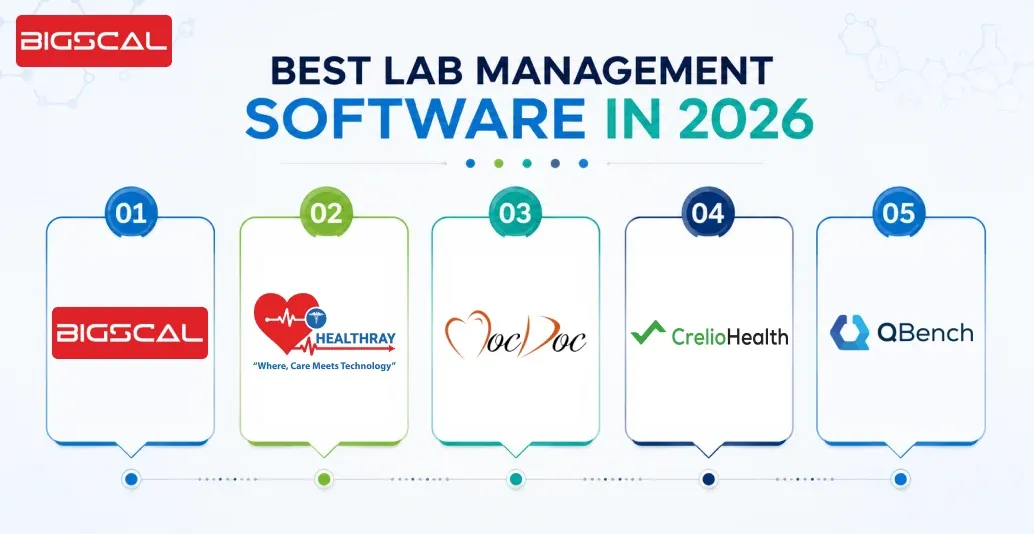
1. Bigscal Technologies LIMS
In 2026, Bigscal built a solid reputation in the healthcare industry. It gives equal weight to usability and flexibility. Let’s check some remarkable features of Bigscal.
Modular Architecture
The most distinctive feature of Bigscal is its modular architecture. Laboratories can start the implementation with core LIMS functionalities. Further, the lab can add modules as the business requirements evolve. Bigscal provides flexibility to labs to adopt workflow automation, instrument integration, advanced analytics, and telepathology modules.
Scalability Without Complexity
Few LIMS platforms introduce complexity once they scale. Bigscal effectively helps labs address these challenges. Bigscal uses the same unified architecture to provide immense support to small laboratories and large enterprises. This long-term scalability saves organizations from technology replacement costs and operational disruptions.
User-Centric Design
Laboratory software is successful only when users adopt it efficiently. Bigscal has designed the LIMS platform with a usability-first approach. Lab technicians, pathologists, and administrative teams can start the workflow with minimal training. Bigscal’s intuitive interfaces’ implementation reduces staff stress. This helps healthcare organizations achieve faster time-to-value.
Provide Best Real-Time Collaboration Tools
Modern labs are increasingly becoming interconnected environments. Modernization in labs requires multiple stakeholders and real-time information access. Bigscal built-in collaboration tools help enable seamless communication among pathologists, technicians, and administrative staff.
Customization Without Coding
Every lab has different workflows and reporting requirements. Bigscal provides flexibility to organizations to customize their workflows, reports, and business logic. No-code customization capabilities help labs to quickly adapt to their changing operational requirements. This minimizes the implementation cost.
Pricing Model
Bigscal offers a flexible pricing model on the basis of lab size, user requirements, and selected modules. Bigscal LIMS software prioritizes transparency. It builds scalable pricing structures that align with future growth trajectories.
Ideal Use Cases
Bigscal LIMS solutions are particularly useful for healthcare organizations that are in a rapid growth phase. It is also well tailored to healthcare facilities or treatment centers that are contemplating growth plans in the next few years. Growing diagnostic centers, regional pathology networks, scaling research institutions, and multi-location laboratory deployments can derive significant value from Bigscal LIMS solutions.
2. Healthray LIMS
Healthray is eminent as a game-changing platform for the modern laboratory ecosystem. Heathray works as an intelligent assistant that automates complex workflows. Additionally, it learns from continuous patterns to optimize the process. Let’s check more about Healthray features:
AI-Powered Sample Routing
The Healthray artificial intelligence platform accurately analyzes test parameters. It automatically routes the samples to the right analyzer and workstation. This intelligent routing eliminates manual handling errors. Therefore, samples follow an efficient pathway inside the laboratory. Improving processing speed.
Critical Sample Detection and Prioritization
It is highly imperative to quickly identify time-sensitive samples in diagnostic laboratories. Healthray machine learning models instantly detect urgent ER samples and critical patient samples. And automatically place them in the top of the processing queue. This capability of the Healthray LIMS solution reduces dependency on manual intervention.
Predictive Maintenance to Ensure Equipment Dependability
Productivity and income are directly impacted by laboratory downtime. Labs can identify maintenance needs prior to equipment failures with the aid of Healthray’s predictive maintenance capabilities. This helps laboratories avoid unplanned downtime. Labs can maintain instrument availability. This improves operational continuity.
Integrated Business Automation
One of Healthray’s unique strengths is its business automation approach. Platforms are no longer just restricted to managing workflow. Financial tracking, revenue cycle management, and billing integration are all offered by the Healthray LIMS solution. In conventional LIMS system, these business integrations are relatively uncommon.
Pricing Model
Healthray LIMS systems operate on a scalable subscription model. Small laboratories that manage standard sample volumes. The cost is usually around $30 a month and $1,000 if clinics opt for a subscription. High-throughput enterprises and research facilities are relatively expensive.
Ideal Use Cases
Healthray is a highly useful LIMS solution for pathology labs. Diagnostic centers. Hospital laboratory departments and multi-branch diagnostic networks. The Healthray platform’s biggest strength is automating complex workflows. Heathray efficiently manages business operations.
3. MocDoc LIMS
MocDoc LIMS software is specifically constructed for diagnostic testing facilities. Let’s check out some remarkable features of LIMS.
Unified LIMS and LIS Platform
Multiple disconnected structures greatly impact lab efficiency. MCdoc integrates automation, patient engagement, billing, diagnostics and workflow management into a single integrated system. This unified approach reduces data silos.
Automated Sample Management
Sample handling is critical for high-volume diagnostic laboratories. Mocdocs provides flexibility to labs to directly place sample orders from apps. Register sample containers. Print barcode. Recording sample data. Assigning collection agents. Complete automation approach helps labs reduce manual intervention.
Customizable Synoptic Reporting
Pathology reporting is not identical for every laboratory. Customization capabilities are highly important for different specialties and reporting requirements. MocDoc provides customizable synoptic reporting features. This helps labs configure according to their specific reporting requirements.
Pricing Model
MocDoc follows a flexible pricing approach. Further, Mocdoc provides perpetual license and SaaS deployment models. Prices range from $300 to $800 per month for small and medium-size specialized diagnostic testing facilities.
Ideal Use Cases
Mocdoc is especially helpful for multi-location diagnostic chains, hospital pathology departments, home collection networks, and standalone diagnostic centers. Mocdoc’s greatest asset is its in-depth knowledge of the daily operational realities of diagnostic labs.
4. CrelioHealth LIMS
Creliohealth is a web-based, mobile-ready laboratory and radiology information management system. Let’s check more features about Crelio Health.
AI-Powered Registration and Automation
Manual test requisition entries are the major sources of errors and delay in clinical labs. CrelioHealth, through AI, automatically converts handwritten paper test requisitions into digital orders. This automation significantly reduces registration errors.
Customizable Workflows and Sample Tracking
Every laboratory workflow is not identical. CrelioHealth provides customizable workflows, end-to-end sample tracking, and configurable report formats. This helps labs configure their system according to operational requirements.
AI Dashboards and Real-Time Insights
Modern labs require a constant need for real-time operational visibility. CrelioHealth AI-powered multi-view dashboards provide viable insight on lab performance, inventory levels, test results, and operational metrics. This helps users quickly identify bottlenecks.
Pricing Model
CrelioHealth is based on a flexible subscription-based pricing model. Pricing starts from $550 for new lab setups and small-sized laboratories. Customizable monthly, quarterly and annual billing options are available for enterprise laboratories. Also, it provides additional add-ons on user logins, machine interfacing, and report-view packages.
Ideal Use Cases
CrelioHealth is suitable for small and mid-sized diagnostic centers. Multi-location diagnostic networks. Physician office labs, hospital labs, and D2C (direct to consumer) testing organizations. The platform’s greatest strength is its ability to strike the perfect balance between affordability and quick implementation and enterprise-grade functionality.
5. QBench Cloud-Based LIMS
Qbench creates traction gain among organizations that are frustrated with legacy LIMS implementations’ complexity and lengthy deployment cycles. Let’s elaborate on more features.
Rapid Configuration Without Coding
Every laboratory workflow is unique. Customization capabilities are far more important. QBench provides an intuitive point-and-click configuration interface for creating custom fields, workflows and business logic. Healthcare facilities no longer require coding expertise and extensive vendor consulting.
Modern API-First Integrations
Qbench are designed with modern API architecture. Here, integration is a part of core capability. Through well-documented REST APIs , laboratories can connect with external systems, dashboards and laboratory instruments in a scalable manner. This approach significantly simplifies future integration.
Quick Deployment and Faster ROI
LIMS implementation timelines directly impact business outcomes. QBench standard implementations take approximately 4–8 weeks for deployment. quicker user adoption, reduced operational disruption and faster return on investment (ROI) are some of the most beneficial qualities of qbench.
Flexible and Predictable Pricing
Budget predictability is an important consideration for laboratories. Qbench follows a transparent per-user pricing model. It naturally scales with the lab’s growth. Organizations no longer face the uncertainty of hidden customization costs and extensive consulting expenses.
| Feature/Criteria | Healthray | Bigscal | MocDoc | CrelioHealth | QBench |
|---|---|---|---|---|---|
| Best For | Pathology labs, scalable clinics, diagnostic centers | Growing networks | Diagnostic centers | Scalable clinics | Mid-market labs |
| Deployment Model | Cloud SaaS/On-premises | Cloud/On-Premise | Cloud/On-Premise | Cloud SaaS | Cloud SaaS |
| Implementation Timeline | 2–4 weeks | 2–4 weeks | 6–10 weeks | 2–10 weeks | 4–8 weeks |
| Configuration | Pre-built + Custom | Highly Modular | Workflow Templates | Quick Setup Templates | Point-and-Click |
| Starting Price | $29–12K/month | $30–80K/year | $300–800/month | $550–1000/month | ~$45K/year (10 users) |
| Enterprise Scalability | Excellent | Excellent | Good | Excellent | Good |
| AI/ML Features | AI-Driven (Core) | AI-driven | Basic | AI-Powered | Emerging |
| Instrument Integration | Excellent | Very Good | Good | Good | Good |
| Regulatory Compliance | FDA, ISO, GMP/GLP, HIPAA | FDA, ISO 17025, HIPAA | NABL, ISO 17025 | HIPAA, ISO 17025 | ISO 17025 |
| Mobile Capabilities | Good | Good | Good | Excellent | Good |
| Multi-Location Support | Excellent | Excellent | Excellent | Excellent | Good |
| API/Integration Flexibility | Good | Very Good | Good | Very Good | Outstanding |
| Ease of Use | Good | Excellent | Excellent | Excellent | Very Good |
| Customer Support | Very Good | Excellent | Good | Good | Good |
| Training Requirements | Low | Low | Moderate | Moderate | Moderate |
| Customization Without Coding | Excellent | Excellent | Good | Good | Excellent |
| Integrated Billing/Business Tools | Yes (Unique) | Optional | Yes | Yes | No |
| Pathology-Specific Features | Outstanding | Good | Outstanding | Good | Basic |
| Best For Small Labs | Yes | Yes | No | No | No |
| Best For Multi-Site Enterprise | Good | Excellent | Good | Excellent | Good |
| Cloud Security/Data Protection | Excellent | Excellent | Excellent | Excellent | Excellent |
| Typical ROI Timeline | 6–8 months | 3–9 months | 6–12 months | 6–9 months | 6–12 months |
Detailed Platform Comparison by Use Case
Let’s check out
1. Best Lab Management Software for Small Diagnostic Centers (50 Employees)
Small diagnostic centers require a platform that quickly gets implemented. Demand minimal IT resources. Organize daily activities and automate them.
Recommended Platforms: Healthray, CrelioHealth, Bigscal
Key Advantages
- Quick implementation timeline: 2–8 weeks
- Affordable entry pricing: $30–$100 per month
- Minimal IT infrastructure and maintenance requirements
- Mobile app support for remote monitoring and management
- Easy user adoption and low training requirements
- Faster ROI and lower operational risk
2. Best Lab Management Software for Growing Multi-Location Networks (50–200 Employees)
As laboratories expand to multiple locations. Then, centralized visibility and standardized workflows become highly critical. In this phase, it is highly recommended to use scalable architecture to accomplish long-term success.
Recommended Platforms: Bigscal, Healthray, QBench
Key Advantages
- Cost-effective multi-location coordination
- Balanced customization and ease of use
- Centralized reporting and operational visibility
- Strong vendor support and training programs
- Better collaboration across distributed teams
3. Best Lab Management Software for Large Healthcare Organizations (200+ Employees)
Large healthcare enterprises have to face the complexities of high transaction volumes. They deal with multiple departments and complex compliance standards. For these organizations, enterprise-grade architecture and proven deployment capabilities are a must.
Recommended Platforms: Healthray, Bigscal
Key Advantages
- Enterprise-grade architecture and governance capabilities
- Proven multi-site deployment experience
- Advanced reporting, dashboards
- Powerful analytics
- Dedicated implementation
- Onboarding support
- Better control over compliance and data management
- Scalability over the long run for intricate healthcare systems
4. Best Lab Management Software for High-Throughput Diagnostic Laboratories
Speed and efficiency directly impact the business’s performance. high-volume diagnostic laboratories highly deal with such intricate challenges. Healthcare organizations should choose a platform that simplifies sample processing. Enhances patient experience. Raises operational profitability.
Recommended Platforms: Healthray, MocDoc, Bigscal
- AI-powered sample routing optimization
- Faster turnaround time improvements
- Efficient sample batch processing capabilities
- Advanced result management and tracking
- Reduced manual intervention and processing errors
Conclusion
Selecting the best lab management software is a critical decision for clinics. This decision is not just limited to software implementation projects. It has a direct impact on operational efficiency. Regulatory compliance. Employee satisfaction. And ultimately patient care. There is no single platform on the market that is considered to be the best. Your ideal LIMS depends on your operational realities. Business priorities and future objectives. Therefore, laboratories should verify actual requirements and conduct an accurate assessment. They should not just rely on feature comparisons and vendor popularity.
FAQ
What makes Heathray the best lab management software?
Healthray boost remarkable features such as automation, compliance, scalability and compliance This makes a perfect fit for all sizes of lab facilities. It reduces complex workloads to a great extent at an affordable price.
Why should hospitals choose Bigscal?
Bigscal LIMS solutions are extremely beneficial for healthcare organizations that are in a rapid growth phase. It is also well suited to healthcare facilities or treatment centers that are considering expansion plans in the coming years. Bigscal LIMS solutions can provide significant value to growing diagnostic centers, regional pathology networks, expanding research institutions, and multi-location laboratory deployments.
Why is Healthray the best lab management software for low-budget startups?
Healthray boasts customizable features and AI automation. Even startups that require limited features and rely on low budgets can easily afford Healthray LIMS solutions.
Which LIMS is best for large healthcare organizations at an affordable price?
In 2026, healthray and Bigscal are leading the market. As these platforms provide high-tech features at a low budget. Any lab sizes can efficiently automate their work even if run on a low budget.
Is the LIMS solution secure if the organization deals with highly sensitive financial information?
Yes, LIMS software are highly trained on regulatory compliance procedures. It follows all the essential parameters that hospitals require. It is completely safe to use.