Best Technology for Developing Scalable EMR Software
Quick Summary: This blog helps you discover the best technologies available for developing scalable EMR software. Firstly, it offers an insight into the characteristics of the EMR application. Following it, technologies are listed that help you fulfill the business requirements and build EMR software, offering flexibility, top-notch performance, data security, and all other such leverages.
Introduction
With the increasing business caliber and data processing, EMR software has become a fundamental requirement. There are numerous EMR software available in the market that you can purchase at any time. However, experts recommend creating a custom one, and for that, you need to choose the right technology.
Here, we have listed all the potential technologies that can help you build an EMR from scratch. All the techs are listed in accordance with business constraints so that you can save money, effort, and time.
The Core Characteristics of Scalable EMR Software
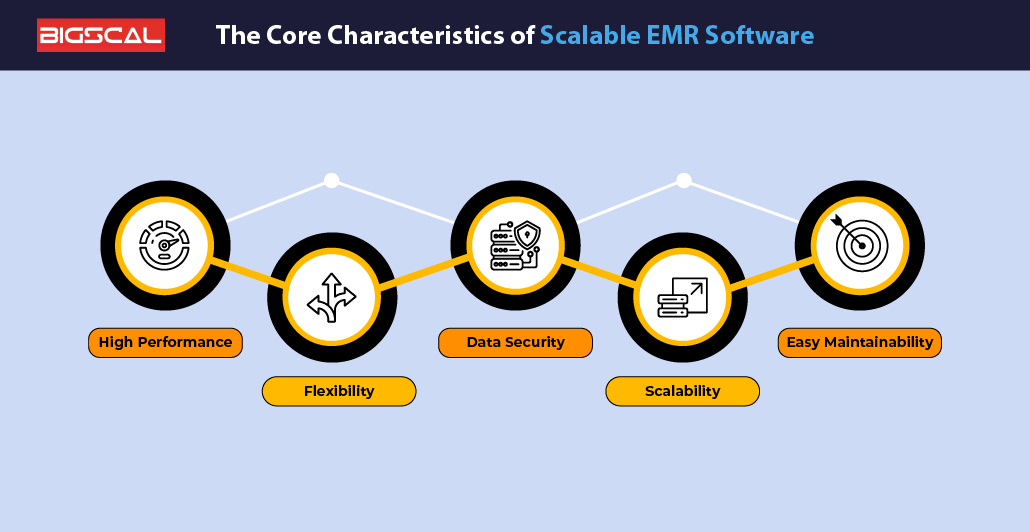
Before you dive directly into choosing the best technology for EMR development, you should understand its core functionalities. It’ll help you cross-verify the requirements with available technologies, helping you select the one that complies accurately and appropriately.
#1: High Performance
Your EMR software must be high in performance, enabling you to process millions of requests per second with the utmost quality. In addition, it should be available 24/7 to all stakeholders so that business operations can retain their consistency and support in improving productivity.
#2: Flexibility
In the dynamic business environment, the requirements change frequently. To meet all such needs, your EMR application must be flexible so that it can integrate newer and legacy solutions seamlessly. Moreover, it should be compatible with advanced cloud, microservices, and database systems to provide the best-in-class results.
#3: Data Security
Data is one of the primary assets of organizations, and your EMR system should protect it at all costs. So, you should choose a technology that helps you configure fundamentals. and advanced security controls. This will help maintain data integrity. availability, and confidentiality.
#4: Scalability
As we are discussing scalable EMR software development, scalability is going to be a must for the core characteristics. It refers to adding new functionalities and enabling the application to handle more users with growth over time. Both horizontal and vertical scalability are considered in this aspect.
#5: Easy Maintainability
Your enterprise resource management software should be easy, affordable, and quick to maintain. This means that all technological updates and patches should be impeccably accessible throughout their lifetime. Also, if there’s some official support, documentation, and third-party maintenance services, then it’s going to be best for continuous improvement.
For every EMR and similar application, such as custom healthcare software solutions, you should evaluate the development technology based on the factors listed above.
Recommended Technologies for EMR Software Development
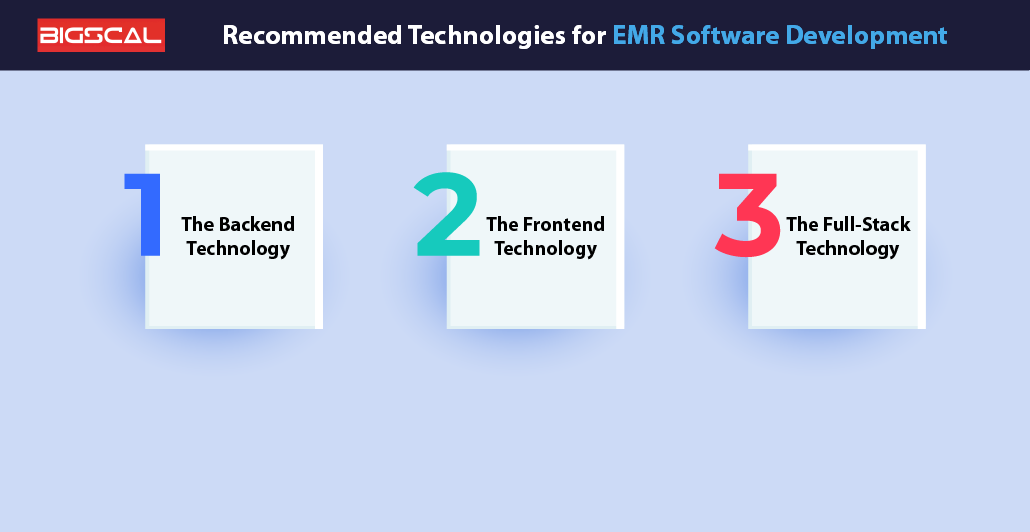
Now, let’s have a look at the available technologies that can help you develop scalable EMR software with all the characteristics undergone in the previous section.
#1: The Backend Technology
Firstly, we have the backend technology that will help you define and process logic to maintain the business operations. These technologies are responsible for performance, responsiveness, and ensuring consistency of the EMR application.
Some of the most popular backend techs for EMR are:
- Node JS: For a web-based EMR system. Node JS is a reliable technology. As it can concurrently handle thousands of threads. In addition, its event-driven. And non-blocking architecture. Node ensures top-notch performance. and a scalable backend.
- PHP: PHP is more of a scripting language. Used to build web applications. It can help you build any kind of responsive, dynamic and interactive feature you need to streamline operations.
- Python: Python is used as a language for development. and scripting. It can act like PHP, Java and Node JS as well. But, it provides some additional benefits of artificial intelligence and machine learning capabilities in your EMR application. Also, it’s lightweight and functions faster than others.
- .NET: You can use .NET Core and .NET framework as a backend for your EMR application. It can process more than seven million requests per second and maintain higher availability of the system. Moreover, .NET is secure and ensures data integrity and confidentiality.
#2: The Frontend Technology
We now have frontend technology, which will be used to design an interface that will improve the user experience by making it more effective, streamlined, and appealing.
React JS: It’s a library. Based on JavaScript. It is utilized to create responsive interfaces. Both native and web interfaces can be designed using React. In addition, you can configure it to dynamically update. According to the current EMR application state.
- Angular JS: It’s a framework that offers extensible features. It offers flexible libraries and tools for creating alluring interfaces for desktop. web. and mobile apps. It’s quite affordable and easy to use and maintain.
- .NET: In the .NET ecosystem, you have the .NET MAUI and ASP.NET to create the interface of your EMR software. It focuses on all frontend aspects, such as scrolling, icon placement, responsiveness, clarity, cognitive load, and more. Due to this, industry experts recommend to hire .NET developers for EMR development.
#3: The Full-Stack Technology
This category belongs to the technology that you can utilize for both frontend and backend development. Microsoft .NET is one of the popular, high-end and excellent full-stack technologies. It gives you all the necessary frameworks, libraries, tools, databases and cloud services under one umbrella.
Also, you can hire a .NET development company to save costs and leverage the .NET framework, .NET Core, .NET MAUI, ASP.NET, ML.NET, Xamarin, and all other Microsoft technologies. Moreover, you can integrate .NET with other frontend techs, such as ReactJS and AngularJS, and your EMR software will function smoothly.
Furthermore, .NET can also aid you in utilizing any of the cloud services to deploy the EMR application. Also, you can create any kind of software, as .NET allows the development of a web app, desktop software, mobile app, and even a hybrid solution.
Thus, .NET is the perfect full-stack technology for developing scalable EMR software.
Why 2026 EMR Development Requires a New Technology Mindset
FHIR-Based Interoperability As A Core Requirement
In modern healthcare ecosystem, EMR software should communicate with multiple systems. It allows seamless data sharing between hospitals. Labs, pharmacies, insurance providers. and telehealth platforms.
A strong EMR technology stack should support the following:
- HL7 FHIR R4 and R5 standards
- RESTful API architecture
- JSON and XML data exchange
- Real-time healthcare data synchronization
- Cross-platform interoperability
- Standardized patient information sharing
Deciding on the Right Backend Technologies
Backend technology directly impacts performance. scalability, and integration capabilities. That’s why development companies should select healthcare-specific requirements.
Popular backend choices include:
- .NET Core for enterprise-grade applications
- Node.js for scalable API services
- Python for AI and machine learning workloads
- Microservices architecture support
- High-performance database connectivity
- Cloud-native deployment capabilities
Building Ambient Clinical Intelligence (ACI)
Clinician exhaustion is a significant problem in the medical services industry. Ambient clinical intelligence liberates medical professionals from traditional manual paperwork and documentation. Help them focus more on patient care.
ACI-enabled EMR solutions can provide:
- Voice-to-chart functionality
- Automated clinical note generation
- Natural language processing (NLP)
- Real-time conversation transcription
- AI-assisted documentation workflows
- Reduced administrative workload
Leveraging AI and Machine Learning Frameworks
AI is no longer an optional feature in healthcare software. Modern EMR platforms are integrating AI technologies for predictive insights and intelligent automation.
Key AI technologies include the following:
- PyTorch for deep learning models
- Hugging Face APIs for NLP tasks
- Clinical speech recognition engines
- Predictive analytics algorithms
- Medical data classification models
- Automated workflow optimization
Implementing Zero-Trust Security Architecture
Healthcare data are a highly valuable target for cybercriminals. modern EMR systems should go beyond traditional perimeter-based security.
A Zero-Trust framework typically includes the following:
- Continuous user verification
- Device-level authentication
- Least-privilege access controls
- Identity-based security policies
- Continuous monitoring and threat detection
- Segmented data access environments
Advanced Authentication and Access Control
It is highly crucial to implement robust authentication mechanisms to keep the patient data secure. Access management role is critical in modern healthcare applications.
Security controls should include:
- SMART on FHIR implementation
- OAuth 2.0 authorization
- OpenID Connect authentication
- Multi-factor authentication (MFA)
- Role-based access control (RBAC)
- Session monitoring and management
Conclusion
To develop scalable EMR software by using the best technology, you should first understand the core characteristics of the system. Following it, you need to explore the available and well-established frontend, backend, and full-stack development technologies. It will help you to make the right decision and meet the stakeholder needs in the long run.
You can also choose from a variety of frontend and backend technologies like AngularJS, ReactJS, NodeJS, Python and PHP. But full stack is always recommended like .NET for high compatibility. So you can choose yourself, but it’s better to consult a specialist.
FAQ
Why focus on EMR characteristics when choosing development technology?
Once you understand the required characteristics in your EMR solution, you have a clear insight into the type of technology that can help you build those features. In addition, it helps you understand the basic functionalities that must be developed and maintained to achieve the best-in-class results.
Why is full-stack technology better than individual frontend and backend tech?
The components of the full-stack technology are in sync by default. You don’t need to put additional effort and resources into integrating them for building the EMR application. In addition, there are no updation and upgradation complexities with full-stack tech. In addition, when you choose full-stack, you pay a generous amount to developers and avail of both frontend and backend development services. However, for individual technologies, you need to invest more in hiring and retaining professionals.
How is .NET the only reliable full-stack for EMR development?
.NET technology is capable of covering user requirements, and it also ensures the development of each EMR feature. The dotnet tech is scalable in itself, which ensures that your EMR solution will be able to handle a growing user base in the extended run. In addition, the .NET ecosystem has every technology for your need, such as the .NET framework and .NET Core for the backend, ASP.NET for the front end, .NET MAUI for the complete app, MS Azure for the cloud, and more. Thus, it’s a complete package and by choosing it, you don’t have to look at any other development technology.
Which is better, backend technology: Python or PHP?
Python and PHP are both excellent development technologies. However, experts recommend PHP for web development. And Python for server-side scripting purposes. In addition, Python advances in scalability. and performance factors,. which makes it a Reliable and dependable choice. But you should always consult with the development firm before selecting any of them.
How can we ensure that the selected technology is capable of maintaining data security?
To ensure whether the technology is secure or not, you only need to follow the following three steps: Check the currently available vulnerabilities and their exploitation levels. If the loopholes are minimal and the threat factor is low, it’s good to go.
- Check the currently available vulnerabilities and their exploitation levels. If the loopholes are minimal and the threat factor is low, it’s good to go. Verify the by-default available security mechanisms and ensure that authentication, HTTPS enforcement, encryption, and authorization are on the list.
- Verify the by-default available security mechanisms and ensure that authentication, HTTPS enforcement, encryption, and authorization are on the list.
- Validate that the technology is able to integrate third-party security tools.
Validate that the technology is able to integrate third-party security tools. If the selected tech passes all three conditions, it can secure data.