10 Must-Have Clinic Management System Features For Better Workflow
Quick Summary: Upgradation is a must to increase your office efficiency, continuously. Even if you have an online clinic practice management software makes a system, it’s useless without these must-have features; these Clinic Management System features are the key to efficiency for clinical practices. So, read this article and increase your staff productivity with these must-have features.
Introduction
We all know about the importance of CMS in many medical practices, but without Must-Have dental clinic management system Features it is not worth it. Thus, you need to integrate all the mandatory features to get maximum outcomes. By integrating features, you can ensure a seamless workflow and efficient patient care.
You are now having questions like the exact reason to integrate innovative features, how it would benefit medical practice, and what must-have practice management software features are.
So, from appointment scheduling to prescription management tools and automated medical billing, and invoicing, there are more features you need to know. And all the remaining features you will read in this article. Furthermore, you will also get answers to all your questions.
Keep reading and get insights about how these features can enhance your clinic management system project!
Must-Have Clinic Management System Features
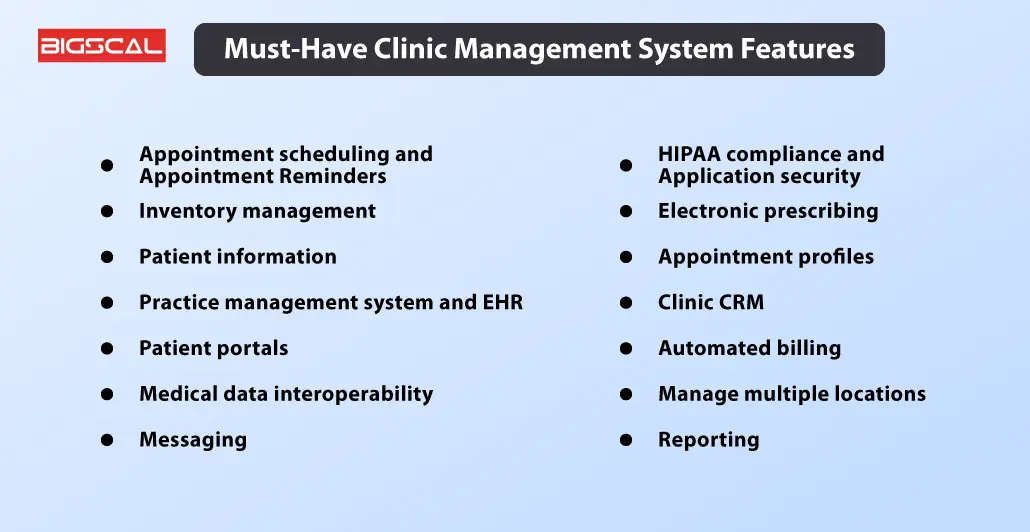
Let’s have a look at hospital clinic management system Features:
Appointment Scheduling And Appointment Reminders
The features of performance management the practice should include are Appointment scheduling and Appointment Reminder. We should strive toward making the whole process of finding a convenient appointment time as straightforward as possible by allowing them to schedule the appointment easily. Similarly, this option is critical for hastening patients’ flow within the facility and decreasing the waiting time.
Through complementing these components, medical specialists would be able to allow patients to book their appointments through his CMD. On the contrary, the CMS practices are most likely utilizing the built-in appointment reminders and reminder features in order to limit no-shows. Automatic reminders in SMS or e-mails for physicians and patients always ensure that their appointments won’t be overlooked or sleeping out time.
Inventory Management
Inventory management is the most temporary function undertaken in the clinical set-up to monitor and control its consumables. The CMS includes stock management tools that save companies from spending on special clinic inventory management system The functionality of this feature makes it possible for healthcare providers to monitor the operating cycle of medical equipment such as bed sheets, syringes, and medication.
It prevents shortages or overstock situations and helps the service run smoothly. It therefore helps healthcare services to achieve their best potential. The hospital staff will be informed about patient status and stock level in real-time via this web-based platform, thereby allowing for proper supply management and usage decisions. Proper inventory management is one of the drivers that also helps to cut costs in company operations, as it reduces waste and guarantees that the much-needed stuff is available when a demand arises.
Patient Information
Unlike other features, patient information management is the core element in a Clinic Management System Software. This aspect encompasses keeping data inclusive of a patient’s demographics, point of contacts, medical details like his history, and insurance information in the correct order.
Such an e-track of health record allows fast retrieval of all the necessary data for healthcare providers and consequently keeps treated person’s care procedure more efficient. Through it, correct registration records are kept, appointments are tracked, and the team members can communicate well.
Practice Management System And EHR
Introducing Practice Management System (PMS) and electronic health records (EHR) should be a necessary step to manage procedures in healthcare operations. With that, PMS arranges administrative work such as scheduling appointments, billing, and inventory that is expected from the right practice management software. On the plus side, HER converts and gathers patients records digitally and peripherizes them to all healthcare specialists across the board, thus sharing maximums of information safely.
The multifunctional practice management system allows for whole clinic effectiveness enhancement, management of paperwork, reduction of errors, and ultimately improvement in the quality of patient care by incorporating all of the information that is required, whether it is a patient’s medical history or treatment plan. coordinating these systems play a crucial role in the working of modern and ordered health care services.
Patient Portals
A patient portal is a fundamental part of a health management system providing a secure online platform for particular individuals who can then read their own health information easily. It provides patients to screen their test results, makes arrangements for their appointments and be in contact with healthcare providers.
With coming closer, the patient engagement is also getting facilitated and the users are getting the chance to join the care journey as the real actors more than never before. Patient portal is a piece that is a part of the much transparent and involved healthcare environment that will help the patients and the health caregivers to communicate and be on the same page.
Medical Data Interoperability
The ability of systems or platforms to exchange data in the electronic field and using it, is called the interoperability of medical data. In any clinic management system, the term interoperability means that the patient data is shared among healthcare providers, labs, and other relevant entities in a smooth and timely manner.
This feature is the fundamental of well-integrated care as it ensures the prevention of data windows and helps increase healthcare performance in general. This makes it possible for healthcare specialists to catch up with a patient’ medical history giving way to decisions that are more evidence-based which further results in improved levels of care.
Interoperability plays a vital role in building a real time communication Highway which would help data transfer and translation smoothly for better patient care.
Clinic CRM
A Clinic Customer Relationship Management (CRM) system is essential for maintaining patient relationships and better clinical care. It organizes patient data, appointments, and communication, ensuring a personalized and efficient healthcare experience.
How to Choose Features Based on Clinic Size and Specialty
While selecting clinic management system features, it is important for clinics to understand their size and specialty. The right features simplify all the complex operations and help clinics achieve fruitful outcomes.
Basic Features are Best for Small Clinics
Small clinics and solo practices should select simple and affordable clinic management system features.
Important features:
- Online appointment booking
- Basic EHR/EMR
- Patient portal
- Mobile access
- Digital prescriptions
Additionally, cloud-based CMS are best for small clinics, as upfront costs are lower and maintenance is convenient.
Medium Clinics Need Advanced Workflow Features
When clinics grow, then multi-provider management and automation become important.
Useful features include:
- Multi-doctor scheduling
- Automated billing
- Role-based access
- Analytics dashboard
- Appointment reminders
Additionally, these features reduce no-shows and also improve revenue tracking.
Large Clinics And Multi-Specialty Setups Need Scalable CMS
Large clinics require an enterprise-level system that can conveniently handle a high volume of patients.
Important capabilities:
- Centralized EMR
- AI-based queue management
- Lab and LIMS integration
- API/FHIR interoperability
- Advanced reporting tools
Overall, this clinic’s management system features simplify the complex operation and make it organized.
Select Features According To Specialty
Every medical specialty requirement is different.
Examples:
- Cardiology: ECG integration
- Dermatology: Image upload support
- Pediatrics: Vaccination reminders
- Dental clinics: Imaging integration
- Orthopedics: Rehab planning templates
Additionally, specialty-based tools make the doctor workflow easy.
Choose Scalable System For Future Growth
A clinic management system feature should support future expansion. Before finalizing the systems, clinics should:
- Audit the workflow
- Staff and patient volume
- Attends demo sessions
- Features should match with the existing process
Overall, the right clinic management system helps clinics achieve long-term efficiency. They can successfully deliver better patient management and attain faster ROI.
How Do Small Clinics Decide Which Modules To Skip
Small clinics typically choose modules based on their limited resources and patient volume. It is not necessary to buy all the features at the beginning. Let’s check how small clinics should select the modules:
Audit The Workflow
Small clinics should analyze their daily operations. Check the following in the auditing process:
- Daily patient count
- Appointment handling
- Billing workload
- Staff responsibilities
- Manual processes
Moreover, if any task is a small part of overall flow, then clinics can skip that module.
Prioritize Core Features
Many small clinics begin with small modules. Must-have modules include:
- Appointment scheduling
- Basic EHR/EMR
- Billing and invoicing
- Patient records
- SMS/WhatsApp reminders
Overall, these features improve efficiency in the practices. Also, it helps small clinics to reduce front desk workloads.
Skip Unnecessary Advanced Modules
Every advanced feature is not useful for clinics. Moreover, if a clinic handles a single specialty or low patient volume, these modules will create extra cost.
Commonly skipped modules:
- AI-based analytics
- Enterprise reporting
- Multi-department workflows
- Advanced inventory systems
- Complex HR/payroll tools
Take Decision As Per Existing Workflow
Clinics need to determine the tasks that are easy for them to do manually. Examples:
- Excel-based reports already working
- External lab partnerships available
- No in-house pharmacy setup
In such cases, clinics can initially skip analytics, LIMS, and pharmacy sections.
Prefer Modular SaaS Systems
Small clinics prefer flexible clinic management system features. This helps them integrate additional modules in the future.
Benefits include:
- Lower starting cost
- Easy scalability
- No unnecessary feature overload
- Better user adoption
This approach helps clinics to pay only for the required features and helps them expand their system in the future.
How Bigscal Can Help In Integrating Key Clinic Management System Features?
If you want to integrate such Clinic Management System Features. Don’t have an idea how to create clinic management system? And are searching for a software development company to integrate customized features as per your choice, then you must approach us.
Our developers are pro at integration of customized features. This will help you to optimize seamless healthcare delivery. With a focus on real-time accessibility, We ensure connectivity for on-call consultation services. Our Expertise lies in establishing a secure telehealth infrastructure. Further we implement end-to-end encryption for patient information protection during virtual consultations.
Conclusion
A right clinic management system features streamlining all the complex operations of medical practices. The healthcare industry is rapidly moving towards a digital-first model. Clinics that are adopting modern clinic management system features get incredible benefits. A right CMS helps clinics to survive and grow in the competitive healthcare market.
FAQ
What is clinic management system in ASP.Net?
A clinic management system in ASP.Net is a web-based application developed using the ASP.Net framework. It facilitates efficient clinic operations management, including appointment scheduling, patient records, billing, and staff coordination. ASP.Net provides a robust platform for creating dynamic and scalable solutions, enhancing the overall functionality of the clinic management system.
What is cloud based clinic solution and system?
Cloud based software-based clinic solutions and systems refer to a healthcare management platform hosted on the cloud. It enables clinics to store and access patient data, manage appointments, and streamline operations online. This scalable and accessible approach enhances collaboration among healthcare providers and ensures data security through remote servers.
What is the aim of the clinic management system?
A clinic management system aims to streamline and enhance the overall efficiency of healthcare operations. It focuses on automating administrative tasks, optimizing appointment scheduling, maintaining accurate patient records, and facilitating better communication among staff. The ultimate goal is to improve patient care delivery and create a more organized healthcare environment.
What are the functions of a clinic?
Clinics serve various functions, including medical consultations, diagnosis, treatment, and preventive care. They handle routine check-ups, vaccinations, and manage chronic conditions. Clinics also provide health education, promote wellness, and offer specialized dental care or reproductive clinical management behavioral health services. Overall, their functions aim to have health care organizations ensure community health and well-being.
What is a feature of practice management software?
A key feature of practice management software is appointment scheduling and tracking. This functionality allows healthcare providers to manage patient appointments efficiently, reducing scheduling conflicts and optimizing daily clinical workflows. These systems often include billing, electronic health record management, and reporting features to enhance overall practice efficiency.