Roadmap Essentials for Hospital App Development
Quick Summary: A hospital application is no longer just software. It’s a digital bridge between patients, doctors, administrative staff, and healthcare systems. If healthcare organizations design and execute roadmaps in the right way, then hospital apps significantly increase patient engagement. Streamline appointment management. Reduce communication gaps. Makes healthcare delivery fast and more efficient. This blog explores the roadmap that is essential for hospital app development. This will help healthcare organizations create future-ready digital ecosystems. Achieve long-term operational success. Keep Reading!!
Introduction
Healthcare industry is rapidly growing digitally. Patients no longer just depend on physical visits. Appointment booking, online consultations, digital prescriptions, and instant health updates have become a necessity. If you think only a basic website and simple patient portal are sufficient. Then you are underestimating the current landscape of healthcare technology. Hospital app development is no longer just an optional investment. It improves patient experience. Reduce administrative burden. Also, it becomes a strategic step of making the healthcare services more accessible.
But there are common mistakes that hospitals and healthcare providers usually make. They start initiating the development without making proper planning. They often experience challenges with higher development costs. Low user adoption. Security gaps. And operational inefficiencies. For a healthcare app to be successful. Hospitals need a well-defined roadmap. This helps an organization to clearly define their requirements and make the development process less complex. Healthcare organizations should select the right objective. Prioritize features. Regulatory compliance. Data security. User experience. Third-party integrations and ongoing support after launch. Healthcare organizations need to plan all elements strategically.
What is Hospital App Development Roadmap?
Hospital app development roadmap is a structured plan. It demonstrates the purpose of the app. Who will use it? How to build? And the timeline at which it will get launched. In a nutshell, it’s a document that turns ideas to execution. Latest healthcare technology surveys indicate that 73% of the hospitals plan to boost their digital health investments over the next 24 months.
Moreover, the healthcare market is growing at a CAGR of 15.3%, to a forecast of $185.19 billion by 2026. That’s the reason a hospital app development roadmap is not just a planning document. It’s a strategic blueprint that includes vision and goals. Timeline. Technical requirements and all the execution steps. If the roadmap is strong, then the development team, stakeholders, and hospital administrators will work in the same direction. Let’s check how a proper roadmap helps in hospital app development:
- Clearly define app vision
- Setting business and clinical goals
- Organizing development phases
- Clearing technical requirements
- Planning optimization technical requirements
Why is a Hospital App Development Roadmap Essential?
In 2026, building a healthcare app is not a game of just adding features. It’s a long-term digital transformation decision. It is essential to have a proper roadmap to make the decisions successful. Let’s check out why a roadmap is essential:
- Keep budget in control: Hospitals or clinics can easily determine the investment in each phase.
- Reduce Delays: A Clear timeline simplifies the development process.
- Eliminate extra work and confusion: When scope is clearly defined. Hospitals can reduce unnecessary changes in the middle of the cycle.
- Stakeholders are aligned: Doctors, administrative personnel, the IT department, and management collaborate on the same mission.
- Better patient care: Supports actual healthcare workflow.
- Eases Compliance and security: Healthcare data are sensitive, so high protection is essential in the planning stage.
How To Prepare A Hospital App Developement Roadmap?
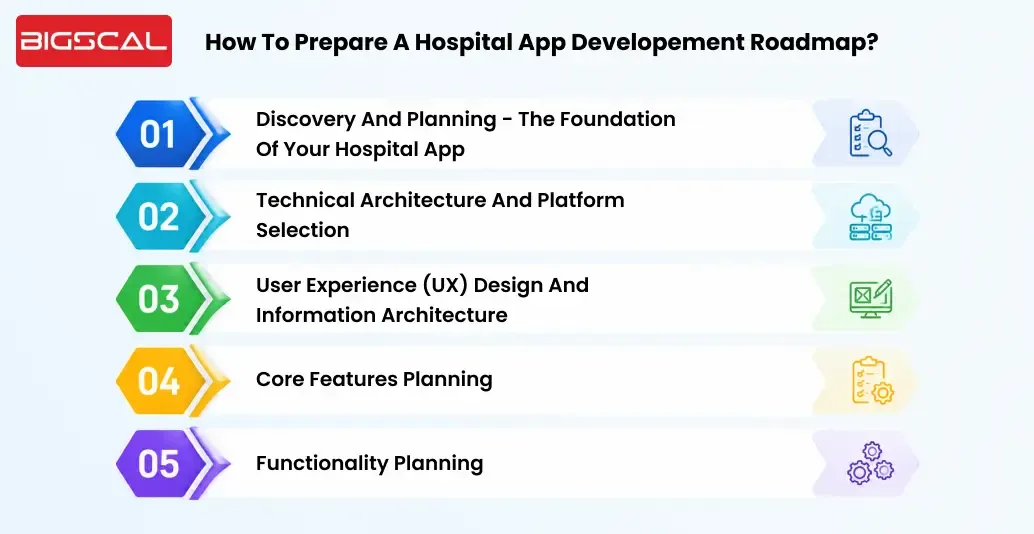
Phase 1: Discovery and Planning – The Foundation of Your Hospital App
The most important stage of hospital app development is the discovery and planning phase. If discovery and planning stages are weak. This will create problems in the later stages of the design, development, and launch phases. Let’s check what steps clinics need to make:
1. Understanding Your Hospital’s Needs
Before writing the code, first you should understand the actual problem of the hospitals and what solutions they require. The purpose of the app should be clear. Analyze all the features that your hospitals want, such as
- Patient appointment scheduling and reminders
- Telemedicine consultations between patients and physicians
- Real-time patient monitoring for chronic disease management
- Staff communication shift management
- Prescription refill requests and medication management
2. Conducting Market Research and Competitive Analysis
Understanding only your hospital requirement is not enough. Hospitals should also analyze the current market trends. What user likes. Where gaps exist. This will help hospitals make concrete decisions. They should thoroughly analyze the following:
- Analyze UI patterns of existing healthcare apps
- Understand feature prioritization
- Read user ratings and reviews
- Check platform availability: iOS, Android, web
- Review integration capabilities with existing hospital systems
3. Setting Budget, Timeline, and Resource Expectations
It is highly essential to define a budget and timeline in the planning phase. Otherwise, the project gets stuck halfway. Healthcare apps are not just about development cost. compliance, testing, integration, and maintenance are also a part of the budget. Hospitals should carefully perform the following:
- Divide the budget into phases
- Break the timeline into realistic milestones
- Assign internal and external resources
- Include security and compliance costs
- Estimate post-launch support in advance
Phase 2: Technical Architecture and Platform Selection
When planning is clear, then the next big decision you need to make is technical architecture. Therefore, you should select not on the basis of trends. But on the foundation of actual hospital needs.
1. Native Development (iOS/Android separately)
Native development is best when hospitals need maximum performance. Device-level control for application. This approach is a strong option for complex workflows. Real-time updates. And high security. However, cost and development time are high. Native development offers:
- Optimal performance for demanding healthcare workflows
- Full access to device features and sensors
- Superior user experience and responsiveness
- Best for real-time intensive analysis and requirements
2. Hybrid Development (React Native, Flutter)
Hybrid development is a practical choice for hospitals that need more rapid launches. And deal with controlled budgets. It improves development speed because of a single codebase. Also, it simplifies the maintenance process. Hybrid development presents the following:
- Faster development with a single codebase
- Cost-effective for moderate functionality
- Easier maintenance and quicker updates
- Slightly compromised performance in some cases
- Potential compatibility issues on certain devices
3. Web-Based Development (Progressive Web Apps)
Web-based hospital app development is not fit for every healthcare facility. It’s most suitable for healthcare facilities that require connectivity to multiple platforms. This approach is best for telehealth, appointment booking, and patient portals. Further, web development offers the following:
- Cross-platform compatibility across devices
- No app store approval delays
- Easy access through browsers
- Limited offline functionality
- Reduced performance for complex operations
- Best for telehealth and general patient portals
Phase 3: User Experience (UX) Design and Information Architecture
In healthcare, UX is not simply a designing phase in a development journey. It is also a part of workflow efficiency, patient trust, and clinical speed. Hospitals should design apps in such a way that they create balance between clinical requirements and consumer app intuitiveness.
1. Designing for Healthcare Professionals and Patients
The best healthcare apps should have a simple, dependable, and clear interface. It should be simple to use. Physicians, nurses, employees, and patients should feel comfortable understanding its working features. Therefore, hospitals should implement the following.
- Clear labeling and intuitive navigation
- Consistent visual design across every screen
- Minimal cognitive load for busy healthcare professionals
- Accessibility features for diverse user populations
For Patient-Centric Design:
- Use plain language to avoid medical jargon
- Large and readable fonts should support aging populations
- Color contrast should meet accessibility standards
- Visual design should feel pleasing
- Should include dependable features
- Ensure clear explanations to every features
2. Information Architecture Best Practices
Information should be organized on the basis of user priorities and access frequency. If architecture is weak, even the best features will remain hidden.
- Primary Functions: Give quick and easy access. Most-used features should immediately get accessed.
- Progressive Disclosure: Share important information early. And add additional information as needed.
- Consistent patterns: Repeat successful patterns in other features
- Search and Filtering: Implement robust search and filtering for large datasets
- Error Prevention: Design forms and workflows to prevent mistakes before they happen
Phase 4: Core Features Planning
It is one of the critical phases of hospital app development. In this phase clinics decide what features need to be delivered at the time of app launch.
1. Essential Hospital App Features
First, clinics should define core features that support daily hospital workflow. They should consider the following features:
- Appointment booking and rescheduling
- Doctor availability tracking
- Secure login and authentication
- Lab report and prescriptions access
- Billing and payment support
- Push notifications and reminders
2. Patient Portal Features
A patient portal goal should be simple. Patients should have access only to health information and hospital services. Hospitals should design the following features:
- Appointment scheduling and management
- Medical history access
- Prescription requests and refill tracking
- Lab results and imaging reports
- Bill payment and insurance information
- Secure messaging with healthcare providers
3. Healthcare Provider Features
For doctors and clinical staff, app focus should be on speed, accuracy, and coordination. Hospitals should focus on the following features:
- Schedule management and patient notifications
- Patient chart access
- Diagnostic tool integration
- Communication tools with colleagues
- Clinical decision support
- Patient follow-up tracking
- Documentation and note-taking
Phase 5: Functionality planning
Don’t indulge in launching every feature simultaneously. This is not a feasible approach in the initial stage. Clinics should implement a prioritization framework. This will help the team determine which feature is essential to launch.
1. MoSCoW Prioritization Method
The Moscow method is the most effective method to determine which feature should launch first and which at a later part.
- Must Have: Critical features that are mandatory for launch. Such as appointment scheduling and authentication.
- Should Have: Important features that add significant value. Such as secure messaging and results delivery.
- Could Have: Nice-to-have features that boost experience. Example: fitness tracker integration.
- Won’t Have: Features that are not required in the current release. However, they are needed in the later part.
First, fix must-have features, then make a budget. This will save the organization from unnecessary expenses.
2. MVP Scope And Release Planning
MVP is the first version that delivers the core value. While building a hospital app, it is crucial to consider an MVP. Ignoring the MVP will delay the launch. Hospitals should focus on the following:
- Include only essential workflows
- Reserve advanced features for later releases
- Plan next phase on the basis of user feedback
- Launch pilot after internal testing
- Align release scope with hospital goals
Best Practices For Hospital App Development Success
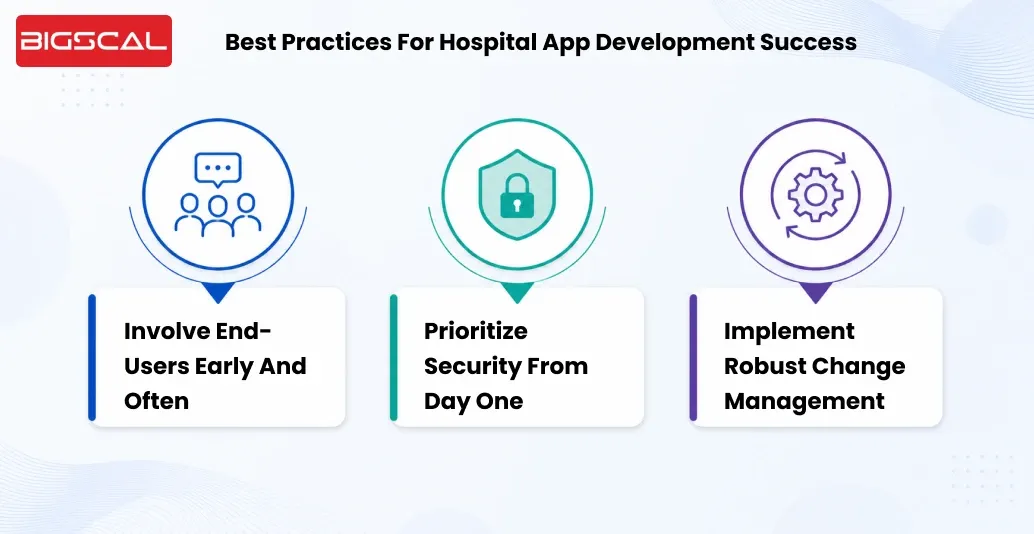
Let’s check out:
1. Involve End-Users Early and Often
The most important fact about the hospital apps is that they can’t become powerful without user feedback. Doctors and nurses have different workflows than front desk staff and billing teams and patients. Otherwise, the app will be practically weak even if it has powerful features, unless you involve them from the beginning. Hospitals should be engaged in the following:
- Collect input from physicians, nurses and administrative staff
- Test wireframes before full development begins
- Observe real hospital workflows and daily routines
- Iterate based on actual user pain points
- Include patients in usability testing whenever possible
2. Prioritize Security from Day One
As we know, healthcare data are highly sensitive. It includes sensitive information related to patient records, prescriptions, lab results, insurance details, and personal information. Security is not just a concern of the IT team. It is a responsibility of the entire healthcare ecosystem. Further, hospitals should consider the following:
- Use role-based access control for different user groups
- Make use of multi-factor authentication
- Schedule regular compliance audits
- Check security reviews
- Encrypt your data in both rest and transit phases
- Engage in penetration testing before making the product live
3. Implement Robust Change Management
In a hospital environment, technology change is not just about software updates. It’s all about changing working style. Resistance is natural in change. It takes time for staff to understand change. Trust the process. And use it. Therefore, hospitals should focus on the following:
- Create role-based training modules for different teams
- Provide clear documentation and quick reference guides
- Assign internal champions to support adoption
- Offer ongoing help after launch
- Collect feedback during the transition phase
Understanding Hospital App Development Costs: Realistic Budget Planning
Smart budget planning is about defining the right scope. Understanding hidden costs. Making decisions that create long-term value. Let’s elaborate more about it:
1. Patient Management Apps: Entry-Level Budget Planning
Patient management apps are usually an entry point of app development budget planning. It focuses mainly on patient convenience and basic digital access. This app budget generally costs you around $100–$250. This investment is reasonable for the basic portal.
2. Hospital Management Apps: Mid-Level Budget
Hospital management apps are constructed for both patients and the internal team. Its main purpose is to reduce administrative burden. Improve coordination. Streamlining hospital operations. These apps are usually more functional. And highly integrated. This category is expensive. And ranges between $150 and $250.
3. Telemedicine with Medical Device Integration: Higher Investment Zone
The scope becomes complex when you integrate connected medical devices in it. Only relying on video consultation is not sufficient. Hospitals need to handle Real-time vitals monitoring. Device data sync. And remote care workflows. Designing these types of apps will cost you around $300–$400.
Try to understand hidden costs; otherwise, the budget balance will break.
What Drives Cost Beyond the Baseline
1. Baseline Quote Often Misses the Real Healthcare App Cost
After looking at the initial quote of the healthcare app, founders often assume that the project budget is clear. In reality, baseline is just a starting point. As compliance, integrations and testing are included. The total cost structure gets changed.
2. EHR Integration Adds a Major Cost Layer
EHR integration is the most expensive hidden driver of healthcare apps. Therefore, cost rises quickly above the baseline.
Typical cost impact:
- Each EHR integration adds significant budget
- Vendor certification increases effort
- Data exchange depth affects pricing
- Authentication setup takes extra engineering time
- Multiple EHRs multiply complexity fast
3. Maintenance Is a Recurring Expense, Not a One-Time Task
Many founders underestimate the maintenance after launch. In a hospital app, annual upkeep is not just limited to bug fixes. Security updates. API changes. compliance refreshes and vendor updates altogether become a meaningful part of ongoing budget.
Maintenance usually covers:
- Security patches
- API version updates
- Compliance adjustments
- Infrastructure monitoring
- Feature stability fixes
Budget reality:
- Annual maintenance can consume a large share of initial spending
- Long-term support must be planned early
- Post-launch costs are unavoidable
- Vendor changes create recurring work
- Maintenance is part of product ownership
4. Testing Healthcare Workflows Costs More Than Expected
In healthcare apps, testing is more complex than normal testing. Validating interaction among Video layer, audit logs, scheduling engine and billing system demands extra efforts.
Testing complexity includes:
- Workflow-to-workflow validation
- Audit log verification
- Billing and scheduling checks
- Cross-module integration testing
- Edge-case scenario coverage
Why it increases cost:
- More test environments are needed
- QA cycles become longer
- Failures affect multiple modules
- Compliance-sensitive flows need deeper validation
- Hidden dependencies surface late
5. Hidden Cost Drivers Compound Over Time
In healthcare app development, hidden costs are not isolated. EHR integration, maintenance, testing and compliance amplify each other. If the baseline is weak. Then the total cost quickly reaches the original estimate.
Compounding cost factors:
- Integration increases testing effort
- Compliance increases infrastructure cost
- Maintenance increases long-term spend
- Vendor changes create rework
- Delays increase team burn rate
Planning approach:
- Build buffer into estimates
- Separate baseline from compliance cost
- Treat integration as a major workstream
- Include post-launch support in budget
- Review assumptions before quoting
Conclusion
Hospital app development is no longer just a technology project. It has become a strategic healthcare decision. If you’re starting a project without a proper roadmap. Then the project will eventually lose direction. Hospitals should follow a structured roadmap. They should consistently follow all the steps from discovery to post-launch support. Healthcare apps that adhere to a methodical roadmap are highly successful. It will be a strategic asset for hospitals. Improving clinical capability and operational efficiency if they carry out the projects correctly.
FAQ
Why should hospitals follow a roadmap before implementing the hospital app development project?
It is highly essential to prepare a structured roadmap before embarking on this journey. Apps for healthcare that follow a methodical roadmap are very successful. Hospitals will benefit strategically from it. If the projects are completed correctly, they will improve clinical capability and operational efficiency.
Which hospitals should follow a moscow technique?
The Moscow method is the most effective method to determine which feature should launch first and which at a later part. This will help hospitals save time on designing non-essential features. If it is not appropriate. And consume considerable time.
Which is the best healthcare app development company in 2026?
In 2026, Heathray is the best medical app development company. Heathray designs customizable features and can automate all the hectic operations of hospitals and clinics.
What are the features that a good app should have?
The interface of the best healthcare apps should be straightforward. Trustworthy. And easy to use. It should be designed in a simple way. It should be easy for doctors to use in their daily operations. Nurses, staff, and patients should be able to comprehend how it operates.