How does Telehealth improve patient care? Benefits and Case Studies
Quick Summary: Wondering how telehealth improves patient care? It does so by offering remote medical consultations, increasing accessibility to healthcare services and reducing travel time. Additionally it reduces costs for health resources, enhancing monitoring of chronic conditions, cardiovascular disease, and health risks. It enables timely interventions, and provides mental health support and health and human services, especially in underserved areas.
Introduction
Improving patient care is one of the top goals the healthcare delivery industry strives to meet. But how does telehealth improve patient care? Hence with time, the model has shifted from free services to a value-based health care provider model.
Hence it has further changed how they approach this goal. Amid this, Telehealth is growing to be a contributing factor.
With new digital technologies, providers have minimized emergency department visits. Hence this approach helps people seek health remotely through remote consultations, diagnoses, and treatment plans.
It prompts timely interventions and reduces the strain on doctors. The convenience that telehealth services provide has led to easy accessibility. But how does Telehealth technologies improve patient care?
Additionally, telehealth platforms have made the management of chronic diseases easier without visiting the provider’s office. It doesn’t only represent proactive primary care but also reduces frequent hospital visits.
The combination of technology and healthcare or AI in telehealth paves the way for a personalized and convenient manner to enhance patient experience. This blog will brief you about telehealth companies’ contribution to patient outcomes and the evolution of telehealth.
How Does Telehealth Improve Patient Care Using Patient Engagement?
Here’s and answer to the question of what are some benefits of telehealth appointment:
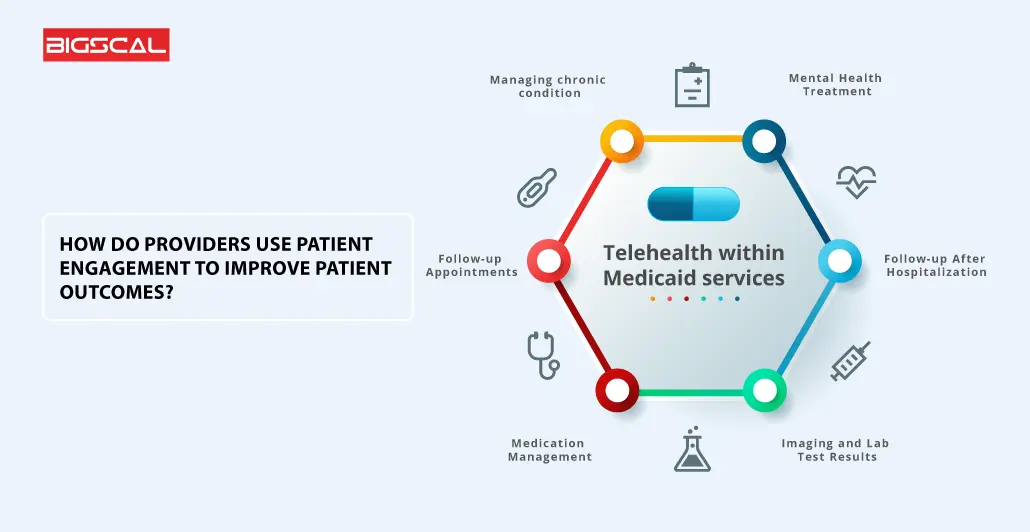
Managing Chronic Condition
As per National Health Council, almost 157 million Americans suffered from chronic health conditions in 2020. Surprisingly it is half of the total population. Hence the application of Telehealth visit can lessen the total in-person visits for chronic conditions. Therefore, this might increase the cases that they will comply with their treatment.
Mental Health Treatment
Telehealth removes access barriers and enables fewer primary care providers to attend to a more extensive patient base.
Hence, it also increases privacy levels. For individuals hesitant to pursue in-person mental health care, receiving treatment through a virtual visit or video can be a convenient experience. They can use wearables that record vital signs to help in a physical exam.
Imaging And Lab Test Results
Telehealth enables healthcare professionals to analyze patients’ reports, helping them comprehend the test outcomes. Hence this helps them take the required steps. Telemedicine and telehealth visits for reviewing test results are only sometimes essential. Conducting phone-based communication might also be enough for conveying critical diagnostic details.
Furthermore, the majority of phone-based test reviews should be reimbursed. Telehealth enhances patient understanding by facilitating direct virtual visits and interactions between patients and providers. Moreover, it strengthens the patient-provider bond and enables reimbursement for the provider’s services.
Follow-Up Appointments
Patients frequently miss these appointments due to financial constraints and transportation challenges associated with visiting the physician office. hence this one of the answers to how telehealth improves telehealth urgent care. It is more beneficial to have more telehealth online health care services for older adults and underserved areas.
The utilization of the platform for telehealth video conferencing simplifies the process of virtual visits for patients. Hence this will enhance their ability to attend follow-up appointments. Eventually, it will improve the health status and likelihood of successful treatment outcomes.
Medication Management
Individuals might need help to arrange face-to-face appointments to seek physical therapy and address possible side effects. Therefore rather than enduring side effects quietly or discontinuing medication like blood pressure ones, they can utilize telehealth appointments.
Providers frequently can enhance patient outcomes by adjusting dosages during telehealth visits.
What Benefits Do Telehealth Services Offer Patients?
Removing Barriers To Treatment
Understand various factors that might prevent patients from accessing necessary medical treatment. These factors include expenses related to transportation, the time taken for travel and loss of income due to missed work. There are certain inconveniences tied to in-person clinic appointments.
Increasing Face Time Between Patients and Providers
Telehealth enables patients and healthcare providers to concentrate on immediate health issues without distractions fully.
It allows them to allocate more in-person time to address patient concerns without typical office interruptions.
Moreover, Telehealth is more than telephone consultations, where health information is protected. One can convey intricate, and protected health information, electronic health record medical information, and details and demonstrate excellent patient trust.
Improving Treatment Plans
Occasionally, treatment protocols include procedures that may not align with the traditional environment. Hence activities like overseeing patient prescriptions and conducting assessments of diagnostic tests can be more convenient.
Telehealth adoption expands the array of care choices available to healthcare providers. Additionally, it does not impose additional expenses or challenges on their already busy medical practices.
Reducing Exposure To Other Patients And Illnesses
Enhancing health results becomes challenging when individuals must wait in crowded waiting areas. Whenever patients coexist in such an environment, there’s a potential for airborne infectious disease to spread.
In contrast, Telehealth visits offer a solution by enabling individuals who might be contagious like covid 19 pandemic. Hence they need to seek medical care and attention without putting others at risk.
This approach also protects individuals not afflicted by viruses infectious diseases or infections from contracting them. This development brings positive benefits for both patient’s condition and healthcare providers.
Case Studies Of Successful Telemedicine In Healthcare That Has Enhanced Patient Outcomes
Teladoc

Teladoc was established in 2002 with the vision of making healthcare accessible worldwide. It has now emerged as the leading global authority in virtual healthcare services. It has an almost 90% customer satisfaction rating.
The application boasts the expertise of the top 5% of globally certified medical specialists. There are now medical center offices in 20 countries, and the network has facilitated over 15 million medical consultations.
Teladoc facilitates connections between individuals and a diverse range of medical healthcare professionals. It also offers guidance for more critical cases that may necessitate in-person medical attention. It has a robust medical group of 7,000+ doctors.
Amwell

Amwell is a telemedicine company based in Boston, Massachusetts, that offers a convenient way to consult remotely.
This service is available through subscriptions to various healthcare systems and institutions for in-person care. Hence, it implements measures to ensure HIPAA compliance. It offers a wide range of online medical services, including urgent care, therapy, psychiatry, primary care physician breastfeeding support and much more.
All patient data used, virtual visits, virtual consultations, medical records, and personal patient data are encrypted over secure connections.
Choosing the Right Telehealth Platform for Healthcare Organizations
Prioritize EHR Integration
Telehealth platform should conveniently pair up with your existing EHR software. This facilitates the management of deadlines, standardized paperwork, and billing within a single workflow for businesses.
Check for:
- Native EHR integration
- Unified patient records
- Automated documentation flow
- Simplified billing process
Verify HIPAA Compliance
Maintaining the safety and security of patient health information is crucial for healthcare organizations. Vendors must appropriately assess security control measures and compliance guidelines.
Must-have features:
- HIPAA compliance support
- Secure data storage
- Business Associate Agreement
- Strong access controls
Test Patient Experience
The telehealth platform should be comfortable and intuitive to use. Complex joining processes negatively impact the patients’ adoption.
Evaluate:
- Easy appointment joining
- Simple user interface
- Reliable video quality
- Technical support availability
Evaluate Remote Patient Monitoring (RPM) Support
If an organization wants to provide remote patient monitoring services, the telehealth platform should be properly connected with RPM.
Important capabilities:
- Device integration support
- Automated data transfer
- Real-time health monitoring
- Centralized patient records
Check Reimbursement & Billing Features
Accurate billing and reimbursement assistance directly shapes the revenue cycle of healthcare organizations. Organizations should verify support for:
- CPT coding assistance
- Billing documentation tools
- Payer-specific requirements
- Claims submission support
Conclusion
It is hoped that you will have a better understanding of how telehealth improve patient care by the end of this text. A collection of technologies known as telehealth can be used to deliver medical care for a variety of ailments, demographics, and environments. The expansion of Telehealth allows healthcare providers to devote more time to patient interaction, resulting in increased productivity.
Bigscal’s Telehealth solutions provide an innovative way to improve patient outcomes with advanced technology. Our telemedicine software solution platform allows patients to connect with top-tier healthcare professionals remotely in this interconnected world.
Our telemedicine software solution has secure video consultations. Bigscal ensures prompt medical assessment, leading to faster evaluations and treatment strategies.
FAQ
In healthcare, what are the three advantages of telemedicine services? Three benefits of telemedicine includes:
Increased accessibility to medical services.
Reduced travel time and costs for patients.
Improved monitoring of chronic conditions.
What are the three types of telemedicine? It also enhances health care due to telemedicine in that it has the ability to grant access to medical practitioners who are far away, decrease travelling time and waiting time in emergency wards, access more specialists and the right time to connect with patients in regions that scarcely have any medical facilities. The three types of telemedicine are the following:
Such as store-and-forward or asynchronous communication through an online patient portal.
Remote monitoring.
Telehealth, such as adopting a remote patient monitoring approach for constantly accessing data collected in real-time.
This is real-time telemedicine, which requires direct interactions in the form of video consultations.
How has telehealth helped healthcare? Telehealth platform has benefited healthcare in the following ways: firstly, by expanding access to medical services to areas with limited easy access to a registered clinic; secondly, by reducing the load on actual health facilities and emergency departments; and thirdly, as a way for patients to receive their medical records, pointers, and treatment.
How does Telehealth improves treatment plans? Telehealth adoption expands the array of care choices available to healthcare providers. Additionally, it does not impose additional expenses or challenges on their already busy medical practices.