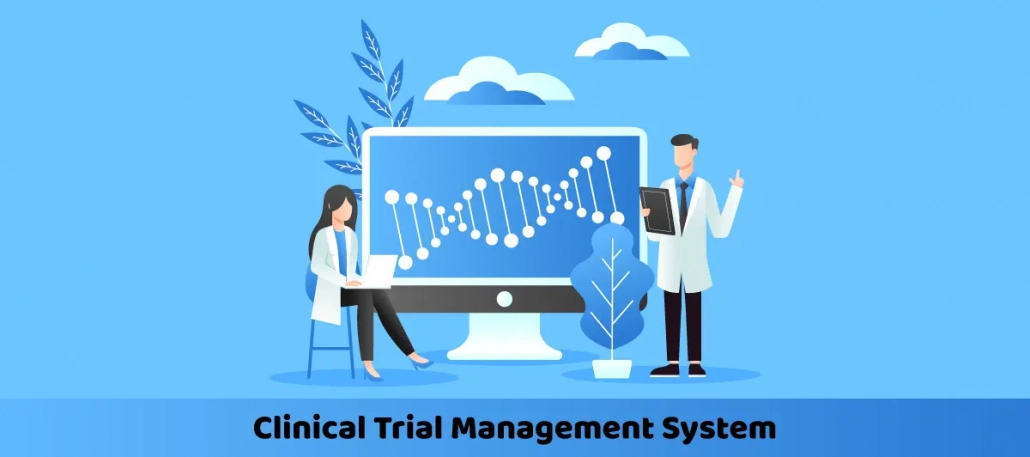
Clinical Trial Management System: All You Need To Know
Quick Summary: CTMS is a fundamental aspect that every clinic takes to make the trial procedure successful. Clinical trial management software simplifies all the crucial components. Employee recruitment, data handling, and reporting are some of the tasks CTMS can simplify easily. This software ensures data accuracy. It helps clinics maintain adherence to regulatory compliance. It also fosters collaboration among research teams. It speeds up the process of developing new treatments and therapies. This blog will explore all the essential features and benefits of CTMS. Also, it covers how AI integration in CTMS simplifies complex tasks.
Introduction
A clinical trial management system is necessary for all doctors. In this growing era of innovation, implementing CTMS is the ultimate step towards a clinic’s success. It emerges as the key to progress in patient management.
The number shows its importance: 80% of clinic trials experience delays attributed to manual data management and other systems inefficiencies. Here, CTMS works to reduce trial durations by 33% and cut operational costs by 25%. Consider this a future where research teams collaborate seamlessly, patient recruitment increases by 40%, and data errors plummet by 90%.
This article is dedicated solely to Clinical Trial Management Software Systems; you will get all your knowledge by reading this.
Keep reading!
What Is a Clinical Trial Management System?
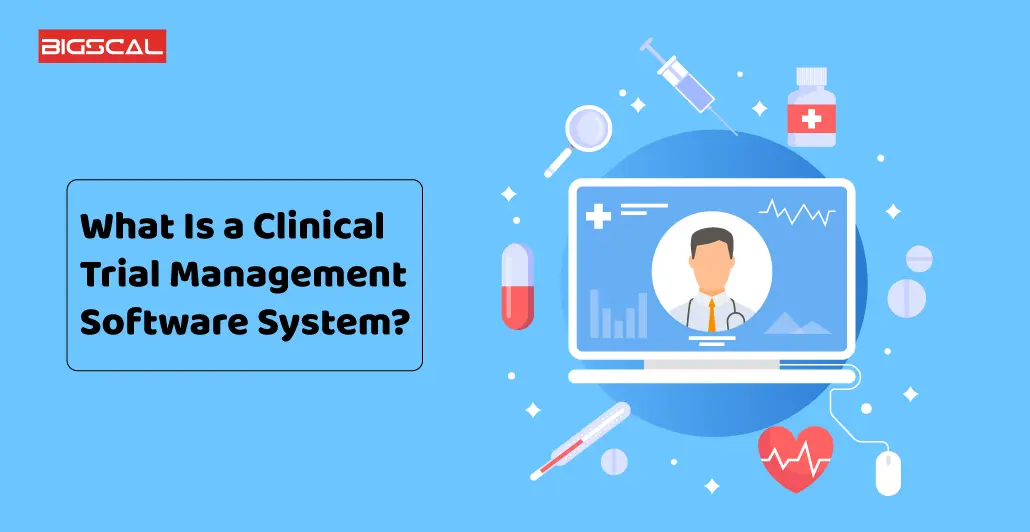
A clinic’s management system is an all-in-one system that organizes all the important works of clinic trials. patient enrollment, site administration, payments, and compliance tracking are some of the tasks that CTMS software simplifies.
It also aids in compliance with regulatory standards by maintaining detailed records. A good part is that it can even integrate into a Vet clinic management system.
The market for clinical trials management systems (CTMS) is expected to increase at a compound annual growth rate (CAGR) of about 15.59% from its 2025 valuation of USD 2.35 billion to USD 7.40 billion by 2033.
Top CTMS Companies
Here’s the list of top clinical trial software Companies:
- MasterControl Clinical Excellence
- CloudLIMS
- Clinion
- OnCore
- Medidata Solutions
- ClinPlus
- Advarra eReg
- Quanta View
- Fusion eClinical Suite
- Medable in Palo Alto offers their Digital Trial Platform
Why Every Clinical Trial Needs a CTMS in 2026
In 2026, clinical trials are becoming highly complex. Further, clinics are facing challenges with multiple sites, strict rules and regulations, and a huge data volume. If clinics will not use CTMS , then the team will work independently. This will increase delays, compliance and risks in the practices.
What problems do clinics have to deal with when they don’t have CTMS?
If clinics lack a CTMS, then the workflow will be like
- Site coordinators will use spreadsheets.
- Observers will monitor information through emails.
- Finance department calculates the payment manually.
- Regulatory team maintains papers and documents.
Trial Delays Will Become Common
According to research, 80% of clinics face delays in trials.
Reason:
- Manual data submission
- Poor communication
- Slow approvals and standards
CTMS automates this process and helps clinics to control the timeline.
How Can CTMS Implementation Simplify the Clinics’ Trials?
Faster Trial Completion (Up to 33%)
Through CTMS implementation, clinics can do the following:
- Organize the workflows.
- Automate the tasks.
- Real-time tracking is possible.
Overall, this helps clinics reduce the trial duration up to 33%.
Cost Savings (Up to 25%)
Manual processes are highly expensive. Further, clinics deal with many challenges:
- Extra manpower
- Rework required due to errors
- Inappropriate resource use
Clinical research management system can reduce the operational cost by up to 25%.
Expedites Patient Recruitment
Patient recruitment is the biggest challenge in trials.
CTMS helps in:
- Identify patient eligibility
- Tracking enrollment
- Improve multi-site coordination
Overall, CTMS increase the recruitment speed up to 40%.
How Does a Clinical Trial Management System (CTMS) Work?
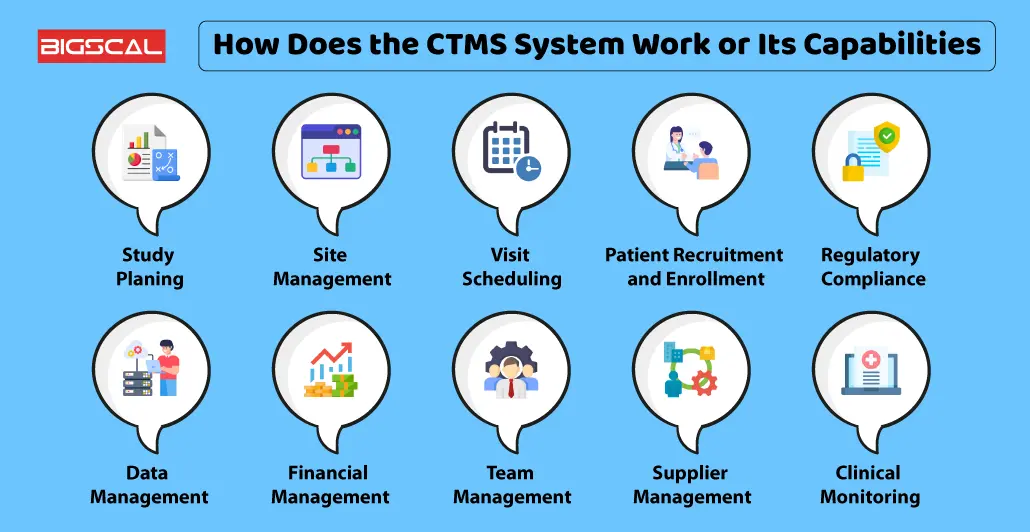
The Clinical trial Management System role is to centralize all the trial data in one place. In simple words, CTMS is a smart system that tracks, organizes, and streamlines every step of trials. Let’s check how CTMS work:
Study Setup
Everything is set up in CTMS, before the trails begin:
- Protocol information
- Inclusion/exclusion requirements
- Visit a regular schedule
- Site description
- Team responsibilities
This all together makes the blueprint, that system follows during trials.
Site Activation
CTMS ensures every site activates properly. CTMS ensure:
- System efficiently tracks IRB approvals.
- Collect regulatory documents.
- Investigator accurately monitors the training.
Additionally, the system automatically sends alerts if there is any delay in any step.
Patient Enrollment Tracking
When a patient reaches the trials, CTMS tracks their status, such as:
- Screened
- Consented
- Enrolled
- Randomized
CTMS software compares the following:
- Target vs. actual enrollment
- Site-wise performance
Visit Management
CTMS efficiently manages every patient visit. Further, system checks
- Scheduled visits
- Completed visits
- Missed visits
If visit time is outside the window, then the system alerts to protocol deviation. Coordinators get reminders for upcoming visits.
Data Management
In clinical trials, data management is the most crucial part. Clinical trial management software makes this fast and accurate. Further, CTMS creates a central hub where all data gets stored:
- Patient data
- Site data
- Financial data
- Regulatory documents
Overall, CTMS helps clinics in bringing all the scattered data into a single platform.
Essential Document Tracking
The document tracking within a CTMS involves a systematic process of uploading, categorizing, and monitoring essential trial documents. It provides professional services and a centralized repository accessible to authorized personnel, allowing them to track the status and completeness of documents easily.
The CTMS’s Essential Document Tracking capability offers real-time visibility into document status, reducing the risk of missing or incomplete electronic records. It automates document version control, ensuring the most current and approved versions are readily available.
Configure expiry based alert for trial documents. Know that most compliance gaps occur due to silent document expiration not missing files.
Benefits Of AI Integration In CTMS
Smart Site Selection
AI analyzes past data, investigator performance and patient demographics and suggests the best trial sites. This improves the enrollment rate to 30-50% and reduces startup delays.
Risk-Based Monitoring (Targeted Oversight)
Machine learning analyzes data in real time. It helps in the following:
- Detect Protocol deviations.
- Identify Data anomalies.
Faster Patient Recruitment
AI and NLP algorithms match the eligibility criteria with EHR data. It helps clinics in many ways:
- It is capable of identifying the right patients.
- It predicts the dropout risk.
Overall, it helps elevate the recruitment rate by 20-30%.
Financial Forecasting and Cost Control
AI predictive analytics help clinics:
- It keeps track of the budget
- Recognize cost overruns
- Optimise resource distribution
Overall, it helps clinics accomplish the trials under the planned budget.
Intelligent Document Processing
AI eTMF helps clinics organize the document in many ways:
- Categorize the document
- Redact highly sensitive data
- Ensure compliance with the standard such as the U.S. Food and Drug Administration and the International Council for Harmonization.
Key Features of a Clinical Trial Management System (CTMS)
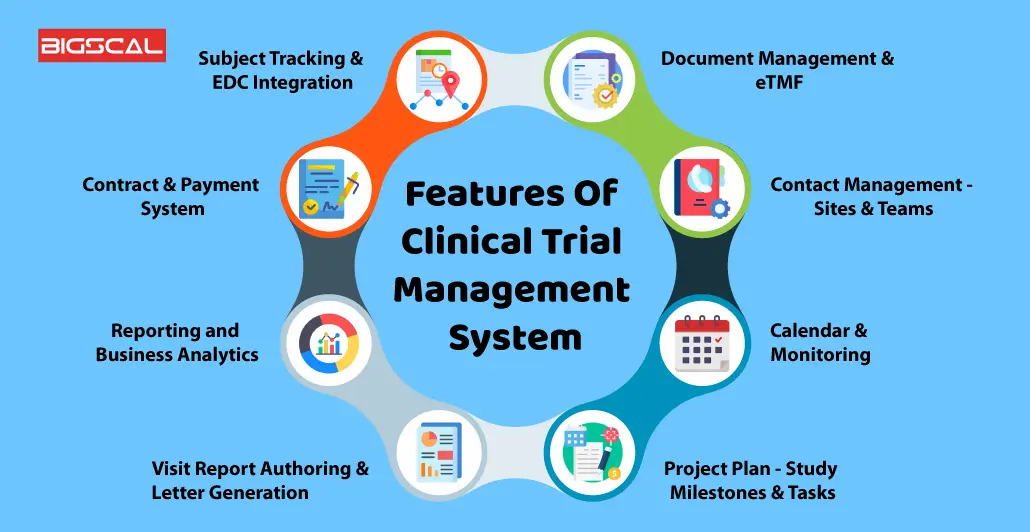
Document Management & eTMF Integration
CTMS provides a centralized document such as
- Version control (Track latest document)
- Completeness tracking
- Expiry alerts
- eTMF (electronic Trial Master File) integration
Contact Management (Sites & Teams)
CTMS includes a searchable contact database, such as the following:
- Investigators
- Coordinators
- Monitors
- Site staff
Additionally, CTMS features such as role-based accessibility, credential monitoring, and training history enhance coordination among different departments.
Calendar & Monitoring Scheduling
CTMS provides an integrated trial calendar. Further, the system helps in the following:
- Patient visit scheduling
- Monitoring visit planning
- Milestone tracking
Also, automated reminders make sure that no visits are missed and there are no delays.
Project Planning & Study Milestones
Clinical trails system makes the project planning simple. Further, the CRMS system includes features such as
Subject Tracking & EDC Integration
CTMS ensures real-time tracking. Further, it helps in:
- Screening
- Enrollment
- Visit status
Additionally, with EDC (Electronic Data Capture) integration, clinics can simplify the process. Clinics can auto-synchronize the data. and avoid duplicate entries. Thus, CTMS provides reliable, precise, and updated trial data.
Decentralized Clinical Trials (DCTs) and CTMS in 2026
The massive change in clinical research is the rise of Decentralized Clinical Trials (DCTs). Now, trails are not just limited to hospitals and research sites. With the help of digital tools, patients can participate even while sitting at home.
What are DCTs?
In decentralized clinical trials, patients can:
- A patient can participate remotely.
- Involves usage of digital tools.
- Physical visits are fewer.
Overall, it ensures better patient satisfaction and faster hiring processes.
Remote Site Activation
CTMS needs to support virtual site setup, which includes.
- Online regulatory document submissions
- Digital approvals and standards
- Remote investigator training surveillance
Overall, CTMS eliminates the need for site visits. Clinics can manage everything online.
eConsent Integration
CTMS uses eConsent systems. It replaces the traditional approach of sending consents. CTMS integrates:
- Digital consent forms
- Electronic signatures
- Audit trails (FDA compliant)
Overall, it helps clinics maintain paperless consent procedures.
Why CTMS is Critical for DCTs
It is impossible to manage DCT without integrating clinical trail management software. This causes difficulty in managing multiple data sources, remote participants and complex workflows. CTMS ensure:
- Ensure centralised control
- Provide Real-time visibility
- Ensure compliance in every step
Top benefits of using CTMS system
Accessibility to latest information
One of the challenges that our team encountered in our former work of dealing directly with sponsors and CROs in managing clinical trials was locating the right information about the study, which was current. High level information such as updated site roster, and finer information such as startup monitoring or schedule of site visits was sometimes difficult to get.
This is not the way that a study is to be done. A CTMS system can be used to assist the study team to perform their functions and make prudent decisions, as it provides transparency and a centralized access to the data of the studies.
Cooperation
The members of a study team may also cooperate effectively with each other in the CTMS, and team cooperation (e.g. sponsor, CROs, sites) may also be achieved. Sponsors, CROs, sites and other providers can also be shared in the task of ensuring up-to-date data is monitored in the studies.
Effectiveness
The CTMS is an expert productivity application that enables your busy study team to plan and track and monitor studies efficiently. Electronic visit report authoring features such as this can automatically add the details about your visit (study, site, date, investigator, monitor name, etc.) and ensure you filled out the right sections (Word does not). When the subject visits are recognized as complete, the Payment feature will automatically create site payment tracking records based on your contracts.
Oversight
Study management, action item, and issue management of your study are some important features of your study management that the CTMS will provide transparency to. Data reports and dashboards provide performance ratings and views of one research or a combination of multiple studies.
Simplify clinical trials with Bigscal
- Streamline trial workflows and data
- Ensure compliance and accuracy
Conclusion
The clinical trials management system is not just an optional tool. It is a core infrastructure of modern clinical research. In 2026, trail complexity has been increased. Managing through spreadsheets, emails, and paper is not practically possible. Clinics should use CTMS as strategic tools. Winning organizations consider CTMS an operational backbone. This mindset difference determines the success.
FAQS
Is it essential for clinics to adopt oncore clinical trial management system? Yes, it is essential for clinics to adopt clinical trial management software. clinical trials are becoming highly complicated. Further, clinics are facing challenges with multiple sites, strict rules and regulations, and a huge data volume. If clinics will not use CTMS , then the team will work separately. This will increase postponements, compliance isues and potential risks in the practices.
How does clinical trial management system software help in reducing trial delays? Through clinical trial data management system implementation, clinics can do the following:
Manage the workflows.
Execute and automate the tasks
Real-time tracking is possible.
Overall, this helps clinics decrease the trial duration up to 33%.
Can a clinical trial quality management system reduce cost? Yes, clinical trial management can reduce cost. Manual processes are highly expensive. Further, clinics deal with many common issues:
Extra human resources
Rework was required due to errors
Inappropriate resource use
CTMS clinical trial management systems can reduce the operational cost by up to 25%.
How does the clinical trial management process manage data? In clinical trials, data management is the most essential part. Clinical trial management software makes this convenient and dependable. Further, CTMS provides a centralized hub where all data gets maintained: Patient records A clinical trial management system helps healthcare providers in consolidating all the scattered data into a single platform.
Site information
Financial data
Regulatory documentation
Does clinical trial management system software ensure regulatory compliance? Yes, CTMS follow strict government regulations and standard rules to eliminate threats in the system and ensure 100% safety.