10 Best Healthcare Software Development Companies
Quick Summary: Hospitals, clinics and health startups need software partners that understand patient data, compliance and clinical workflows, not just code. This 2026 guide compares 10 healthcare software development companies, explains how we chose them, and shares what to check before you hire one, including security, interoperability, AI features and typical costs. Short on time? Start with the comparison table below.
Introduction
Healthcare software has become part of everyday care. Doctors rely on electronic health records, patients book appointments and see doctors online, and labs, pharmacies and billing teams share data through connected systems. When this software works well, staff save time and patients get faster, safer care. When it doesn’t, the result is double data entry, frustrated staff and serious risks to patient privacy.
That is why choosing the right development partner matters so much. A good healthcare software company understands clinical workflows, protects sensitive data and builds systems that connect with the tools a hospital or clinic already uses. If you are new to the topic, our guide to healthcare software development explains the process step by step.
This list is for hospital administrators, clinic owners and healthtech founders who want to build or modernize healthcare software. A note on transparency: this article is published by Bigscal, and we have included ourselves in the list. We have described each company using the same criteria, and we recommend checking every company’s latest case studies and reviews before you decide.
Top Healthcare Software Development Companies at a Glance
| Company | Healthcare focus | Best for |
|---|---|---|
| Bigscal Technologies | Custom hospital, clinic, patient management, telemedicine, EMR/EHR and lab software | Providers and startups that need fully custom software |
| Healthray | Ready-made EMR, hospital, clinic, pharmacy and lab software | Clinics and hospitals that want a proven product they can deploy quickly |
| Technostacks | Telehealth, wearables, medical device software and lab solutions | Connected health and IoT-based projects |
| Citrusbug Technolabs | AI-enabled EHR/EMR platforms and patient portals | Organizations adding AI to clinical records and workflows |
| Hyperlocal Cloud | Healthcare mobile apps, telemedicine and EHR integration | Providers launching patient-facing mobile apps |
| Ronas IT | Custom web and mobile healthcare products | Startups that need product design and development together |
| Nadcab Labs | Hospital management, telemedicine, EHR and pharmacy software | Organizations that want a broad set of healthcare modules from one vendor |
| Leanware | Agile custom development and nearshore teams | US healthtech companies that want teams in nearby time zones |
| Bytes Technolab | Custom healthcare apps with long-term support and maintenance | Projects that need ongoing updates and scaling after launch |
| DreamSoft4U | Interoperable healthcare software using HL7 and FHIR | Projects that must connect with many existing healthcare systems |
How We Chose These Companies
Every company on this list was reviewed against the same practical criteria that matter when you hire a healthcare software partner:
- Healthcare experience: published healthcare projects, products or case studies, not only general software work.
- Security and compliance: experience building software that protects patient data and follows rules such as HIPAA.
- Interoperability: the ability to connect with EHRs, labs, pharmacies and devices using standards such as HL7 and FHIR.
- Modern technology: experience with cloud platforms, mobile apps, telemedicine and AI features.
- Different strengths: a mix of custom developers, product companies and team sizes, so you can find the right fit for your budget and goals.
Services and team details change over time, so use this list as a starting point and confirm the latest information directly with each company.
What Is Healthcare Software Development?
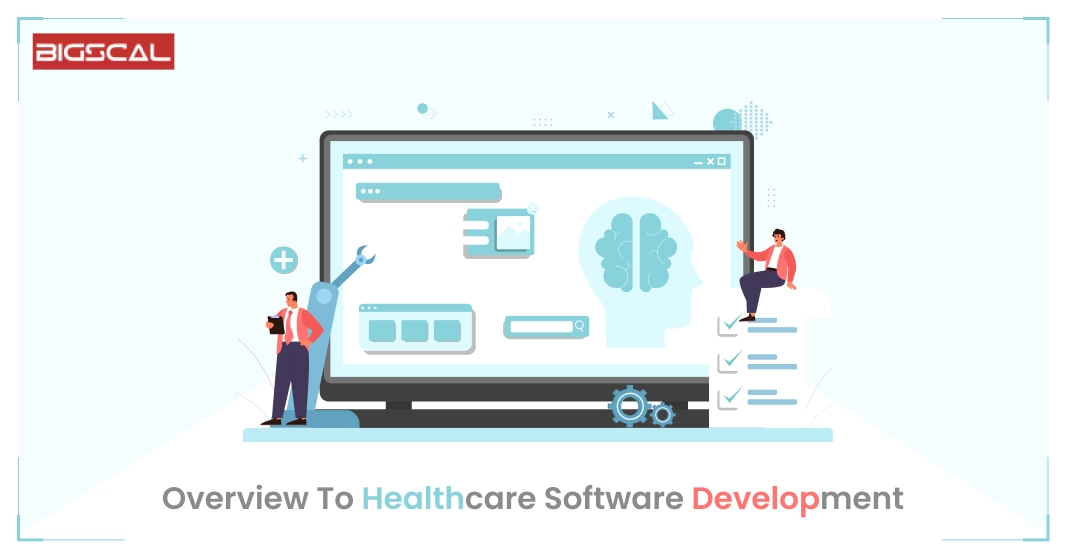
Healthcare software development is the process of designing, building and maintaining software for hospitals, clinics, labs, pharmacies, insurers and health startups. This software helps teams manage patient records, appointments, billing, prescriptions, lab results and virtual consultations in one connected system.
What makes healthcare software different from other software is the level of responsibility involved. It handles highly sensitive personal data, so it must be secure and follow privacy laws such as HIPAA in the US, GDPR in Europe and India’s Digital Personal Data Protection Act. It also needs to fit real clinical workflows, because doctors and nurses have little time to learn complicated tools, and it must exchange data reliably with other systems used across the care journey.
Types Of Healthcare Software
These are the most common types of healthcare software that hospitals, clinics and health startups build or buy:
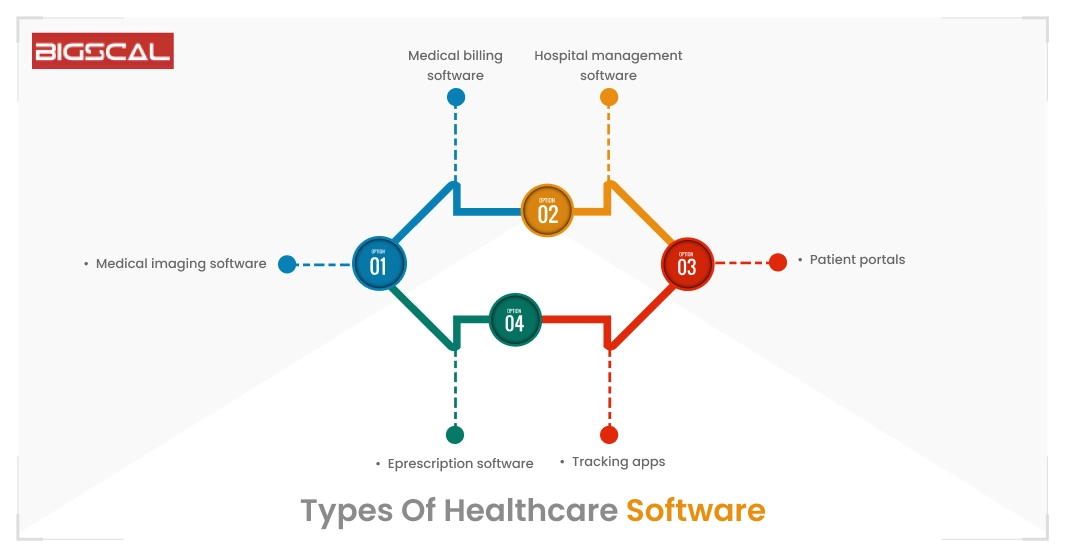
- Electronic health records (EHR) and electronic medical records (EMR): digital patient charts, histories and treatment notes.
- Hospital management systems: admissions, beds, staff, billing and departments in one platform.
- Clinic and practice management software: appointments, front desk, billing and reports for smaller practices.
- Telemedicine software: video consultations, online prescriptions and follow-ups.
- Patient portals and mobile apps: booking, reports, payments and messages for patients.
- Medical billing and claims software: invoicing, insurance claims and payment tracking.
- E-prescription and pharmacy management software: prescriptions, stock, expiry dates and dispensing.
- Laboratory information management systems (LIMS): samples, tests, results and lab workflows.
- Medical imaging software: storing, viewing and sharing scans such as X-rays and MRIs.
- Remote patient monitoring: data from wearables and home devices for ongoing care.
- Clinical decision support systems (CDSS): alerts and recommendations that help clinicians make safer decisions.
- Mental health software: online therapy, mood tracking and secure messaging.
Read more: Types Of Telemedicine: Benefits, Types, And Examples
10 Best Healthcare Software Development Companies in 2026
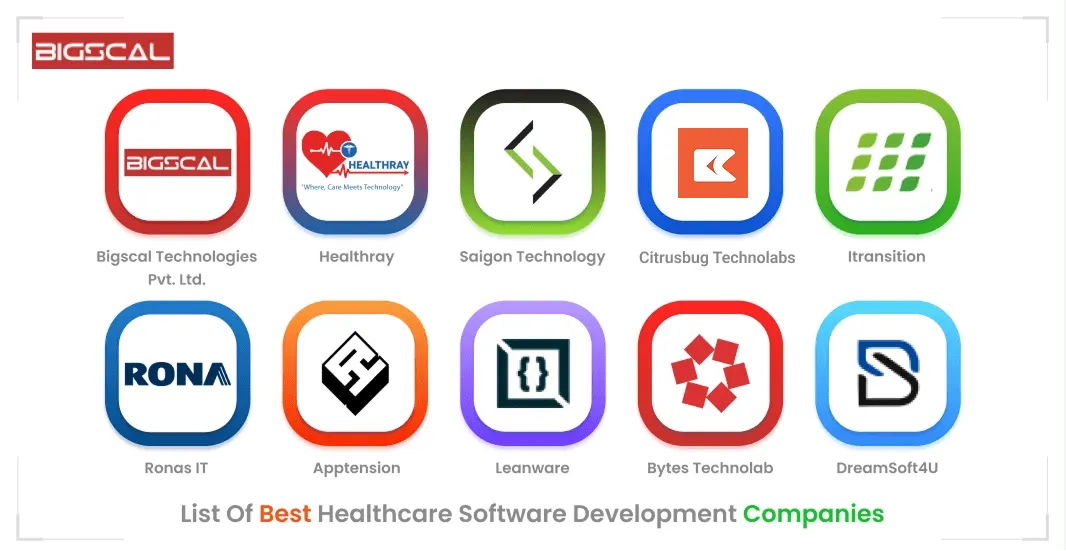
Here are 10 healthcare software development companies worth considering, whether you plan to build in-house or outsource healthcare software development:
1. Bigscal Technologies Pvt. Ltd.
Bigscal is a software development company based in Surat, India, with an office in New York, and a custom healthcare software development company with 12+ years of experience. Its team builds tailored software for hospitals, clinics and health startups, including hospital management software, patient management software, telemedicine apps, EMR and EHR systems, and laboratory information management systems.
Bigscal starts each project by mapping the client’s real workflows, such as how patients are registered, how doctors write notes and how bills reach insurers, so the software fits the way staff already work. It builds web and mobile apps, connects them with existing systems through APIs and healthcare standards such as HL7 and FHIR, and can add AI features such as automated reports and smart scheduling where they save time.
Bigscal is ISO 27001 certified, follows HIPAA requirements when building software that handles patient data, and offers flexible engagement models, from a full project team to dedicated developers added to a client’s own team.
Best for: hospitals, clinics and healthtech startups that need custom software built around their own workflows.
2. Healthray
Healthray is a healthcare technology company that focuses only on healthcare. Instead of building every system from scratch, it offers ready-made software for EMR, hospital management, clinic management, pharmacy and laboratory operations, which providers can set up and configure for their needs.
This product-based approach suits hospitals and clinics that want to go digital quickly and at a predictable cost. Healthray’s software is designed for day-to-day use by doctors, front-desk teams and pharmacists, with modules that share data across departments.
Best for: clinics and hospitals that want a proven healthcare software product they can deploy quickly.
3. Technostacks
Technostacks is a software development company with a dedicated healthcare practice. It builds telemedicine and telehealth platforms, including solutions for online therapy, as well as EHR/EMR systems, patient management software and other custom healthcare applications.
The company also works on connected health projects, such as wearable apps that track vital signs and fitness data, software for medical devices and equipment, and laboratory management solutions that automate routine tasks and improve the speed and accuracy of results.
Best for: connected health projects that combine software with wearables, IoT or medical devices.
4. Citrusbug Technolabs
Citrusbug Technolabs, founded in 2013, builds custom software for hospitals, clinics and healthtech companies, with a strong focus on artificial intelligence and machine learning.
Its healthcare work includes AI-enhanced EHR/EMR platforms that use natural language processing to make sense of unstructured clinical notes, automated record organization and reporting, and patient and fitness portals with appointment booking and record access. The company also builds HIPAA-compliant systems for clients that handle protected health information.
Best for: organizations that want to add AI to clinical records, reporting and administrative tasks.
5. Hyperlocal Cloud
Hyperlocal Cloud is a healthcare software development company that has worked in the healthcare sector since 2020, with a strong focus on mobile apps.
The company builds healthcare apps and platforms that move medical services online, automate routine work for staff and improve the patient experience. It also integrates digital tools such as electronic health records and telemedicine into the systems a provider already uses.
Best for: healthcare providers launching patient-facing mobile apps and online services.
6. Ronas IT
Ronas IT is a custom software development company that designs and builds web and mobile products, including software for healthcare organizations and health startups.
Its multidisciplinary team of designers, developers and project managers works closely with clients from the first idea to launch, which suits companies that need help shaping the product as well as building it. For healthcare projects, the team applies security practices and regulatory requirements such as HIPAA to keep patient data private.
Best for: health startups that need product design and development from one team.
7. Nadcab Labs
Nadcab Labs is a technology company that offers a wide range of healthcare software development services, including hospital management systems, telemedicine platforms, electronic health record systems, pharmacy management software, healthcare mobile apps and patient engagement platforms.
The company focuses on simple interfaces and smooth workflows so that staff can manage daily operations efficiently, along with security measures and integrations that let new software work with a provider’s existing systems.
Best for: organizations that want several healthcare modules from a single vendor.
8. Leanware
Leanware is a software development company based in Colombia that provides nearshore development teams, mainly for clients in the United States. Because its developers work in time zones close to the US, healthtech teams can collaborate with them in real time during the normal working day.
Leanware follows lean and agile methods, with short development cycles and frequent client feedback. This suits healthcare startups whose requirements change as they learn from patients, providers and regulators.
Best for: US healthtech companies that want agile nearshore teams in nearby time zones.
9. Bytes Technolab
Bytes Technolab is a software development company that builds custom web and mobile applications, including software for the healthcare industry.
The company puts strong emphasis on user-friendly design and on support after launch. Its maintenance services keep healthcare software up to date, secure against new vulnerabilities and ready to handle more users, new integrations or changing regulations.
Best for: healthcare projects that need reliable long-term support and maintenance after launch.
10. DreamSoft4U
DreamSoft4U is a software development company with long-standing experience in healthcare, including telemedicine, practice management and other medical software.
Its main strength is interoperability. The company follows healthcare data standards such as HL7 and FHIR so its software can exchange data smoothly with other systems, which helps providers make better use of the infrastructure they already have.
Best for: projects that must connect with many existing healthcare systems and data sources.
How to Choose the Right Healthcare Software Development Company in 2026
Healthcare software is becoming more connected, more data-driven and more closely regulated. Use the checklist below to compare companies and avoid costly mistakes.
Define Your Requirements First
Before you contact any company, write down what you need the software to do. For example:
- Do you need an EHR/EMR system, or integration with one you already use?
- Do you need a telemedicine platform or a patient mobile app?
- Do you need billing, insurance claims and practice management features?
- Do you want AI features such as clinical decision support or automated reports?
Clear requirements help companies give you realistic estimates and make it easier to compare proposals side by side.
Check Healthcare Industry Experience
Not every software company understands healthcare workflows. Ask each company for:
- Healthcare projects similar to yours.
- Case studies from hospitals or clinics.
- Client references you can speak to.
- A demo of a healthcare product they have built.
Prioritize Security and Compliance
Patient data is among the most sensitive data any business handles. Make sure the company can provide:
- Experience with the privacy laws that apply to you, such as HIPAA, GDPR or India’s DPDP Act.
- Data encryption in storage and in transit.
- Secure login, role-based access and audit trails.
- Regular security testing and a clear plan for handling data breaches.
Evaluate Integration Capabilities
New software must work with the systems you already use. Check the company’s experience with:
- EHR/EMR integration.
- HL7 and FHIR data standards.
- APIs for labs, pharmacies, payment gateways and insurers.
- Medical devices and wearables, if your project needs them.
Look at AI and Telemedicine Experience
AI and virtual care are now part of many healthcare products. If your project needs them, ask about the company’s experience with:
- AI-powered analytics and reporting.
- Clinical decision support systems (CDSS).
- Video consultations and remote patient monitoring.
- Automated reminders and patient engagement tools.
Plan for Support After Launch
Healthcare software needs regular updates for security, new regulations and new features. Ask what maintenance plans the company offers, how fast it responds to critical issues, and who owns the source code and data.
How Much Does Healthcare Software Development Cost in 2026?
The cost of healthcare software depends on its features, integrations, compliance needs and where your development team is based. The ranges below are typical market estimates to help you plan. Actual quotes will vary by company and project.
| Project type | Examples | Typical cost range |
|---|---|---|
| Basic solution | Appointment booking app, simple patient portal | $25,000 to $70,000 |
| Mid-level platform | Telemedicine platform, clinic management software | $70,000 to $200,000 |
| Enterprise system | Hospital management system, custom EHR with many integrations | $200,000 and above |
Ready-made products can lower upfront costs, while custom software gives you full control over features and workflows. Remember to budget for hosting, security audits, compliance reviews and ongoing maintenance as well.
Conclusion
There is no single best healthcare software development company for every organization. A clinic that wants to go digital quickly may be best served by a ready-made product, while a hospital with complex workflows or a startup with a new idea will usually need custom development. Start by defining your requirements, shortlist two or three companies from this list, and compare them on healthcare experience, security, integrations and support.
If you need custom software for a hospital, clinic or healthtech startup, explore our healthcare software development services or contact us for a free consultation.
FAQ
What does a healthcare software development company do?
A healthcare software development company designs, builds, tests and maintains software for hospitals, clinics, labs, pharmacies and health startups. This includes systems such as EHRs, hospital management software, telemedicine platforms and patient apps, built to protect patient data and fit clinical workflows.
How much does healthcare software development cost?
A basic healthcare app or patient portal typically costs $25,000 to $70,000. A telemedicine platform or clinic management system often costs $70,000 to $200,000, and a full hospital management system or custom EHR can cost $200,000 or more. The final cost depends on features, integrations, compliance needs and team location.
How long does it take to build healthcare software?
A simple healthcare app usually takes 3 to 5 months to build and launch. Mid-level platforms such as telemedicine or clinic management software often take 5 to 9 months, while large hospital systems with many integrations can take a year or more.
What software do hospitals and clinics use?
Hospitals and clinics commonly use EHR or EMR systems, hospital or practice management software, medical billing software, telemedicine platforms, laboratory information systems, pharmacy software and imaging systems such as PACS. Well-known EHR vendors include Epic and Oracle Health, formerly Cerner.
What is HIPAA-compliant software?
HIPAA-compliant software follows the US Health Insurance Portability and Accountability Act rules for protecting patient health information. In practice, this means features such as data encryption, secure user access, audit logs and safe data backup, together with the right agreements and processes at the organizations that use it.
Should I choose custom healthcare software or a ready-made product?
Choose a ready-made product if you need standard features quickly and at a predictable cost. Choose custom software if your workflows are unique, you need deep integrations with other systems, or you are building a new healthcare product to sell to others.